Payment APIs want amounts in minor units, but Stripe and Adyen disagree on how to send the Ugandan shilling, the Chilean peso and the Indonesian rupiah, and neither follows ISO 4217 in every case. Yen is the easy case: 1,234 yen goes in as 1234 at Stripe, Adyen and Square, and PayPal and Braintree both mark it as a currency without decimals.
This is the comparison, from provider documentation and the ISO list read on November 21, 2026. The point is practical: a price multiplied by 100 for every currency, or by whatever ISO says for every currency, will be wrong for some of them at one provider or another.
The baseline, and where providers leave it
ISO 4217 gives each currency a number of minor-unit digits. In the list SIX publishes as the ISO 4217 maintenance agency (version dated September 17, 2026), JPY, ISK, UGX, CLP, KRW and VND have 0, USD, HUF, TWD, IDR and CVE have 2, and BHD, KWD, JOD, OMR and TND have 3.
Every provider below starts from that idea and then bends it, usually for backward compatibility:
- Stripe. Its currencies page lists BIF, CLP, DJF, GNF, JPY, KMF, KRW, MGA, PYG, RWF, UGX, VND, VUV, XAF, XOF and XPF as zero-decimal, then adds four special cases. ISK and UGX “transitioned to a zero-decimal currency”, but you still send them as two-decimal values ending in
00: 5 ISK is500. HUF and TWD are charged in two-decimal form, but manual payouts must be whole multiples of 100. - Adyen. Its currency table says to send minor units for every API except Terminal API, and that where the table differs from ISO 4217, “the decimals in the table on this page are leading”. It lists CLP and ISK at 2 decimals, and IDR and CVE at 0, the reverse of ISO. UGX is 0 and BHD is 3.
- PayPal. Its currency codes page marks HUF, JPY and TWD as zero-digit currencies with “no decimal places or fractions”.
- Braintree. Its currency list marks zero-decimal currencies with an asterisk, including CLP, ISK, JPY, UGX and VND, but not HUF, TWD, IDR or CVE.
- Square. Its monetary amounts guide takes integer amounts in the smallest denomination and gives yen as the zero-decimal example: an
amountof 2 is 2 yen.
Where the conventions collide
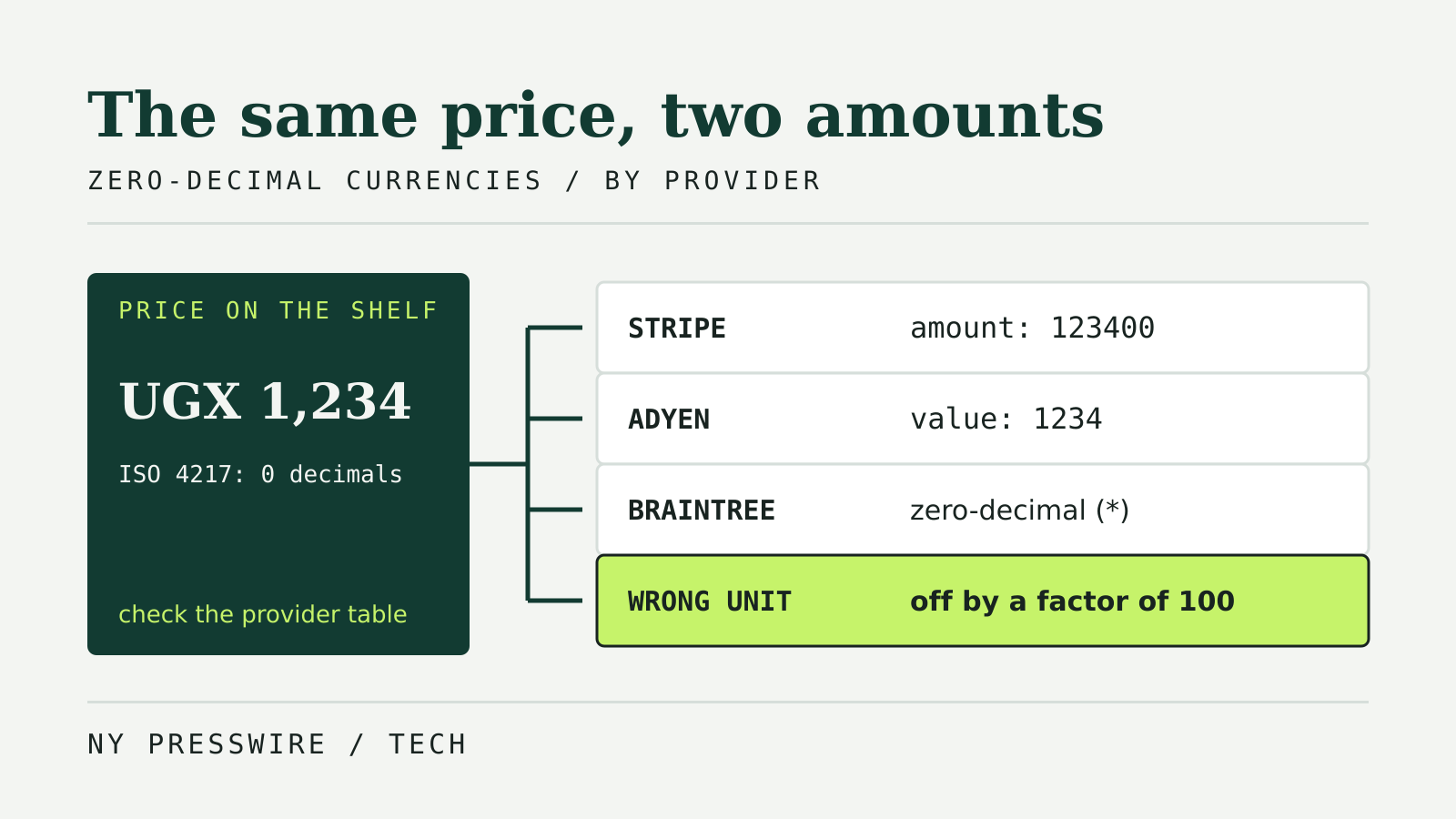
The same price, as each provider’s documentation describes the amount to send:
| Price | ISO 4217 digits | Stripe amount | Adyen value | PayPal | Braintree |
|---|---|---|---|---|---|
| JPY 1,234 | 0 | 1234 | 1234 | whole number | zero-decimal |
| CLP 1,234 | 0 | 1234 | 123400 | not listed | zero-decimal |
| UGX 1,234 | 0 | 123400 | 1234 | not listed | zero-decimal |
| ISK 1,234 | 0 | 123400 | 123400 | not listed | zero-decimal |
| IDR 1,234 | 2 | two-decimal form | 1234 | not listed | not marked |
| HUF 1,234 | 2 | 123400 | 123400 | whole number | not marked |
| BHD 1.234 | 3 | not on the page | 1234 | not listed | not listed |
Stripe’s IDR row is read from its charge limits, which quote the largest amount as 9,999,999,999.99 IDR, written 999999999999. Its page has no separate IDR rule. Square’s guide does not list these currencies, so it is left out of the table.
Two mistakes follow directly:
- Code written against ISO. A helper that multiplies by ten to the ISO digits sends UGX 1,234 to Stripe as
1234. Stripe reads that as UGX 12.34, a fraction its own documentation says you cannot charge. - Code ported between providers. A checkout that sends CLP 1,234 to Stripe as
1234and is later pointed at Adyen with the same helper sends1234there too. Under Adyen’s table that is CLP 12.34, about 1% of the price.
HUF and TWD add a third trap on the payout side. At Stripe, a HUF balance of 10.45 cannot be paid out in full, because the amount 1045 is not divisible by 100; you send 1000 for HUF 10.
A rule that survives provider changes
Treat the exponent as provider data, not as a property of the currency:
exponent = providerTable[provider][currency] ?? isoTable[currency]
amount   = round(price * 10^exponent)
Keep one small table per provider, built from the pages above, and record the date you read each one. Four checks keep it honest:
- Test the odd currencies, not just USD and JPY. A sandbox charge of 1,234 in UGX, CLP and HUF shows the unit at once. Sandboxes can still differ from live behavior, as our sandbox testing guide notes.
- Assert on the response. Compare the amount the provider echoes back with the price you meant to charge, before you capture. Our guide to authorize and capture covers when that gap matters.
- Use the same table for refunds. A refund is an amount in the same unit, so a wrong table fails twice. See payment API refunds.
- Re-read after provider changes. Stripe’s own page says ISK and UGX changed status and kept the old format for compatibility, so tables go stale. Our payment API versioning analysis explains how versions are pinned, and the payment API changelog tracker follows the current ones, with Stripe’s record at Stripe API changes.
A wrong unit is rarely rejected as an error. More often the charge succeeds at the wrong amount, so retries and idempotency keys do not help; the idempotency keys guide covers a different failure.