A payment integration that passes every test in a sandbox has proved something real: your code builds valid requests, reads the responses and survives the failure cases you thought to trigger. It has not proved that production will behave the same way. Payment API sandbox testing is useful precisely to the degree that a team knows where the simulation stops, and the providers’ own documentation is unusually candid about that boundary.
This analysis compares what Stripe, Adyen, PayPal and Square say their test environments do, where each one admits it differs from live processing, and which checks need a plan beyond the sandbox.
What every sandbox does well
All four providers offer an isolated environment with its own credentials, where no real money moves.
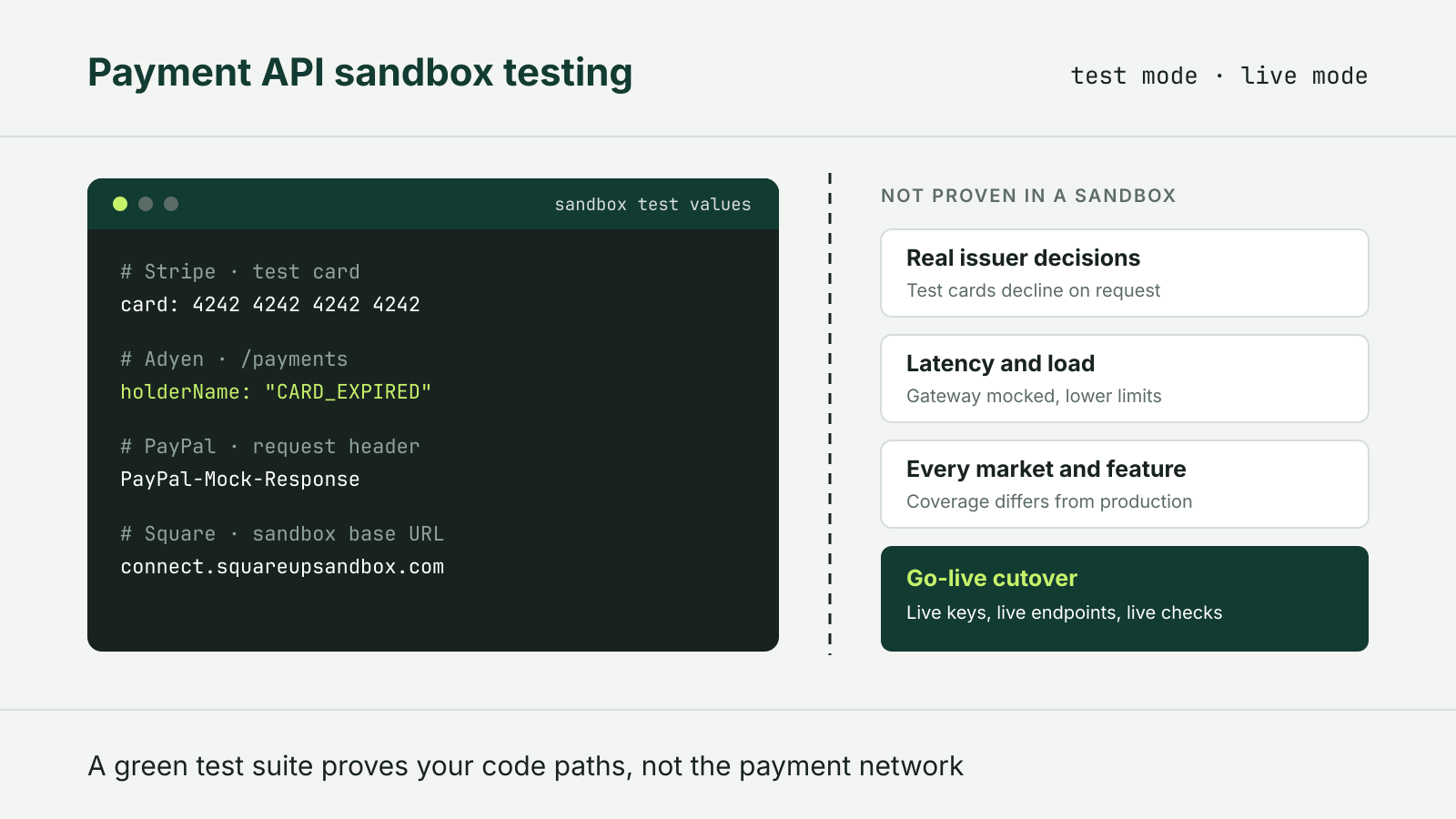
Stripe’s sandbox documentation says payments created there “aren’t processed by card networks or payment providers.” It recommends separate sandboxes for local development and continuous integration so automated tests do not disturb settings or data. Square’s Sandbox overview describes a free, isolated environment at its own base URL, connect.squareupsandbox.com, where credentials from one environment cannot be used in the other. PayPal calls its sandbox a “self-contained, virtual testing environment that simulates the live PayPal production environment” in its sandbox guide. Adyen’s testing guide asks developers to configure the test Customer Area with every feature they will support live and to test the full integration, client and server, before accepting live payments.
That separation is the first thing a sandbox proves: the integration can run end to end without touching a real card or account.
Forcing the unhappy paths
The second thing a sandbox proves, and arguably the more valuable one, is that your code handles failures. Each provider has a different mechanism for triggering them.
Stripe uses special card numbers and PaymentMethod IDs. Its testing page lists cards that return specific decline codes, such as insufficient funds, lost or stolen cards and incorrect CVC, along with cards for Radar fraud blocks, disputes and 3D Secure authentication. Two details catch teams out. Stripe skips the CVC check if no CVC is sent, so a test can only fail that check if one is provided. And card-level state can carry over between tests that reuse the same card, so Stripe advises a different test card for each independent end-to-end scenario.
Adyen triggers refusals through request fields. Its result codes testing page says a specific resultCode and refusalReason can be produced by setting paymentMethod.holderName to a listed value, such as CARD_EXPIRED, or by setting additionalData.RequestedTestAcquirerResponseCode to the matching number. Some redirect methods ignore the holder-name trick and send you to a simulator instead.
PayPal calls this negative testing. For REST apps, its request header guide uses a PayPal-Mock-Response header carrying a mock_application_codes value, such as DUPLICATE_INVOICE_ID, to simulate an error from the Payments and Orders APIs. PayPal labels negative testing in the sandbox as beta and says error conditions cannot be forced in the live environment.
Square relies on Sandbox test values: test card numbers that generate payment tokens, cards for strong customer authentication challenges, and specific payment amounts that return a Payment object with a chosen risk_evaluation level.
For subscriptions, Stripe adds test clocks, which advance time so a team can see how a renewal failure or a mid-cycle plan change plays out and whether Billing webhooks are handled correctly.
Where the sandbox stops
The providers disagree on how closely their test environments mirror production, and the differences are worth reading closely.
Latency and load. Stripe is direct about this in its rate limits documentation. Sandbox API limits are lower than live limits, at 25 requests per second, so a load test is likely to hit limits it would not hit in production. A live charge sends a request to a payment gateway, while the sandbox mocks it, “resulting in significantly different latency profiles.” Stripe recommends mocking its API in load tests and simulating latency with durations sampled from real live calls. We covered live limits and 429 handling separately in our guide to payment API rate limits.
Feature coverage. Square says its Sandbox Dashboard offers only a subset of production features, that some functionality may be missing or behave differently, and that card-present payments, Square hardware and several products are not supported. It recommends API Explorer in Sandbox mode for testing that matches production API behavior. Stripe’s sandbox page lists its own gaps: IC+ pricing cannot be tested, and a Connect platform’s sandbox cannot connect to connected-account sandboxes.
Market support. Square warns that card brand and country support in production may differ from what the Sandbox simulates. A test that passes for a given brand and country is not proof that live acceptance will match.
The parity claim. PayPal goes furthest, saying its sandbox “has the same PayPal API feature set as the live environment” and that processes behave the same in both, while noting exceptions such as account closure and monthly statements. Even so, its negative-testing mechanism works only in the sandbox, so the error responses you rehearse there are simulated rather than produced by real downstream systems.
What a passing sandbox suite does not prove
Reading the four sets of documents together, a passing test suite leaves several questions open:
- Real issuer behavior. Test cards return the decline you asked for. Live issuers decide for themselves, and their reasons will not always map neatly to the test codes you handled.
- Performance under load. Stripe’s guidance makes sandbox load tests misleading by design, because both limits and latency differ.
- Credential and configuration cutover. Square says production calls with a sandbox token fail with an
UNAUTHORIZEDerror, and Stripe says live payments cannot run on test keys. Going live is a configuration change that needs its own check. - Data hygiene. Stripe warns against putting real card numbers in server-side code even in testing, because the code may not be PCI-compliant when it goes live. Square tells developers not to keep personal data in a sandbox.
Two habits close part of the gap. Make retries safe before launch, so a timeout in production does not create a duplicate charge; our explainer on idempotency keys covers how each provider handles them. And verify webhook signatures in the sandbox exactly as you will in production, as described in our comparison of payment webhook signature checks. Provider version changes that alter behavior between test runs are tracked in our payment API changes catalog.
Sources
- Stripe Docs: Sandboxes
- Stripe Docs: Testing
- Stripe Docs: Rate limits and load testing
- Stripe Docs: Test clocks
- Adyen Docs: Testing your online payments integration
- Adyen Docs: Testing result codes and refusal reasons
- PayPal Developer: Sandbox testing guide
- PayPal Developer: Negative testing with request headers
- Square Developer: Sandbox overview
- Square Developer: Sandbox payments