NIST published AI 100-2e2025, “Adversarial Machine Learning: A Taxonomy and Terminology of Attacks and Mitigations,” as a final report in March 2025. The document gives security and product teams a shared vocabulary for attacks on machine learning systems, and it replaces NIST’s first edition of the same taxonomy (AI 100-2e2023, finalized January 4, 2024), which covered only predictive machine learning. The 2025 edition keeps that material and adds a second half built for generative AI — the chatbots, coding assistants and agents that have since become the harder security problem. Its authors are Vassilev, Oprea, Fordyce, Anderson, Davies and Hamin.
NY Presswire already covered one slice of this taxonomy in a piece on prompt injection defenses. This explainer covers the rest of the map: how NIST classifies an attack in the first place, what evasion, poisoning and privacy attacks mean for an ordinary predictive model, and where prompt injection and the other generative-AI categories sit next to them.
Five questions NIST asks about every attack
Rather than one simple list of attack names, the taxonomy sorts an attack along several dimensions at once. A security team is meant to answer each of these before deciding what an incident actually is:
| Dimension | What it captures |
|---|---|
| System type | Whether the target is a predictive ML system (classifiers, recommenders) or a generative AI system (an LLM-based chatbot, agent or image model) |
| Lifecycle stage | Whether the attack happens while the model is being trained or after it has been deployed |
| Attacker goals | What the attacker is trying to break: availability, integrity or privacy for predictive systems, with misuse added as a fourth goal for generative AI |
| Attacker capabilities and access | What the attacker can actually do — submit queries, poison training data, modify the deployed model, and so on |
| Attacker knowledge | How much the attacker knows about the target model, commonly described as white-box (full access to the model), black-box (query access only) or grey-box (partial knowledge) |
Two attacks with the same name can sit in different cells of this grid. A poisoning attack carried out by an insider with access to the training pipeline is a different risk, with different defenses, than the same label applied to a public dataset an attacker can tamper with before it’s scraped.
The three predictive AI attack families
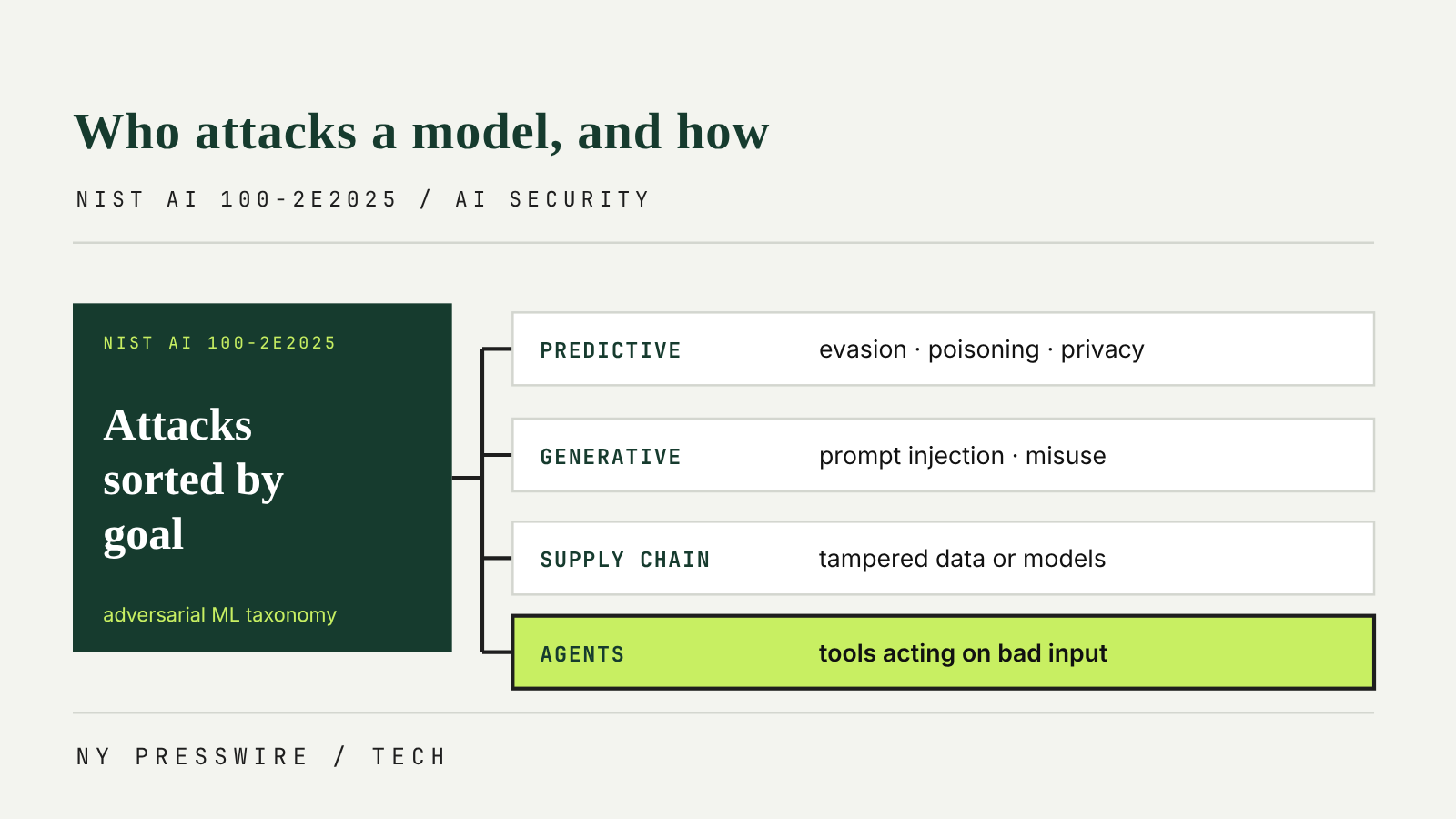
For predictive machine learning, the taxonomy keeps the same three families NIST used in 2023, now with more subcategories:
- Evasion attacks target integrity. The attacker crafts an input — a slightly altered image, a reworded piece of text — designed to be misclassified at inference time, without touching the model itself.
- Poisoning attacks target availability or integrity by corrupting the model before it’s ever queried. NIST splits this into data poisoning (tampering with the training set) and model poisoning (tampering with the model’s parameters directly, as can happen with a compromised training pipeline or a tampered pretrained checkpoint).
- Privacy attacks target the confidentiality of the data or the model itself. The taxonomy groups these into data reconstruction (recovering training examples from the model), membership inference (determining whether a specific record was in the training set) and model extraction (recovering a working copy of the model, or its parameters, through queries alone).
Those three families map directly onto the goal column in the table above: evasion is an integrity violation, poisoning can be either, and privacy attacks are, unsurprisingly, privacy violations.
What’s new for generative AI
The 2025 edition’s generative-AI half doesn’t just rename these three families for LLMs. It adds categories that don’t have a clean predictive-ML equivalent:
- Supply chain attacks cover compromise introduced before a model is even deployed — a tampered base model, a poisoned fine-tuning dataset, a compromised plugin or tool connected to an agent. NIST treats these as a separate category from the model-specific violations above, because the point of compromise is outside the model’s own training or inference process.
- Prompt injection, split into direct and indirect. Direct prompt injection is an adversary’s own input to the model, trying to override its instructions. Indirect prompt injection is the same goal reached through a third-party channel the model reads as part of its normal operation — a webpage, a document, an email — so the person operating the model never typed the malicious text themselves. NY Presswire’s defenses explainer covers how teams building financial LLM apps try to contain this category specifically.
- Misuse violations are the fourth attacker goal added for generative AI, alongside availability, integrity and privacy: getting a deployed model to produce content or take actions its operator didn’t intend to allow, without necessarily breaking the model’s confidentiality or accuracy.
- AI agent security covers the added surface that comes from giving a model the ability to call tools, browse, or take multi-step actions — a risk category that barely existed in the 2023 edition, before agentic systems were common.
Where this fits next to NIST’s other AI documents
AI 100-2e2025 is a taxonomy, not a framework with its own process to follow. NIST’s companion documents build on top of it: the AI Risk Management Framework’s Generative AI Profile, which NY Presswire covered in October, uses this same vocabulary when it discusses security risks inside its broader Govern/Map/Measure/Manage structure. The Federal Reserve’s SR 26-2 model risk guidance doesn’t name this taxonomy directly, but a bank classifying an AI incident for its own model-risk framework is answering a version of the same five questions NIST lays out here.