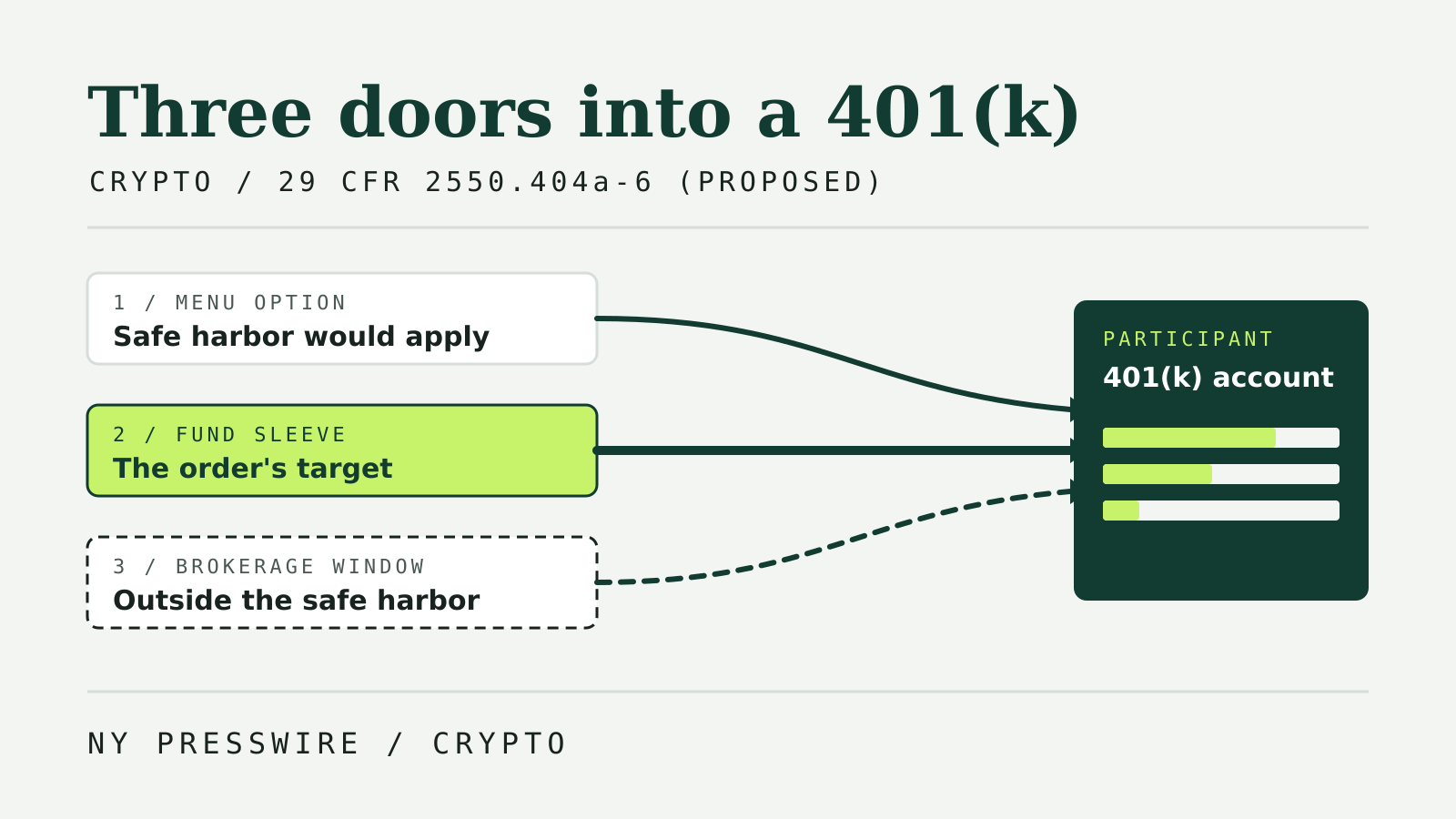
In tri-party repo, a cash lender such as a money market fund lends to a dealer against a general basket of collateral, and the trade settles on Bank of New York Mellon’s (BNY’s) tri-party platform. In bilateral repo, the two sides trade directly and the collateral moves to the lender, which means a lender can ask for one specific security. Bilateral trades are either centrally cleared through the Fixed Income Clearing Corporation (FICC) or settled without a central counterparty.
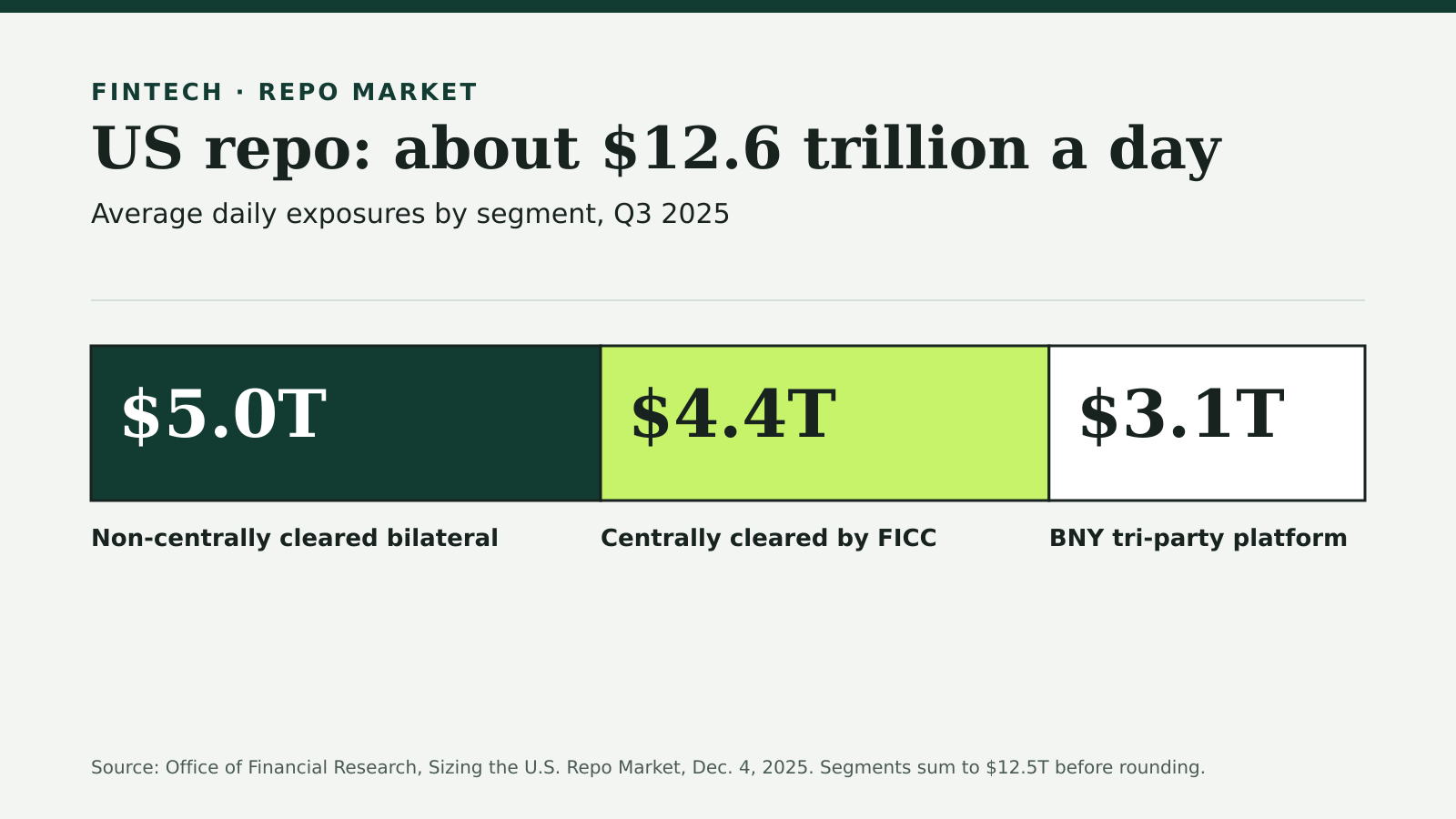
Those differences decide who uses each segment, what collateral changes hands and which benchmark rate a trade feeds. The Office of Financial Research (OFR) put the whole US repo market at about $12.6 trillion in average daily exposures in the third quarter of 2025 (OFR, December 4, 2025): $3.1 trillion on BNY’s tri-party platform, $4.4 trillion centrally cleared by FICC and $5.0 trillion non-centrally cleared bilateral repo.
This explainer walks through the four segments, the dealer’s place between them and what the New York Fed’s reference rates show about each.
The four segments side by side
The OFR’s repo intermediation brief (OFR Brief 24-07, November 14, 2024) and its repo FAQ (OFR Brief 21-01) describe the segments this way:
| Segment | Where it settles | Collateral | Central clearing |
|---|---|---|---|
| Tri-party, non-centrally cleared | BNY’s tri-party platform; the custodian manages collateral for the dealer | General collateral only | No |
| GCF Repo | Tri-party platform, through FICC’s GCF Repo service | General collateral | Yes, FICC |
| DVP, centrally cleared bilateral | Delivery versus payment between the parties, no central custodian | General or a specific security | Yes, FICC |
| Non-centrally cleared bilateral (NCCBR) | Directly between the parties | General or a specific security | No |
“Tri-Party transactions are general collateral transactions,” the OFR brief says. The lender names a class of collateral, such as Treasuries, and the dealer’s securities are allocated to the trade by the custodian. In bilateral repo, by contrast, “lenders and dealers trade directly, with collateral generally being transferred to the lender,” and a specific-collateral repo can “specify a particular security that must be delivered from the repo dealer to the lender” (OFR repo FAQ).
Central clearing adds a guarantor. FICC stands between the two sides and “guarantees trades,” and firms can net offsetting positions within the cleared market (OFR repo FAQ).
The dealer in the middle
Dealers borrow cash in one segment and lend it in another. The OFR brief notes that “money market funds cannot lend directly to hedge funds,” so a dealer takes cash from the fund in tri-party and lends it on, often against collateral sourced from hedge funds, in the bilateral segments.
A Federal Reserve panel of dealer balance sheets shows how lopsided this is (FEDS Notes, July 11, 2025, accessible data). Gross figures for 2024, in billions of dollars:
| Segment | Dealer repo (borrowing cash) | Dealer reverse repo (lending cash) |
|---|---|---|
| Tri-party, centrally cleared (GCF) | 230 | 204 |
| Tri-party, non-centrally cleared | 1,915 | 60 |
| Bilateral, centrally cleared (DVP) | 1,463 | 1,736 |
| Bilateral, non-centrally cleared | 1,514 | 2,991 |
| Total | 5,121 | 4,991 |
In non-centrally cleared tri-party, dealers borrowed $1,915 billion and lent only $60 billion: it is almost entirely a place where dealers raise cash. In non-centrally cleared bilateral repo, they lent $2,991 billion, about twice what they borrowed there. The figures are gross, before inter-dealer trades are netted out.
What the reference rates show
The New York Fed publishes three overnight Treasury repo rates, each built from a different slice of the market. The Broad General Collateral Rate (BGCR) “includes all trades in the Tri-Party General Collateral Rate plus GCF Repo transactions.” The Secured Overnight Financing Rate (SOFR) includes all BGCR trades plus bilateral Treasury repo cleared through FICC’s DVP service, filtered to remove a portion of “specials,” the repos for a specific security that trade at lower cash rates.
The rates and volumes for November 16, 2026, from the New York Fed’s markets data:
| Rate | What it covers | Rate | Volume |
|---|---|---|---|
| TGCR | Tri-party general collateral | 3.90% | $1,218 billion |
| BGCR | TGCR plus GCF Repo | 3.90% | $1,251 billion |
| SOFR | BGCR plus FICC-cleared bilateral DVP repo, specials partly removed | 3.93% | $3,170 billion |
Because each rate adds a segment to the one above, the volumes can be taken apart. By our subtraction, GCF Repo accounted for about $33 billion that day ($1,251 billion minus $1,218 billion), and centrally cleared bilateral DVP trades for about $1,919 billion of SOFR’s $3,170 billion, well over half.
The rates also differ at the edges. TGCR’s 75th and 99th percentiles were 3.91% and 3.92%; SOFR’s, which adds the cleared bilateral trades, were 3.98% and 4.00%.
Worked example. A fund lending $1 billion overnight at SOFR’s 3.93% instead of TGCR’s 3.90% earns 0.03% more. On the actual/360 day count used for US money-market rates: $1,000,000,000 × 0.0003 ÷ 360 = $833 a night, or $2,500 over a Friday-to-Monday weekend.
The Fed’s overnight reverse repo facility, which also settles on the tri-party platform, sets a floor under overnight rates; our explainer on the overnight reverse repo facility covers why it now sits nearly empty. How SOFR is calculated is in what SOFR is.
Collateral and haircuts
Treasuries dominate, but less so in tri-party. In the third quarter of 2025, 69.4% of all repo was collateralized by Treasuries: 88.9% in the cleared segment, 61.8% in NCCBR and 52.6% in tri-party, where other collateral makes up the rest (OFR sizing report).
Haircuts, the margin a lender keeps above the cash it lends, also differ. In the OFR’s 2022 pilot collection from nine dealers, “over 70% of Treasury repo in NCCBR transacted with zero haircut,” and the OFR found that “haircuts in NCCBR materially differ from those in tri-party repo” (OFR, May 12, 2023). The OFR names differences in haircuts, margining and netting as the main reasons dealers keep so much repo outside central clearing.