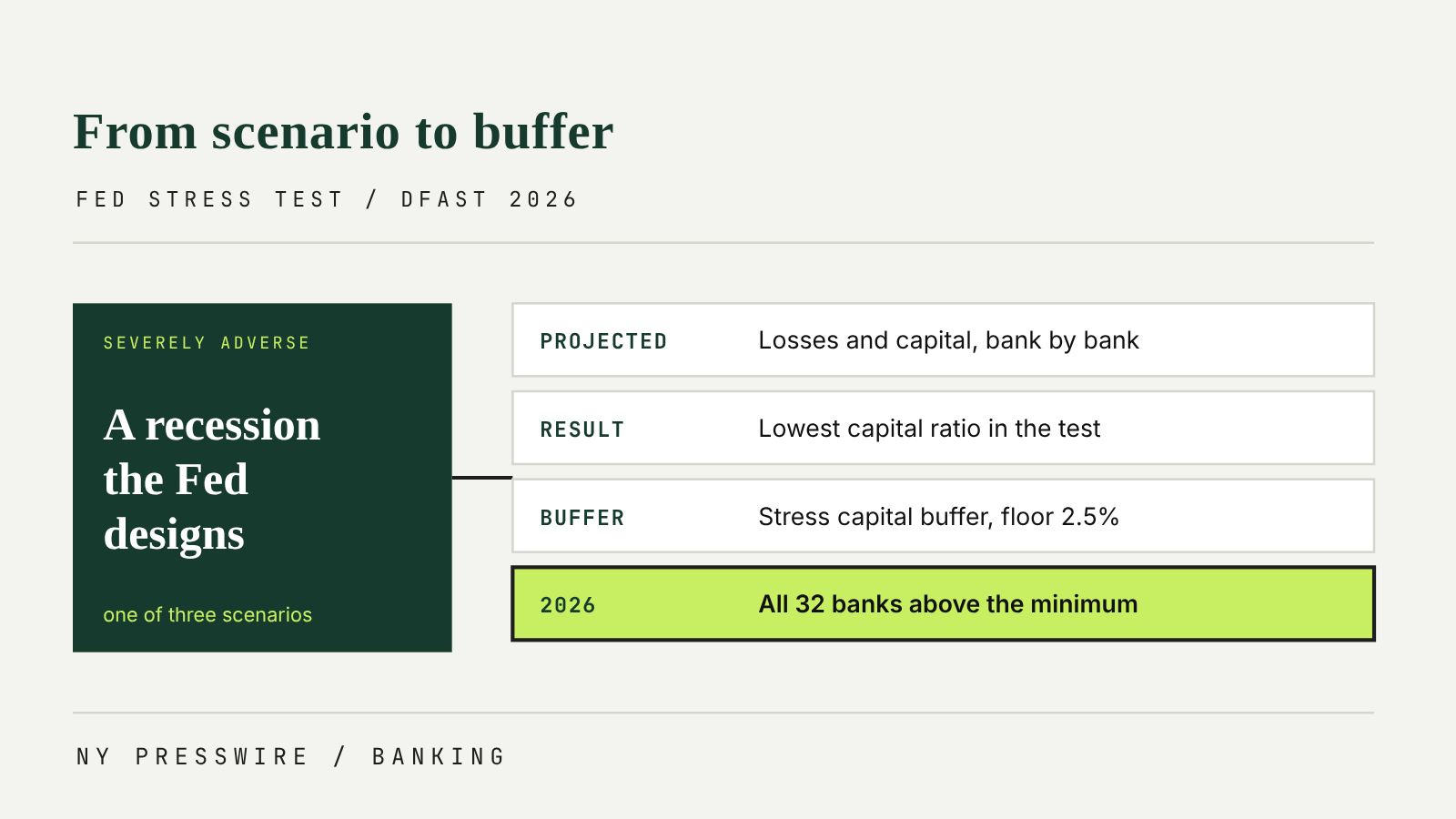
The Federal Reserve released the results of its 2026 Dodd-Frank Act stress test on June 24, 2026: all 32 large banks subject to the test stayed above their minimum capital requirements under a hypothetical severe recession, with the group’s aggregate capital ratio falling 1.6 percentage points — from 12.8% to a projected low of 11.2% — the smallest decline since 2020. The 32 banks absorbed roughly $708 billion in hypothetical losses, most of it ($625 billion, or about 89%) from loan losses.
That result didn’t reset anything for the banks involved. In a separate decision on February 4, 2026, the Federal Reserve Board voted to hold each bank’s stress capital buffer at its 2025 level through 2027, while it reviews the stress test’s own models for “deficiencies.” Here’s how the test works, what changed in this year’s scenario, and why a clean pass didn’t translate into a lower capital requirement.
What the stress test actually does
The Dodd-Frank Act stress test (DFAST) is the Federal Reserve’s annual check on whether the largest US banks — 32 of them in the 2026 cycle — could keep lending through a severe hypothetical recession. The Board itself designs three scenarios each year: a baseline, an adverse scenario, and a severely adverse scenario, then projects each bank’s balance sheet, risk-weighted assets, net income and resulting capital ratios under all three.
The severely adverse scenario follows what the Fed calls a “recession approach”: conditions modeled on the kind of downturn that has actually followed US recessions, not a single fixed worst case. Under the Fed’s scenario design policy, the unemployment rate in that scenario is set to rise by three to five percentage points from its starting level. The Fed’s Director of Supervision and Regulation approves the loss-estimating models used in the test before each cycle, and a separate council of outside academic economists reviews the Fed’s modeling process for the same purpose.
For 2026, outlets covering the released scenario described commercial real estate prices falling 39%, home prices falling 30%, and unemployment rising to around 10%. One notable change from 2025: the scenario set a floor on the projected 10-year Treasury yield at 2.3%, versus a 1.0% floor the year before. Several analysts pointed to that higher rate floor — which raises banks’ projected net interest income under stress — as a meaningful reason the 2026 result came in better than 2025’s, separate from any actual improvement in bank balance sheets.
The stress capital buffer, and why passing didn’t move it
A bank’s performance in the severely adverse scenario normally feeds directly into its stress capital buffer (SCB), the bank-specific capital requirement that replaced the old fixed 2.5% component of the capital conservation buffer. The SCB is calculated, in simplified form, as the largest projected decline in a bank’s CET1 capital ratio under the severely adverse scenario, plus four quarters of the bank’s planned common stock dividends.
That link was switched off for this cycle. On February 4, 2026, the Board voted to keep every bank’s SCB at its 2025 level through 2027, rather than recalculating it from the 2026 test results. The Fed’s own June 2026 capital-requirements document confirms the result: every stress capital buffer requirement disclosed that month matches what was disclosed in 2025. Vice Chair for Supervision Michelle Bowman framed the pause as a chance to find and fix problems in the stress-test models before using them to set capital requirements again. Governor Lisa Cook dissented, arguing that tying model changes to a full notice-and-comment process would leave buffers frozen at levels the Fed itself considers outdated.
The Fed has also finalized a structural change that takes effect after the pause: starting with the 2028 cycle, a bank’s SCB will be calculated from the average of its two most recent annual stress test results, rather than from a single year’s test alone — a change meant to reduce the buffer’s year-to-year swings.
What a “pass” does and doesn’t tell you
Passing the stress test means a bank’s projected capital ratio stayed above regulatory minimums under the Fed’s chosen hypothetical scenario, using the Fed’s own loss-estimation models. It is not a prediction that the same bank would perform identically in an actual recession, and it doesn’t certify that the underlying models are accurate — the Fed’s own February 2026 decision to pause SCB recalculation pending a model review is itself an acknowledgment that regulators see room for the models to improve. The scenario also changes every year, so a bank’s result isn’t directly comparable across cycles without accounting for what moved in the assumptions, such as 2026’s higher interest-rate floor.
NY Presswire’s guide to SR 26-2 model risk management covers the broader supervisory expectations banks face for validating any model used in a regulatory process, stress-test models included.