SOFR, the Secured Overnight Financing Rate, is the benchmark that replaced US dollar LIBOR in loans, derivatives and floating-rate notes. The Federal Reserve Bank of New York describes it as a broad measure of the cost of borrowing cash overnight collateralized by Treasury securities. The Federal Reserve Board has called LIBOR fragile and subject to manipulation; SOFR, by contrast, is calculated from actual repo transactions every business day.
This explainer covers where the number comes from, how the New York Fed turns a day of trades into one rate, when it is published and revised, and how the averages and index used in contracts are built. It does not quote rate levels; the New York Fed publishes the daily figures on its own site.
What SOFR measures
SOFR is a repo rate. In a repurchase agreement, one party sells Treasury securities and agrees to buy them back the next day at a slightly higher price. Economically, that is an overnight loan of cash secured by Treasuries, and the price difference is the interest.
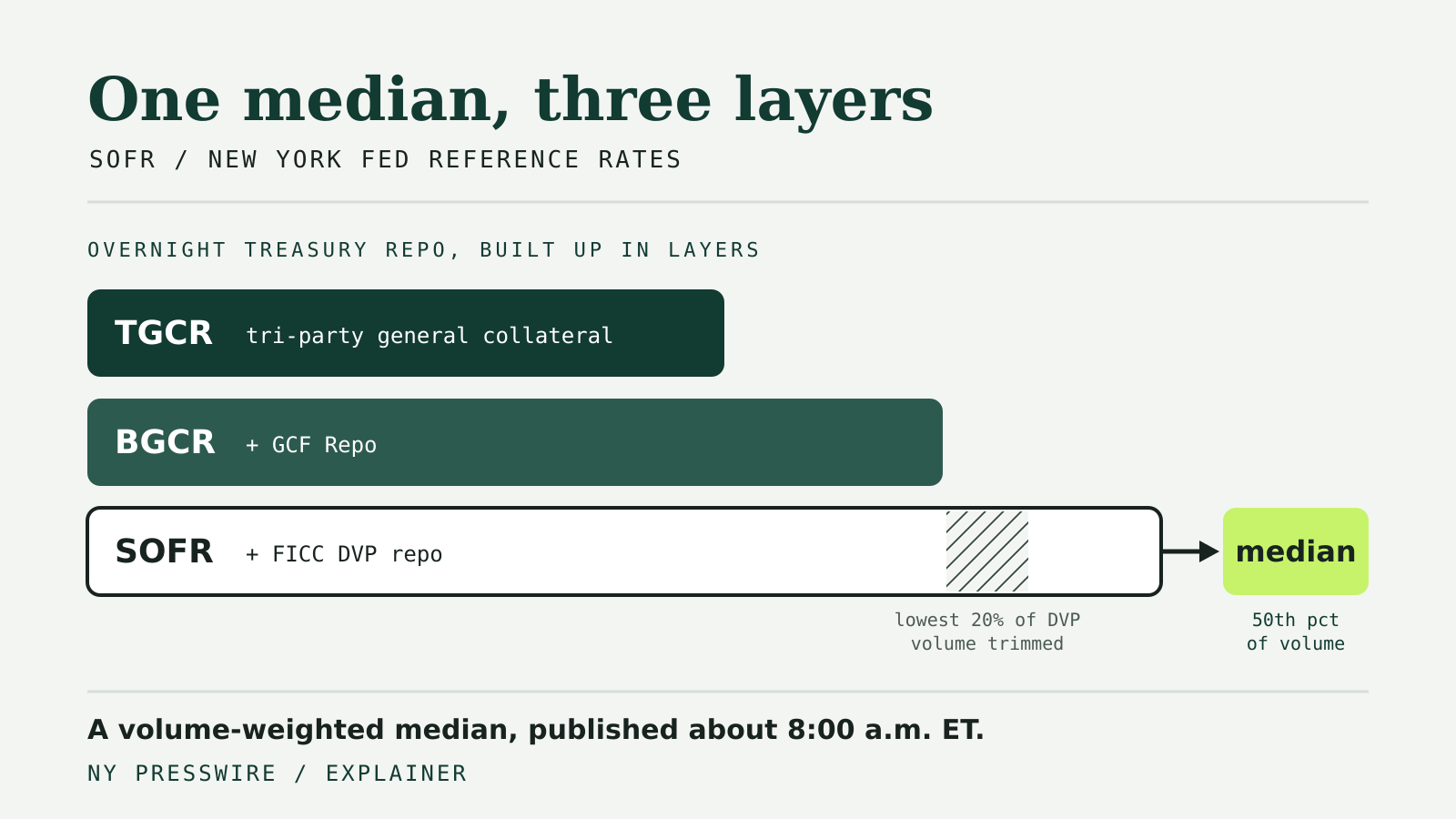
The New York Fed publishes three Treasury repo reference rates, built in layers:
- TGCR, the Tri-Party General Collateral Rate, covers overnight tri-party general collateral repo secured by Treasuries, both centrally cleared and not. It excludes trades in which the Federal Reserve is a counterparty.
- BGCR, the Broad General Collateral Rate, includes everything in the TGCR plus GCF Repo trades.
- SOFR includes everything in the BGCR plus bilateral Treasury repo cleared through the Fixed Income Clearing Corporation’s Delivery-versus-Payment (DVP) service.
“General collateral” means the cash lender accepts any security from an agreed set, with the specific securities identified after the trade terms are set. In the DVP market, by contrast, counterparties name the specific securities for each trade.
Where the data comes from
The rates are built from transaction-level data. According to the New York Fed’s reference rate methodology, tri-party data comes from the Bank of New York Mellon (BNY) and the Treasury Department’s Office of Financial Research (OFR), and GCF Repo and DVP data come from the OFR. The data is collected under the supervisory authority of the Federal Reserve Board and the authority of the OFR. Before January 24, 2022, some of it came from a DTCC affiliate under a commercial agreement.
The specials trim
The DVP segment needs one adjustment. Sometimes a particular Treasury security is in high demand, and cash lenders accept a lower rate to borrow that exact security. Those trades are said to be trading “special,” and their rates say more about one bond than about the general cost of funding.
To limit their influence, the New York Fed removes the lowest-rate 20 percent of DVP transaction volume each day, after excluding relevant affiliated trades. If the cutoff falls in the middle of a group of trades at the same rate, it trims that group pro rata so exactly 20 percent of volume is removed. The New York Fed notes that this removes some, but not all, specials.
It may also exclude trades that appear not to be at arm’s length or that look anomalous or erroneous, using expert judgment.
A volume-weighted median
SOFR is not an average. The New York Fed calculates it as a volume-weighted median. It orders all eligible transactions from the lowest rate to the highest, adds up their dollar volume, and takes the rate at which cumulative volume reaches the 50th percentile. The result is rounded to the nearest basis point.
A median weighted by volume is harder to move with a few unusual trades than a simple average, and each trade counts in proportion to its size. Alongside the rate, the New York Fed publishes the 1st, 25th, 75th and 99th volume-weighted percentiles and the total transaction volume, rounded to the nearest $1 billion. Those percentiles show how wide the day’s distribution was.
When it is published, and when it changes
SOFR is published for one business day on the next business day, at about 8:00 a.m. Eastern time, on the New York Fed’s website. That lag reflects the trades themselves: overnight repo agreed today matures tomorrow.
The rates are published every business day, including days when SIFMA recommends an early close for government securities trading. They are not published for days when SIFMA recommends a full close, and the New York Fed may, with advance notice, skip a day the market broadly treats as a holiday.
Corrections follow a narrow rule. If errors are found or late data arrives, the rate may be revised at about 2:30 p.m. Eastern the same day, but only if the change exceeds one basis point. After that, the published rate stands. Updated summary statistics are released on a lag after each quarter, and they can differ from the original release.
Averages and the SOFR Index
A loan or note that pays interest over a month or a quarter needs a rate for the whole period, not for one night. To support that, the New York Fed publishes 30-, 90- and 180-day compounded SOFR Averages and a SOFR Index.
The arithmetic follows money market convention. Interest compounds daily on business days, simple interest at the previous business day’s rate applies over weekends and holidays, and day counts use actual calendar days over a 360-day year. The SOFR Index started at 1.00000000 on April 2, 2018, the first value date of SOFR, and grows with each day’s compounding. The first official Index value was published on March 2, 2020. The New York Fed publishes a formula that uses Index values on two dates to calculate a compounded average over a custom period, without recomputing from each daily print. The New York Fed notes that results from the rounded Index can differ from the published Averages at the fifth decimal place.
For developers, the New York Fed provides the rates through its Markets Data APIs, subject to its terms of use.
How SOFR replaced LIBOR
The Alternative Reference Rates Committee, a private-sector group convened by the Federal Reserve Board and the New York Fed, selected SOFR in 2017 as its recommended alternative to US dollar LIBOR. US banking regulators told supervised firms to stop new LIBOR use after December 31, 2021, and the last US dollar LIBOR panel settings ended on June 30, 2023.
For contracts that had no workable fallback, Congress passed the Adjustable Interest Rate (LIBOR) Act. On December 16, 2022, the Federal Reserve Board adopted a final rule identifying SOFR-based replacement rates for overnight, one-month, three-month, six-month and 12-month LIBOR in contracts covered by the Act.
SOFR and the fed funds rate
SOFR and the effective federal funds rate are both overnight rates published by the New York Fed, but they measure different markets. The New York Fed calculates the effective federal funds rate from overnight federal funds transactions reported by domestic banks and US branches and agencies of foreign banks; SOFR comes from repo borrowing secured by Treasuries. Our explainer on the federal funds target range vs the effective rate covers how the Fed steers the unsecured side, and the guide to the discount window vs the standing repo facility covers the backstops that sit under repo markets.