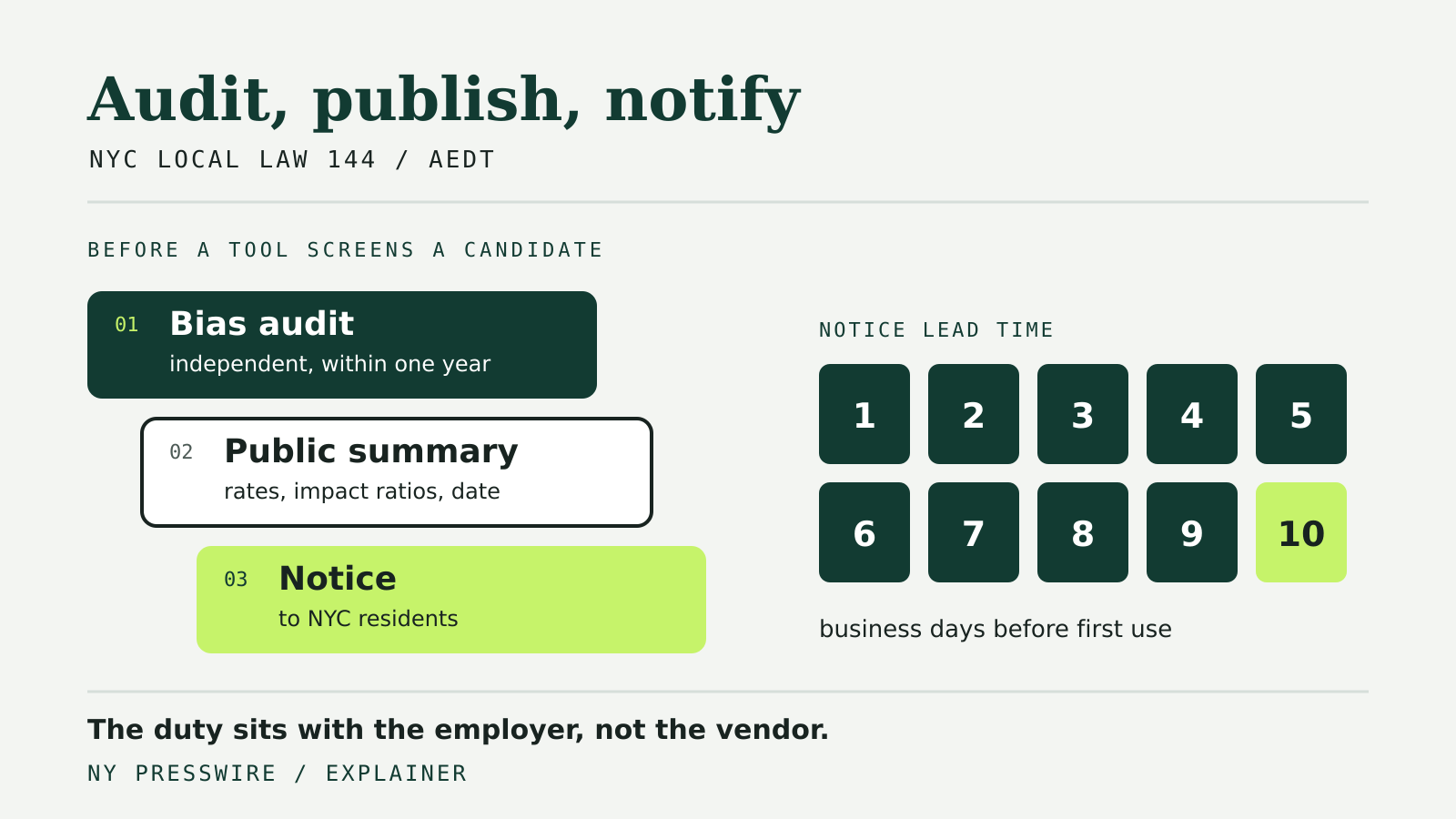
New York City was early to regulate software that screens job candidates. Local Law 144 of 2021 makes it unlawful for an employer or employment agency to use an automated employment decision tool in the city unless the tool has had a bias audit within the past year, a summary of that audit is public, and candidates have been told in advance. The city’s Department of Consumer and Worker Protection (DCWP) enforces it.
For fintech and software companies the law matters twice: when they hire in New York City with screening or scoring tools, and when they sell those tools to employers. This guide uses the law’s text, DCWP’s guidance and a 2025 state audit.
Timeline
The City Council enacted the measure, Int. 1894, on December 11, 2021, as Local Law 2021/144. According to DCWP’s FAQ, it took effect on January 1, 2023, and DCWP began enforcing the law and its implementing rule on July 5, 2023.
Which tools count
The law defines an automated employment decision tool, or AEDT, as a computational process derived from machine learning, statistical modeling, data analytics or artificial intelligence that issues simplified output, such as a score, classification or recommendation, used to substantially assist or replace discretionary decision making for employment decisions. It excludes tools such as a junk email filter, firewall, calculator, spreadsheet or database.
DCWP’s FAQ adds that the techniques are those used to generate a prediction or classification, such as an assessment of a candidate’s fit for the job or a categorization based on skill sets.
An “employment decision” is broader than the final offer. The law covers screening candidates for employment or employees for promotion, and DCWP says the requirements apply if a tool substantially helps assess or screen candidates at any point in the hiring or promotion process.
There are limits. DCWP says the requirements do not apply when a tool is used only to scan a resume bank, conduct outreach to potential candidates or invite applications. A candidate, in DCWP’s reading, is someone who has applied for a specific position.
Where “in the city” reaches
The law applies to tools used “in the city.” DCWP’s FAQ reads that to cover jobs located in a New York City office at least part time, fully remote jobs associated with a New York City office, and employment agencies located in the city. The notice requirement runs to candidates and employees who reside in the city.
What the bias audit must include
A bias audit is an impartial evaluation by an independent auditor. The law ties it to the demographic categories employers report to the federal Equal Employment Opportunity Commission. DCWP’s FAQ says the evaluation must at minimum calculate selection or scoring rates and the impact ratio across sex categories, race and ethnicity categories, and intersectional categories. A category that makes up less than 2% of the audit data can be excluded from those calculations.
The audit must use historical data from the employer’s own use of the tool. Under DCWP’s guidance, an audit can pool historical data from several employers using the same tool, but an employer can rely on that pooled audit only if it contributed its own data or is using the tool for the first time. When there is not enough historical data for a statistically significant audit, test data may be used, and the summary has to explain why. DCWP says employers cannot impute or infer demographic data to run the audit.
The auditor has to be independent. DCWP’s FAQ says an auditor is not independent if it works for the employer or the vendor, was involved in using, developing or distributing the tool, or has a direct or material indirect financial interest in either. DCWP does not approve or list auditors.
An audit is valid for one year. The law allows use only if the audit was conducted no more than one year before the use, so a tool in continuous use needs a fresh audit every year.
What has to be published
Before using the tool, the employer must post a summary of the most recent bias audit and the tool’s distribution date on the employment section of its website, or link to a page that has it. DCWP’s FAQ lists the required contents: the date of the audit, the source and explanation of the data, the number of individuals in an unknown category, and the number of applicants or candidates, the selection or scoring rates and the impact ratios for all categories.
The law does not require any particular action based on the results. DCWP points out that federal, state and city anti-discrimination laws still apply to whatever the audit shows.
The notices
Employers must notify candidates and employees who live in New York City that an AEDT will be used and which job qualifications and characteristics it will assess. Under the law, the notice must come no less than ten business days before the tool is used and must allow a candidate to request an alternative selection process or accommodation. DCWP’s FAQ says notice can be given in the job posting or by mail or email, or, for applicants, on the employment section of the website.
A third item is available on request. If the employer does not post it, information about the type of data collected for the tool, its source and the employer’s data retention policy must be provided within 30 days of a written request.
Vendors and employers
The compliance duty sits with the employer or employment agency. DCWP’s FAQ says the vendor that created the tool is not responsible for a bias audit, though a vendor may commission an independent audit of its own tool and coordinate the data. The employer remains responsible for making sure an audit was done before use.
A company that hires with such software cannot hand the obligation to its vendor.
Penalties and enforcement
Section 20-872 of the law sets a civil penalty of up to $500 for a first violation and each additional violation on the same day, and between $500 and $1,500 for each later violation. Each day a tool is used in violation counts as a separate violation, and each missed notice is a separate violation too.
Enforcement has been mostly complaint-driven. A December 2, 2025 audit by the New York State Comptroller, covering July 2023 through June 2025, found that DCWP received only two AEDT complaints in that period and called its complaint process ineffective at routing complaints to the agency. The audit said DCWP surveyed 32 companies and found one case of non-compliance, while the Comptroller’s own review of the same companies identified at least 17 instances of potential non-compliance. It recommended better complaint routing and more proactive enforcement.
Discrimination claims go elsewhere. DCWP says it enforces the audit and notice requirements, and refers claims of discrimination involving AEDT use to the NYC Commission on Human Rights.
How it fits with other rules
Local Law 144 is a transparency and audit rule for hiring. It does not cover credit decisions; for those, see our guide to AI credit denials and adverse action notices. New York State’s RAISE Act targets frontier model developers rather than employers. Teams building a broader risk program can map the audit to the NIST AI RMF and its Generative AI Profile.