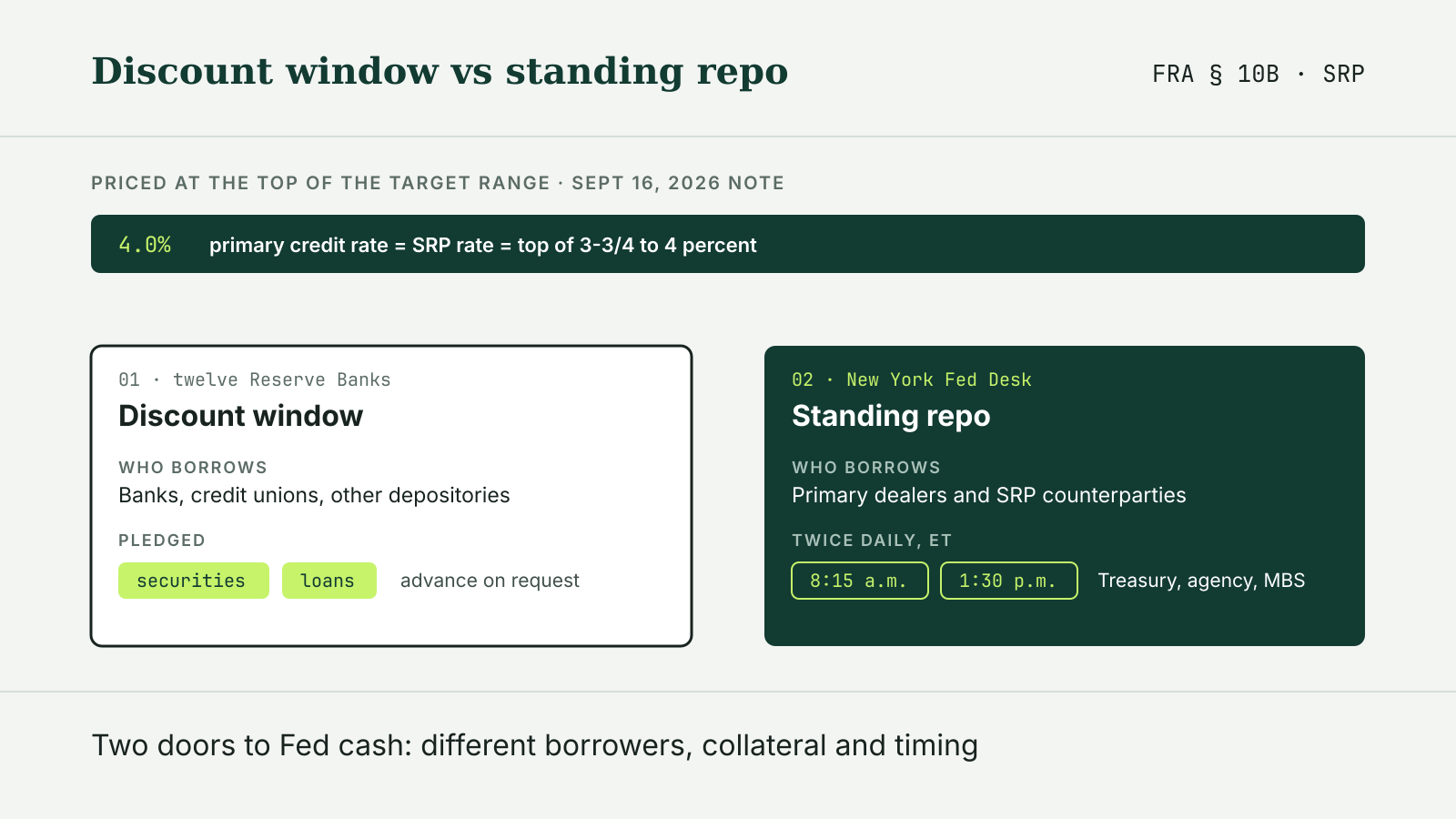
When overnight funding gets tight, the Federal Reserve has two standing ways to lend against collateral: the discount window and standing repo operations. The difference between the discount window vs standing repo facility comes down to who can borrow, what they pledge, how the money moves and what each tool is meant to protect. One is a lending program run by the twelve Reserve Banks for banks and credit unions. The other is a daily market operation run by the New York Fed’s trading desk that also serves securities dealers.
Both are priced off the same policy decision, and both are meant to be used before a squeeze turns into a crisis. Here is how they differ.
The discount window: Reserve Bank loans to depository institutions
The discount window is the collective name for the Reserve Banks’ ordinary lending programs to banks, credit unions and other depository institutions. It is one of the original purposes of the Federal Reserve System. There are three programs, each with its own rate:
- Primary credit is for depository institutions in generally sound condition, on a short-term basis, at a rate set relative to the FOMC’s target range for the federal funds rate. Because it is the main program, the Fed sometimes calls the primary credit rate “the discount rate.”
- Secondary credit is for institutions that do not qualify for primary credit, typically overnight and at a higher rate. It is meant for backup liquidity when the borrower can return quickly to market funding or is being wound down in an orderly way.
- Seasonal credit serves institutions with deposits of $500 million or less that show a recurring pattern of swings in funding needs during the year, at a floating rate.
Eligibility follows the Federal Reserve Act: depository institutions that hold reservable transaction accounts or nonpersonal time deposits, plus U.S. branches and agencies of foreign banks that hold reserves. Every advance must be collateralized to the Reserve Bank’s satisfaction, and Reserve Banks accept both securities and loans. The Reserve Bank values the pledged collateral, and that value helps set how much the institution can borrow. Lending to undercapitalized institutions or those with poor supervisory ratings is limited.
The legal basis is Section 10B of the Federal Reserve Act and the Fed’s Regulation A.
Standing repo operations: a daily market backstop
Standing repurchase agreement operations, which the Fed now abbreviates as SRP and which were long known as the standing repo facility, have run since 2021. In each trade, the Fed buys a security from an eligible counterparty and agrees to sell it back the next day; the price difference is the interest the Fed earns. The Board says the operations supply liquidity, limit upward pressure on overnight money market rates and help put a ceiling on them, so that strain in repo markets does not spill into the federal funds market.
The New York Fed’s standing repo FAQ sets out the mechanics:
- Counterparties: primary dealers and SRP counterparties, which include depository institutions.
- Collateral: Treasury securities, agency debt and agency mortgage-backed securities only. No loans.
- Timing: two operations each business day, from 8:15 to 8:30 a.m. and from 1:30 to 1:45 p.m. Eastern Time, settled the same day.
- Format: full allotment at the SRP rate, with one proposition per security type per operation, each capped at $40 billion.
- Settlement: on BNY’s tri-party repo platform, with BNY holding the securities, valuing them and applying margin.
The Desk publishes the total accepted per security type and the rate after each operation. Counterparty names follow two years after each quarter, as the Federal Reserve Act requires.
The two side by side
| Discount window | Standing repo operations | |
|---|---|---|
| Run by | The twelve Reserve Banks | The New York Fed’s Open Market Desk |
| Borrowers | Depository institutions | Primary dealers and SRP counterparties, including depository institutions |
| Collateral | Securities and loans | Treasury, agency debt and agency MBS |
| Form | Collateralized loan (advance) | Overnight repurchase agreement |
| Access | On request | Two scheduled daily operations |
| Rate set by | Board of Governors, on Reserve Bank requests | FOMC directive to the Desk |
| Legal basis | Federal Reserve Act Section 10B, Regulation A | FOMC directive for open market operations |
Priced at the top of the range
Each FOMC meeting ends with an implementation note that sets both rates. In the September 16, 2026 note, the Committee set the target range at 3-3/4 to 4 percent and directed the Desk to conduct standing overnight repo operations at 4.0 percent. In a related action, the Board approved a primary credit rate of 4.0 percent. Both backstops therefore sat at the top of the range, which is the point: if market funding costs more than that, an eligible firm can come to the Fed instead. The same note set the overnight reverse repo rate, the floor-side tool, at 3.75 percent.
Rates change only at meetings or by separate announcement, so check the latest note. Upcoming meeting dates are in our FOMC meeting schedule, and our explainer on the FOMC statement vs minutes covers where the implementation note fits among the Fed’s releases.
Why a bank might prefer one over the other
The practical differences follow from the table. A bank with loans but few spare Treasuries can pledge those loans only at the discount window. A dealer that is not a depository institution can reach the Fed only through standing repo, if it is an eligible counterparty. Standing repo runs at fixed times, while the discount window is a loan arranged with a Reserve Bank, so readiness matters for both.
That readiness has been a supervisory theme. In July 2023, the federal banking agencies updated their liquidity guidance to encourage depository institutions to include the discount window in their contingency funding plans. If they do, the agencies expect them to keep the operational ability to use it, including periodic test transactions.
For fintech teams, the takeaway is indirect but real. The banks that hold customer funds and move payments are the institutions these backstops serve, and the rates attached to them move with every FOMC decision.
Sources
- Federal Reserve discount window: The Discount Window
- Federal Reserve Board: Standing Repurchase Agreement Operations
- Federal Reserve Bank of New York: FAQs, Standing Repurchase Agreement Operations
- Federal Reserve Board: Implementation Note issued September 16, 2026
- Federal Reserve Board: Agencies update guidance on liquidity risks and contingency planning, July 28, 2023