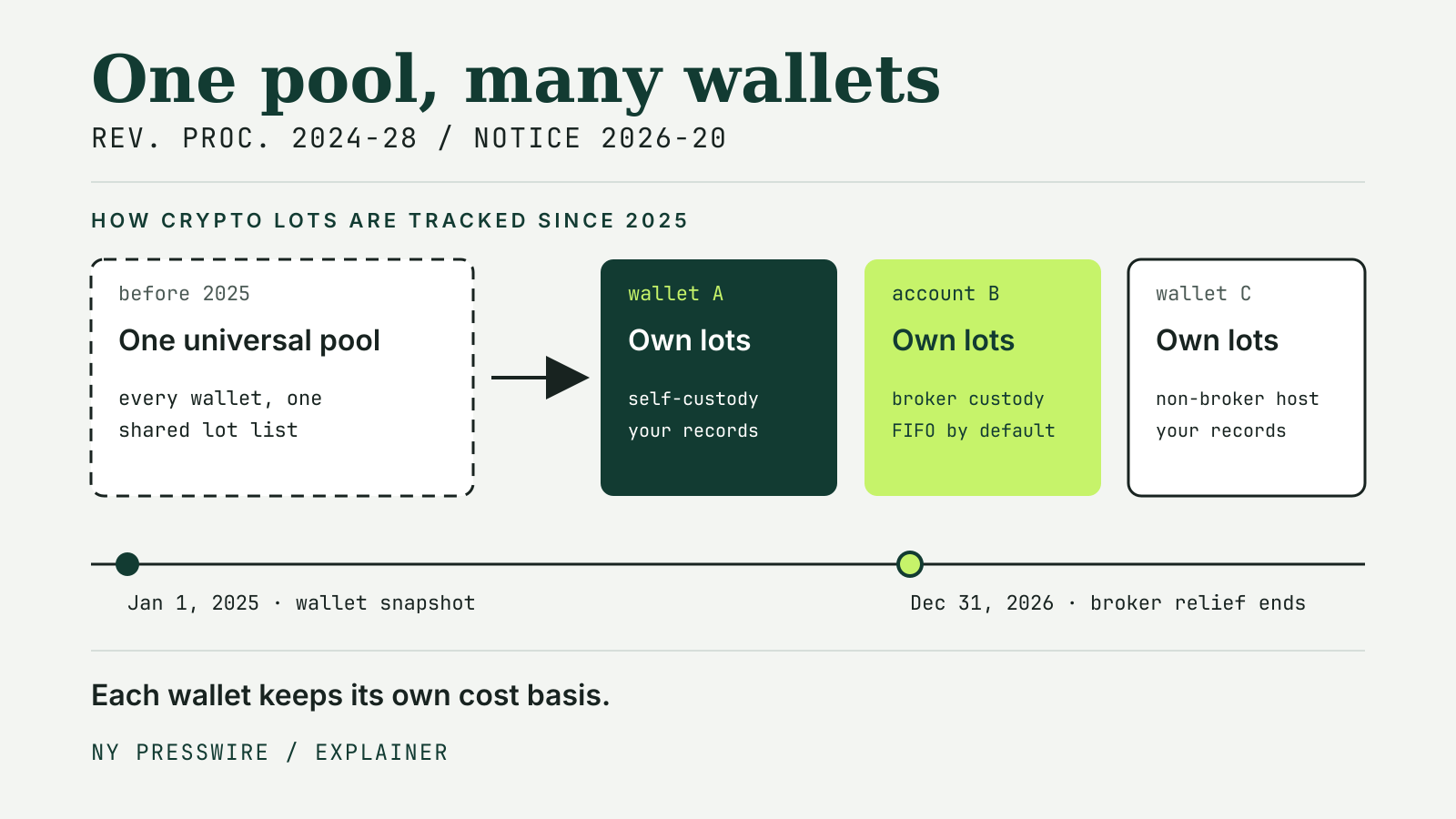
Crypto cost basis is now tracked wallet by wallet. Since January 1, 2025, the IRS rules that decide which units of a coin you sold apply separately to each wallet or exchange account, not to all of your holdings at once. A sale from one wallet can no longer draw on the purchase price of coins sitting in another.
The change came with Treasury’s final broker regulations, T.D. 10000. Two pieces of IRS guidance soften the transition: a one-time safe harbor for coins held at the start of 2025, and temporary relief for coins held with brokers that has been extended once and now runs through December 31, 2026. This explainer covers how the rules work and what that end date means. It describes the rules, not how any individual should prepare a return.
From one pool to many wallets
Before 2025, the IRS’s virtual currency FAQs let taxpayers choose which units they sold if they could identify them, and otherwise applied first in, first out (FIFO). The FAQs did not say whether that identification had to stay inside a single wallet. According to Rev. Proc. 2024-28, many taxpayers read them as permitting a “universal” or multi-wallet approach: one pool of purchases across every wallet and exchange.
The final regulations closed that reading. Section 1.1012-1(j), which applies to all acquisitions and dispositions on or after January 1, 2025, applies specific identification or FIFO to units held within a single wallet or account. The legal hook is section 1012(c)(1) of the Internal Revenue Code, which requires basis conventions to be applied account by account for specified securities. The Infrastructure Investment and Jobs Act added digital assets to that definition, with an applicable date of January 1, 2023.
In practice, each wallet or account now has its own lot history. If you bought one coin at a low price in a self-custody wallet and another at a high price on an exchange, selling on the exchange uses the exchange’s lots.
Two sets of rules: self-custody and broker custody
The regulation splits units by who holds them.
Units in an unhosted wallet follow the rules in section 1.1012-1(j)(1) and (2). The IRS digital asset FAQs set out two requirements for a specific identification: record the particular units in your own books and records no later than the date and time of the sale, using an identifier such as purchase date and time or price, and keep records showing those units left the wallet. Without that identification, units are treated as leaving the wallet in order from the earliest acquired. The FAQs add that the original acquisition date counts, not the date units were moved into the wallet. The same approach applies to a hosted wallet whose provider is not acting as a broker for those units.
Moving coins between wallets you own is not a taxable event, according to the same FAQs, apart from any coins used or withheld to pay transaction fees. The move does matter for records, because the lots travel with the coins.
Units held with a custodial broker follow section 1.1012-1(j)(3). As Notice 2025-7 summarizes it, the default is FIFO within the units held at that broker. To use another order, you must tell the broker which units to sell no later than the time of the sale, either trade by trade or through a standing order such as highest basis first. If a broker offers only one identification method, the regulation treats that method as your standing order.
That broker-facing requirement is what the temporary relief addresses.
The January 1, 2025 snapshot
Rev. Proc. 2024-28 gave taxpayers a one-time way to move from a universal pool to wallet-level records. It lets a taxpayer make a “reasonable allocation” of unused basis, meaning the cost of units not already used against pre-2025 sales, to the units actually sitting in each wallet or account as of January 1, 2025.
Three conditions shape it:
- Matching counts. Each wallet receives exactly as many units of unused basis as it holds units of that asset. The procedure works one asset type at a time; it names Bitcoin and Ether as separate types.
- Records. The taxpayer must be able to show the number of units in each wallet and the cost and acquisition date behind each unit of unused basis. The safe harbor does not prove the amount of basis, which still has to be substantiated separately.
- Irrevocability. The allocation is irrevocable, and basis already used against a pre-2025 sale cannot be reallocated.
The procedure offers two methods. A specific unit allocation assigns identified lots to particular wallets and must be completed before the earlier of the first sale of that asset type on or after January 1, 2025, or the due date, including extensions, of the 2025 return. A global allocation is a rule, such as earliest lots first to wallet A, then wallet B, that had to be written into the taxpayer’s books and records before January 1, 2025. In both cases, coins acquired on or after January 1, 2025 are outside the safe harbor and fall under the new regulation directly.
The relief for broker-held coins, now through 2026
Brokers needed time to build systems that accept lot instructions. Notice 2025-7 therefore let taxpayers make an adequate identification for broker-held units during 2025 by recording it in their own books and records, either trade by trade or as a recorded standing order, rather than communicating it to the broker.
Notice 2026-20, published in Internal Revenue Bulletin 2026-15, extends that relief period through December 31, 2026. The IRS says many custodial brokers could accept standing orders but were not yet ready to accept other specific identifications from customers, and were expected to finish those systems during 2026. Without the extension, units sold before those systems existed would have defaulted to FIFO.
The notice keeps the same limits. The relief covers only units held in the custody of a broker, not self-custody wallets. Taxpayers using the Rev. Proc. 2024-28 safe harbor can rely on it only after completing their allocation. And taxpayers cannot rely on it for sales after the relief period ends. On current guidance, identifying broker-held units in your own records stops working for sales made after December 31, 2026, and identifications will have to reach the broker.
When your records and your 1099-DA disagree
The relief applies to tax liability, not to the broker’s reporting duties under section 1.6045-1. Notice 2026-20 says directly that, for 2026 transactions, the acquisition date and basis a broker reports may not match the lot identification in the taxpayer’s own records. When a taxpayer has made an adequate identification under the notice, the units identified in the taxpayer’s books are the units sold for federal income tax purposes, whether or not the broker’s report matches.
That gap matters because 2026 is also the first year brokers report basis on Form 1099-DA for covered assets. Our explainer on Form 1099-DA covers which assets count as covered and why basis is often blank for coins transferred in from another wallet.
What it means for builders
For a custodial exchange or app, the lasting requirement is an interface for lot selection: per-trade identification, standing orders such as FIFO, last in first out or highest basis, and a record of the instruction in effect at the moment of each sale. The IRS treats a broker with only one method as having given every customer that method as a standing order, so the menu offered shapes customers’ tax results.
For wallet software and portfolio trackers, the change is structural. Lots need to live at the wallet or account level, transfers between a customer’s own wallets need to carry their basis and acquisition dates, and any record built on a universal pool needs a documented bridge to the wallet-level picture that has applied since 2025.