When the Federal Reserve changes interest rates, three numbers appear in the same conversation: the federal funds target range, the interest rate on reserve balances and the effective federal funds rate. They are connected, but they are not interchangeable.
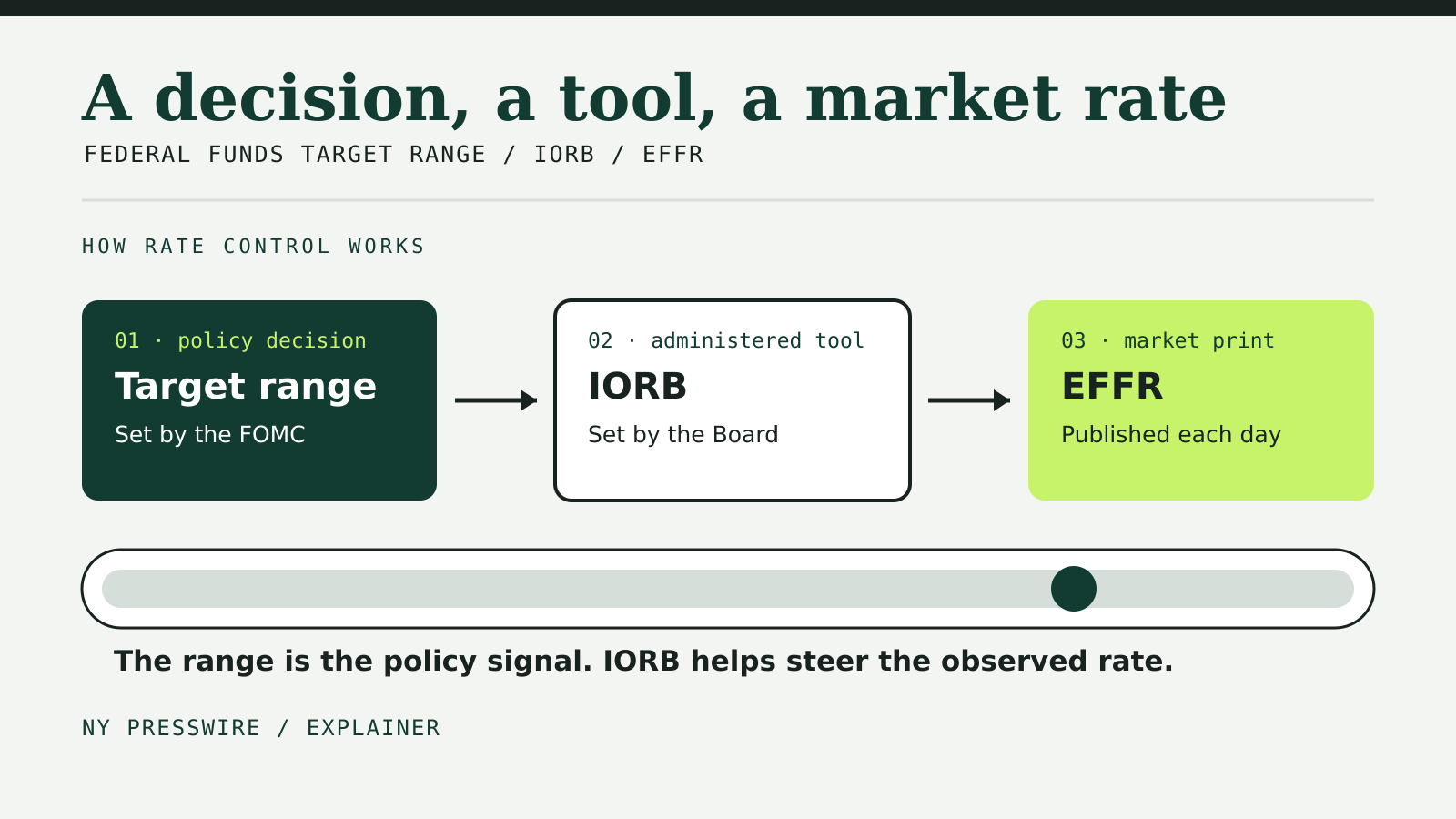
The target range is the Federal Open Market Committee’s policy decision. Interest on reserve balances, usually shortened to IORB, is an administered rate used to implement that decision. The effective federal funds rate, or EFFR, is a daily measure of actual overnight transactions.
The target range is the policy signal
The FOMC sets a target range for the federal funds rate at its scheduled meetings. The New York Fed’s implementation guide defines the federal funds rate as the rate on overnight, unsecured borrowing and lending of reserve balances between banks and other eligible entities.
A range is a policy objective, not the price of a single loan. The FOMC chooses it to communicate whether monetary policy is becoming more restrictive, more accommodative or staying unchanged. Its statement explains the decision. Our guide to the FOMC statement, minutes and projections explains why those documents answer different questions.
The FOMC does not order every federal funds trade to occur at one number. Instead, the Federal Reserve uses its operating tools to keep actual overnight rates within the announced range.
EFFR is an observed market rate
The New York Fed publishes the EFFR each business day. It calculates the rate as a volume-weighted median of the previous business day’s overnight federal funds transactions.
A median is not the same as a simple average. The transactions are arranged by rate, and the calculation identifies the rate at the midpoint by volume. The New York Fed’s reference-rate page says the underlying transaction data come from domestic banks and U.S. branches and agencies of foreign banks through the FR 2420 report.
That makes the EFFR a market print. It reports where eligible institutions actually borrowed and lent overnight. The target range tells readers where the FOMC wants that market rate to trade.
IORB helps steer the market
Banks hold reserve balances in accounts at Federal Reserve Banks. The Board of Governors sets the IORB rate paid on eligible balances. The Federal Reserve’s IORB page describes it as an important monetary-policy tool and points readers to the latest FOMC implementation note for the current setting.
The mechanism is practical. A bank that can earn IORB on a reserve balance has little reason to lend the same cash overnight at a much lower rate to a private counterparty. That opportunity influences the price at which banks are willing to trade.
The Fed’s IORB frequently asked questions say that changes in the FOMC’s target range are typically accompanied by changes in IORB. Raising IORB puts upward pressure on short-term rates; lowering it puts downward pressure on them.
IORB is therefore a tool for implementation, not a second vote on the policy stance. The FOMC sets the target range. The Board sets IORB at a level intended to support that range.
Other facilities support the same goal
IORB directly reaches institutions eligible to earn interest on reserve balances. Other money-market participants need a different floor. The New York Fed says its overnight reverse repo facility gives a broader group, including eligible money market funds and government-sponsored enterprises, a risk-free overnight option.
The standing repo facility works from the other direction. It offers eligible counterparties a financing backstop intended to limit upward pressure on overnight rates. The discount window also supplies temporary bank liquidity. Our explainer on the discount window and standing repo facility covers why those tools serve different borrowers and purposes.
Together, administered rates and standing facilities shape the incentives around overnight trading. They do not replace the trades used to calculate the EFFR.
Why the three rates can move differently
In many meetings, the target range and administered rates move by the same amount. That keeps the operating setup aligned with the new stance.
The Federal Reserve can also make a technical adjustment to an administered rate without changing the target range. The New York Fed says modest adjustments within the range may support rate control and do not represent a change in policy stance. A small shift in IORB can influence where transactions settle inside the range while the FOMC’s broader decision remains unchanged.
This distinction prevents a common reading error. A change in IORB is important, but it is not automatically a new rate-policy decision. Check the FOMC statement and its implementation note together.
How to read a Fed rate announcement
Start with the target range in the FOMC statement. That is the policy decision.
Next, read the implementation note for IORB and the settings of the overnight reverse repo and standing repo facilities. Those are the operating instructions.
Finally, check the EFFR after the change takes effect. The daily print shows whether the observed market rate is trading inside the target range. One day does not explain the whole transmission process, but it does show the immediate overnight-market outcome.
Do not substitute SOFR for EFFR. SOFR measures the cost of overnight borrowing secured by Treasury securities, while federal funds transactions are unsecured. Both are overnight rates, but they cover different markets and datasets.