Crypto in a 401(k) is allowed today, but no federal rule yet tells an employer how to add it safely. The Labor Department dropped its 2022 warning against crypto on May 28, 2025, and proposed a process-based safe harbor for choosing plan investments on March 31, 2026. The final rule has been under White House review since September 28, 2026 and was still pending on November 16, 2026.
Until that rule is published, an employer that adds a crypto option relies on ERISA’s general duty of prudence and nothing more specific. This explainer follows the four documents that set the current position, checked November 16, 2026, and shows what each one means for the three ways crypto can reach a 401(k) account.
The timeline
| Date | Document | What it did |
|---|---|---|
| March 10, 2022 | DOL Compliance Assistance Release 2022-01 | Told plan fiduciaries to use “extreme care” before adding a crypto option, and warned about brokerage windows too |
| May 28, 2025 | Compliance Assistance Release 2025-01 | Rescinded the 2022 release in full; DOL now neither endorses nor disapproves of a fiduciary’s decision to offer crypto |
| August 7, 2025 | Executive Order 14330, 90 FR 38921 | Directed DOL to clarify the fiduciary process for funds holding “alternative assets,” a term that includes vehicles investing in digital assets |
| March 31, 2026 | Proposed rule, 91 FR 16088, RIN 1210-AC38 | Proposed a new 29 CFR 2550.404a-6 with six factors and a presumption of prudence; comments closed June 1, 2026 |
| September 28, 2026 | Final rule received at OIRA | The final rule entered White House regulatory review; status “Pending Review” on November 16, 2026 |
The rescission is the only one of these steps that has changed the law a plan follows today. A proposed rule has no legal effect, and the final text has not been published.
What the 2025 rescission changed
The 2022 release did not ban crypto, but it told fiduciaries to expect questions from DOL about how a crypto option squared with their duties. DOL’s May 2025 release withdrew it and said such decisions are “context specific.” The proposed rule adds that the “extreme care” standard “is not found in” ERISA and “differs from ordinary fiduciary principles.”
So the test for a crypto option is now the same as for any other fund: would a prudent person familiar with such matters have chosen it, after a sound process? That is ERISA section 404(a)(1)(B).
What the proposed rule would add
The proposal is asset neutral. Its regulatory text never mentions bitcoin or cryptocurrency by name. Its paragraph (c) says there is “no per se rule” against alternative assets, and it lists “holdings in actively managed investment vehicles that are investing in digital assets” among them.
Under the proposed safe harbor, a fiduciary that “objectively, thoroughly, and analytically” considers six factors gets a presumption that its judgment was reasonable and “significant deference.” Here is how each factor would apply to a crypto option:
| Factor (paragraph) | What the fiduciary must determine | The crypto question it raises |
|---|---|---|
| Performance (g) | Risk-adjusted expected returns, net of fees, over an appropriate horizon, against a reasonable number of similar options | What return assumption is defensible for an asset with a short price history? |
| Fees (h) | Fees are appropriate for the risk-adjusted return and other value | How do custody and management fees compare with similar crypto funds? |
| Liquidity (i) | Enough liquidity for plan-level and participant-level needs | Can the fund meet withdrawals, loans and rebalancing on a bad trading day? |
| Valuation (j) | The option can be valued “timely and accurately” | Which price source does the fund use, and is it independent? |
| Benchmark (k) | A meaningful benchmark with a similar mandate and risks | Is there an index that matches the fund’s strategy? |
| Complexity (l) | The fiduciary can understand the option, or hires someone who can | Does the committee understand custody and key management? |
The proposed text carries 20 worked examples. Several involve target date funds with private asset sleeves; none involves a crypto fund.
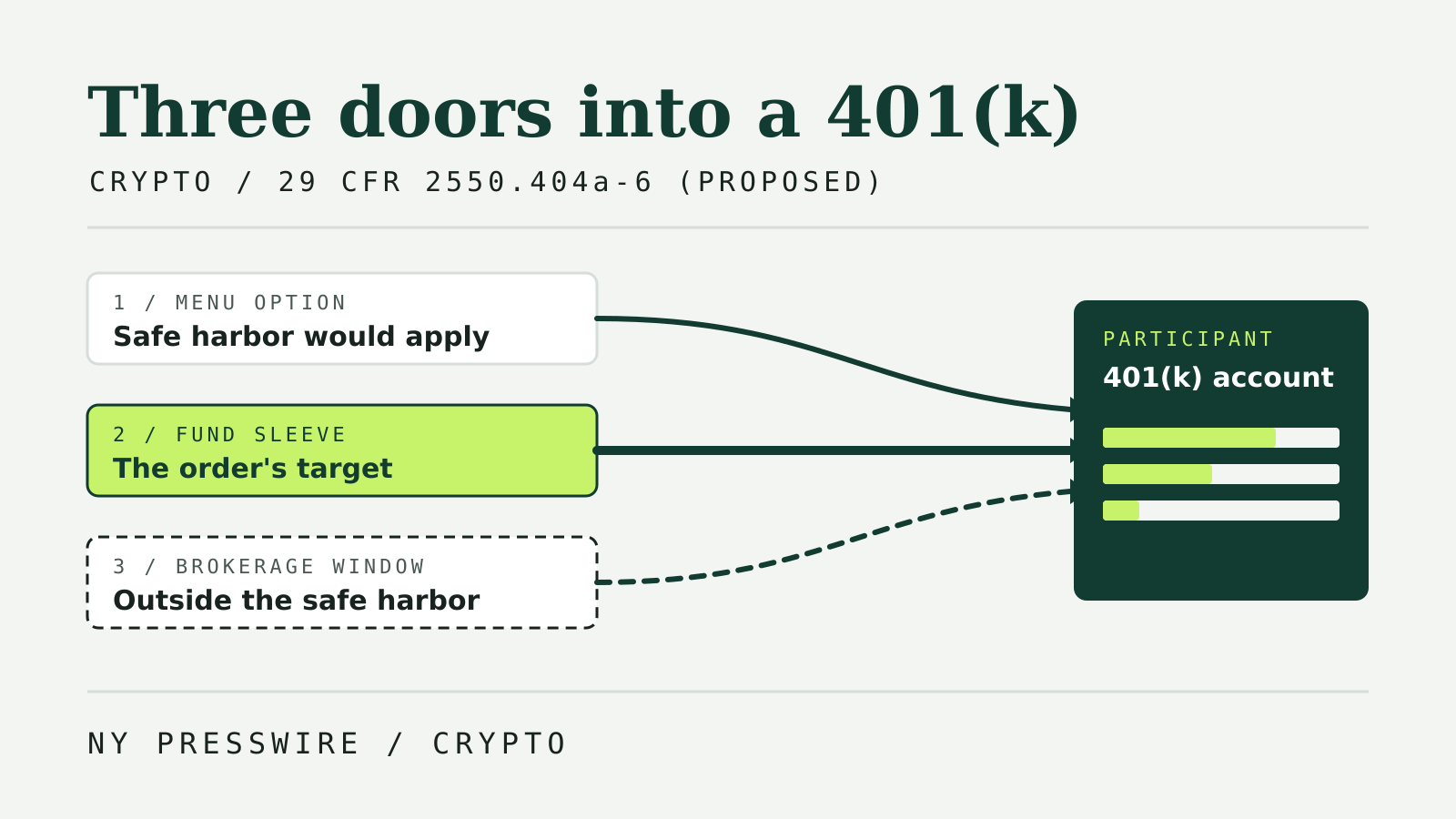
Three ways crypto can reach an account
A core menu option. A spot bitcoin ETF or a crypto fund listed on the plan menu is a “designated investment alternative.” The plan’s fiduciary chooses it and must monitor it, so both the general prudence duty and, once final, the six-factor safe harbor apply. Note the wording: the executive order’s definition of alternative assets names actively managed digital asset vehicles. A passive spot ETF is not named, but the proposal’s process would still apply because it covers every designated investment alternative. Our explainer on generic listing standards for crypto ETFs covers how those funds come to market.
A sleeve inside an allocation fund. This is the route the executive order targets: a target date fund or other asset allocation fund that holds a small digital asset slice. The participant never picks crypto directly; the fund manager does. DOL’s economic analysis assumes this channel and estimates that 47,333 plans a year would add target date series with alternative assets of all kinds, putting about $178 billion and 4.5 million participants a year into them.
A brokerage window. Proposed paragraph (m)(2) excludes brokerage windows and self-directed brokerage accounts from “designated investment alternative.” DOL says fiduciary principles for those arrangements “may be somewhat different,” so the safe harbor would not cover what a participant buys there. The 2022 release had singled out brokerage windows for scrutiny; that warning is gone with the rescission.
A worked example: what a small sleeve does to a fund
The arithmetic below is ours, not DOL’s, and it uses round numbers rather than a forecast. If a target date fund puts a share of its assets in a crypto sleeve and the sleeve falls, the fund falls by the sleeve’s share times the drop, before anything else in the fund moves:
| Crypto share of the fund | Sleeve falls 30% | Sleeve falls 50% | Sleeve falls 75% |
|---|---|---|---|
| 1% | -0.3% | -0.5% | -0.75% |
| 3% | -0.9% | -1.5% | -2.25% |
| 5% | -1.5% | -2.5% | -3.75% |
On a $100,000 balance, a 3% sleeve that halves costs $1,500. The same participant holding a 3% position directly through a brokerage window would lose the same amount, but nobody at the plan would have chosen that position for them. That gap in who made the choice is what the brokerage window exclusion turns on.
What to watch next
OIRA can clear the rule, send it back or hold it longer; reginfo.gov shows the status. After clearance, DOL publishes the final rule in the Federal Register with an effective date. Check whether the final text keeps the presumption of prudence, the brokerage window exclusion and the “actively managed” wording, because each affects how a crypto option is judged.