The Fed’s overnight reverse repo facility, or ON RRP, lets money market funds, government-sponsored enterprises, banks and primary dealers park cash with the New York Fed overnight at a fixed rate, set at 3.75 percent since September 17, 2026. That rate is the bottom of the federal funds target range, and it is the floor the facility puts under overnight rates for firms that cannot earn interest on reserves.
The facility is still open every business day. It is just barely used: on Friday, November 6, 2026, one counterparty placed $150 million, against $2.55 trillion from 113 counterparties at the peak on December 30, 2022 (New York Fed operation results).
This explainer covers how the facility works, what it does to short-term rates, and why it has emptied out, using the New York Fed’s own operation data.
How an ON RRP operation works
In a reverse repo, the New York Fed’s trading desk sells a Treasury security from the Fed’s portfolio to a counterparty and agrees to buy it back the next business day at a slightly higher price. The difference is the interest the Fed pays. The New York Fed’s FAQ on reverse repo operations, dated September 16, 2026, lists the current terms:
| Parameter | Current setting |
|---|---|
| Schedule | Every business day, 12:45 to 1:15 p.m. Eastern |
| Offering rate | 3.75 percent |
| Limit per counterparty | $160 billion a day, one proposition each |
| Smallest bid | $1 million, in $1 million increments |
| Eligible counterparties | Primary dealers, 2a-7 money market funds, banks and government-sponsored enterprises |
| Collateral | U.S. Treasuries from the Fed’s portfolio |
| Settlement | Tri-party, with Bank of New York Mellon as agent |
The full list of eligible firms, from Federal Home Loan Banks to dozens of government money market funds, is on the New York Fed’s reverse repo counterparties page. The rate and the $160 billion cap come from the FOMC itself, in the implementation note issued with each policy statement. The note of October 28, 2026 kept the target range at 3-3/4 to 4 percent and the ON RRP offering rate at 3.75 percent.
All bids are filled at the offering rate unless the total exceeds the Treasuries available to lend, which the FAQ calls highly unlikely. A Friday operation runs over the weekend: the November 6 trade matured on Monday, November 9, three calendar days later.
What it does to short-term rates
Banks earn interest on the reserves they keep at the Fed, currently 3.90 percent. Money market funds and the Federal Home Loan Banks have no reserve accounts, so the interest on reserves cannot set a floor for them. ON RRP does. A fund manager with cash at 1 p.m. will not lend it to a dealer for less than the Fed pays risk-free. That keeps overnight market rates from sinking below the bottom of the range. The New York Fed’s counterparty page says these operations help keep the effective federal funds rate from falling below the target range.
On November 5, 2026, the floor, the policy rates and the market rates lined up like this:
| Rate | Level | Source |
|---|---|---|
| ON RRP offering rate (floor) | 3.75% | FOMC implementation note |
| Effective federal funds rate | 3.88% | New York Fed EFFR |
| Interest on reserve balances | 3.90% | FOMC implementation note |
| Tri-Party General Collateral Rate | 3.90% | New York Fed TGCR |
| Secured Overnight Financing Rate | 3.92% | New York Fed SOFR |
For how the target range, IORB and the effective rate fit together, see our explainer on the federal funds target range vs effective rate. SOFR is covered in what SOFR is and how it is calculated.
From $2.55 trillion to almost nothing
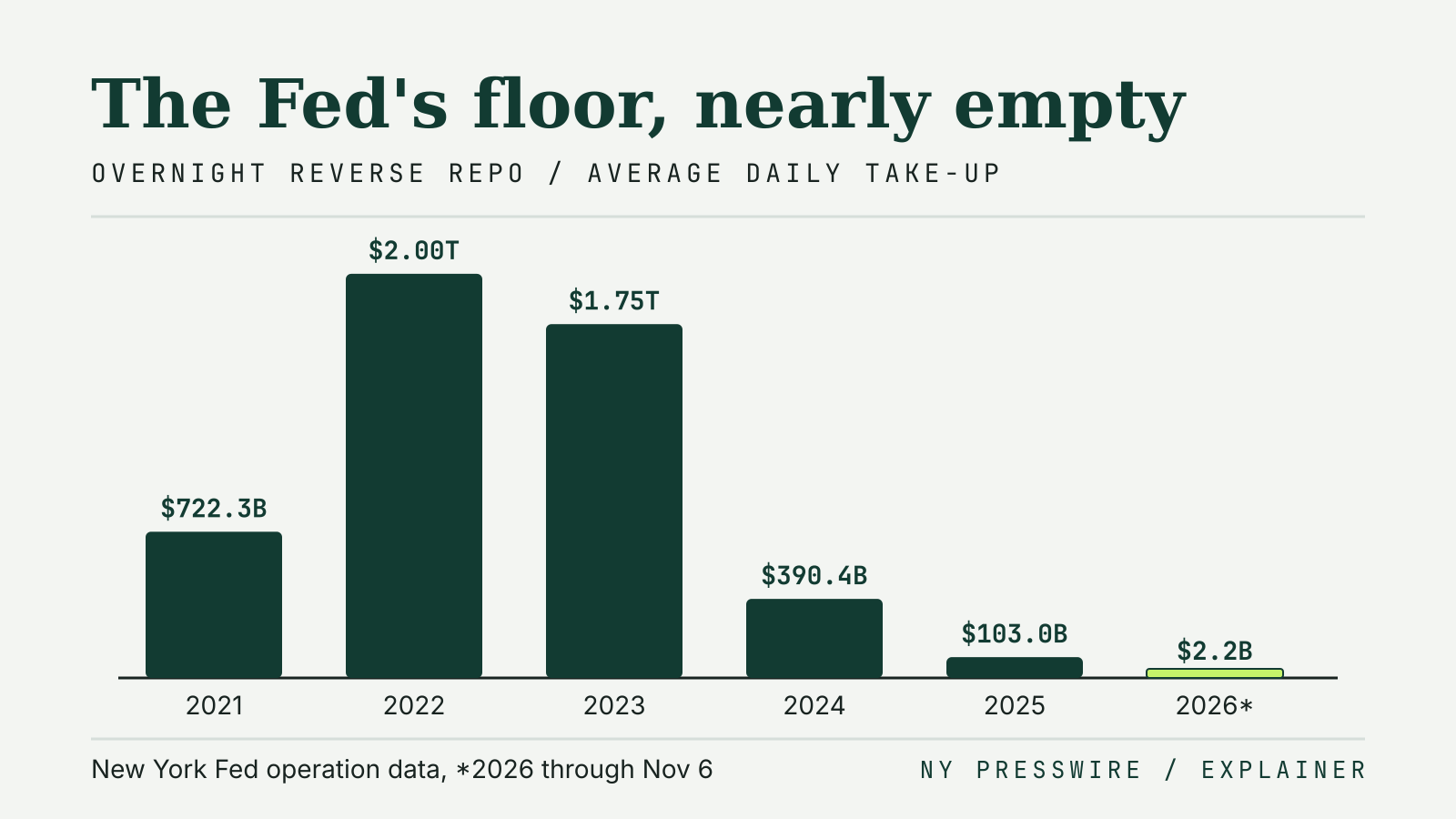
We pulled every overnight reverse repo operation from the New York Fed’s markets data from January 2021 to November 6, 2026, 1,460 in all, leaving out the small-value test operations the desk runs for operational readiness. The yearly picture:
| Year | Average daily take-up | Largest day | Average counterparties |
|---|---|---|---|
| 2021 | $722.3 billion | $1,904.6 billion (Dec 31) | 50 |
| 2022 | $1,995.8 billion | $2,553.7 billion (Dec 30) | 93 |
| 2023 | $1,747.4 billion | $2,375.2 billion (Mar 31) | 99 |
| 2024 | $390.4 billion | $719.9 billion (Jan 3) | 68 |
| 2025 | $103.0 billion | $460.7 billion (Jun 30) | 28 |
| 2026, to Nov 6 | $2.2 billion | $26.9 billion (Jun 30) | 7 |
Take-up first fell below $1 trillion on November 9, 2023, below $100 billion on December 20, 2024, and below $1 billion on November 18, 2025. In October 2026 it averaged $0.7 billion a day.
The rate table shows why. Treasury-backed repo in the private tri-party market paid 3.90 to 3.95 percent from November 3 to 5, 2026, while the Fed paid 3.75 percent. A fund that can lend Treasury-backed cash to a dealer at the higher rate has little reason to take the Fed’s.
Worked example. A money market fund with $10 billion to invest overnight compares the two. At a gap of 15 basis points (3.90 percent against 3.75 percent), using the actual/360 day count of US money-market rates:
- One night: $10,000,000,000 × 0.0015 ÷ 360 = $41,667 more from private repo.
- A Friday trade held to Monday (3 days): $41,667 × 3 = $125,000.
While private rates stay above 3.75 percent, the facility mostly sits idle. If they fall toward the offering rate, funds can move cash back to the Fed the same afternoon, up to $160 billion each.
Month-end and quarter-end days still show up
Use in 2026 is lumpy. The largest days fall on or next to month and quarter ends: $26.9 billion on June 30, $16.3 billion on February 27 and $15.8 billion on March 31. Across 2026, the last operation of each month averaged $10.3 billion, against $1.8 billion on other days. The most recent pair was $4.4 billion on Friday, October 30 and $5.1 billion on Monday, November 2, before take-up dropped back to $125 to $427 million for the rest of that week. The daily results do not give a reason. The New York Fed adds a breakdown by counterparty type each month, with a one-month lag, in its operation search tool.
Where ON RRP shows up on the Fed’s balance sheet
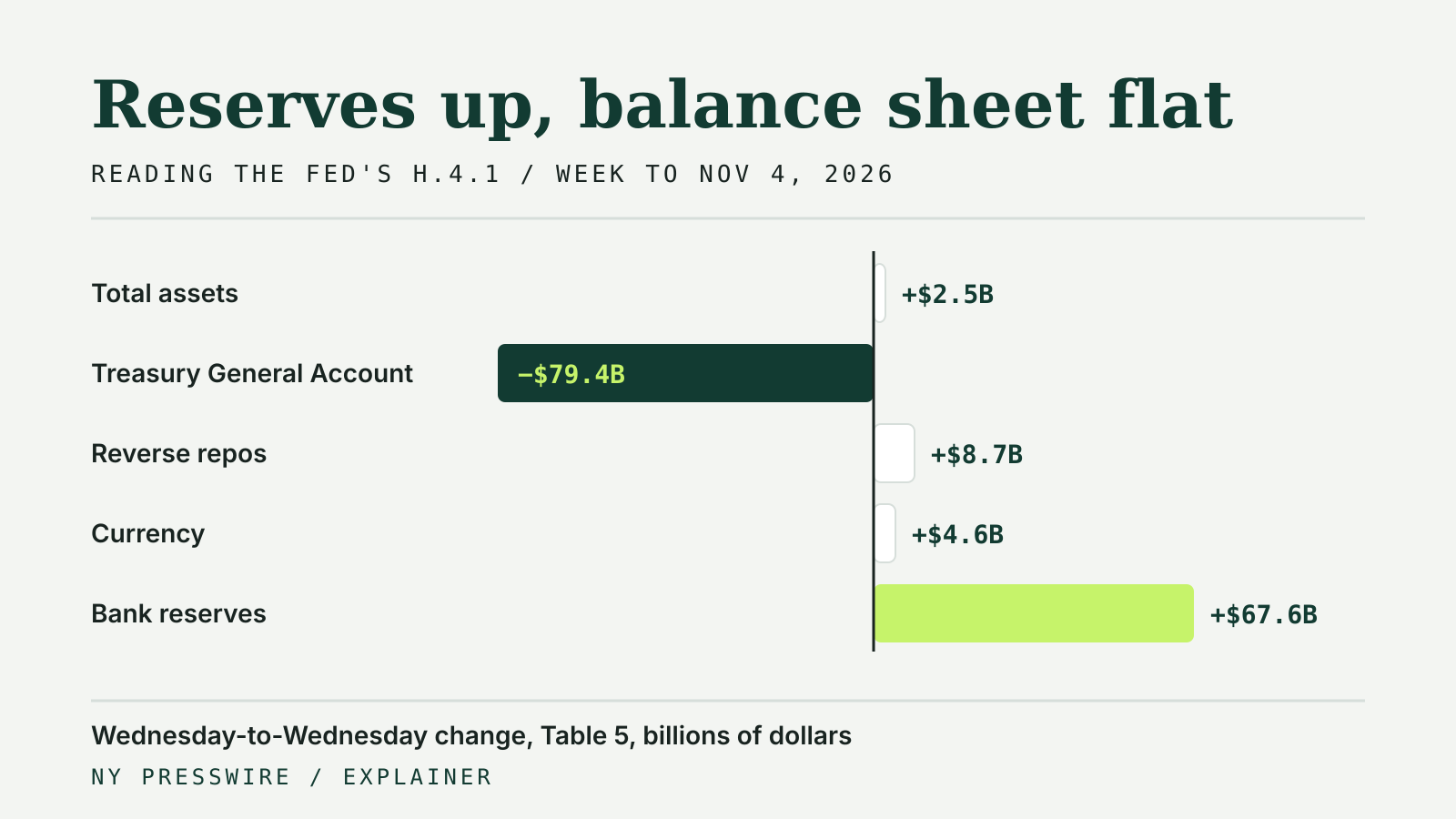
An ON RRP trade does not change the size of the Fed’s portfolio, because the securities sold under repo stay on the books. It changes the liability side. Cash moves from bank reserve accounts into the reverse repo line, so heavy ON RRP use drains reserves and a decline adds them back.
In the weekly H.4.1 release, ON RRP is the “Others” line under reverse repurchase agreements, next to the much larger foreign official account. On Wednesday, November 4, 2026, the ON RRP operation took in $225 million. The H.4.1 of November 5 showed “Others” at $0.2 billion, the same figure rounded. Our guide on how to read the Fed’s H.4.1 balance sheet walks through that week’s release.