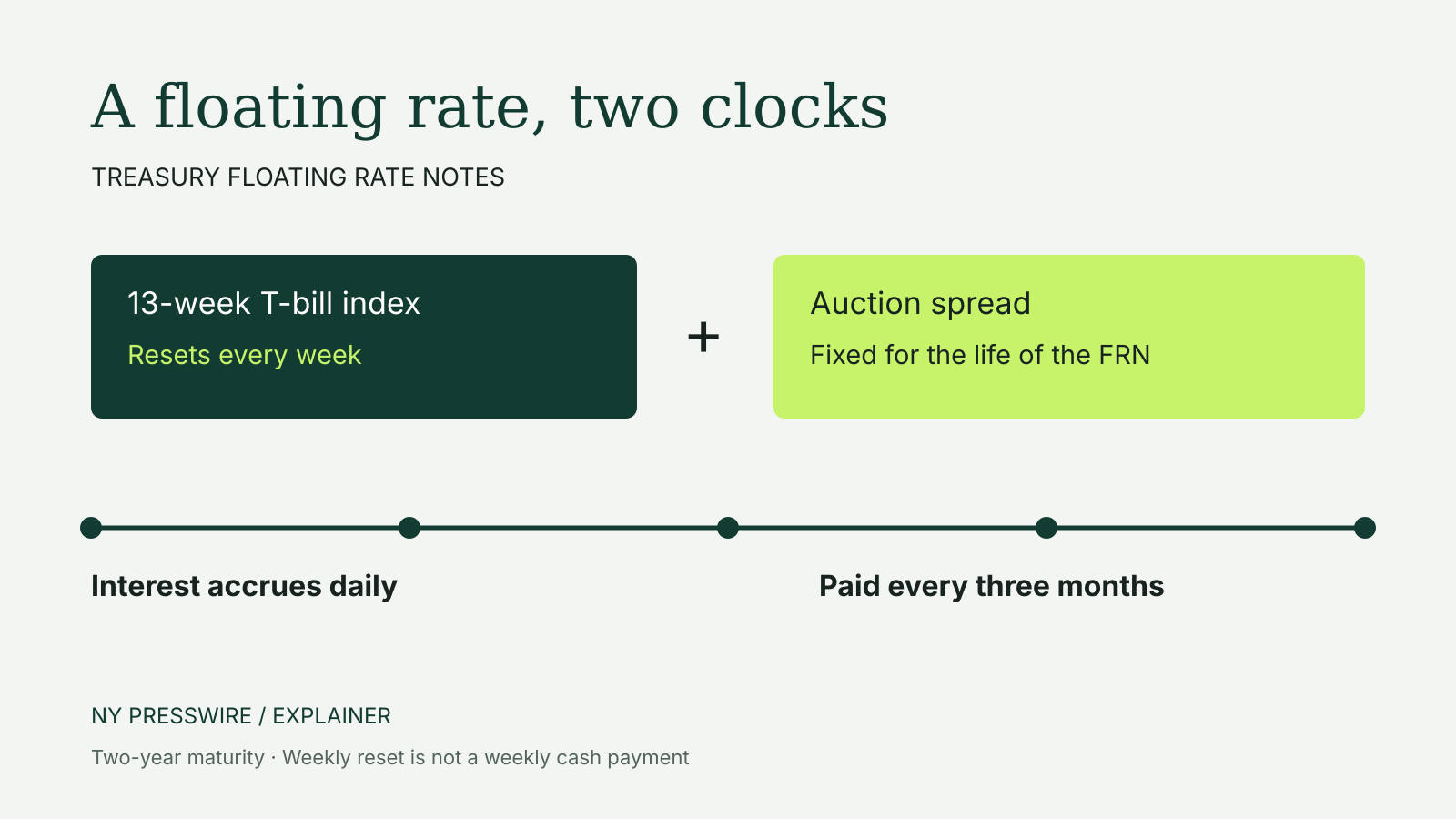
Treasury floating rate notes are two-year U.S. government securities whose interest rate changes over time. Their rate combines a weekly-resetting Treasury bill index with a spread fixed at the original auction. Interest accumulates daily, but the cash is paid every three months. A weekly reset therefore does not mean a weekly payment.
That separation between the rate clock and the payment clock is the main thing to understand before reading an FRN quote. The security can keep the same maturity and auction spread while the interest rate used for daily accrual changes.
The two parts of the rate
TreasuryDirect defines the FRN interest rate as index rate plus spread.
The index is tied to the highest accepted discount rate from the most recent 13-week Treasury bill auction. Treasury auctions that bill every week, so the FRN index resets weekly.
The spread comes from the auction at which the FRN is first offered. It is the highest accepted discount margin in that auction and remains the same for the life of that FRN. “Floating” refers to the changing index, not to a spread that Treasury renegotiates every week.
| Component | Where it comes from | What happens afterward |
|---|---|---|
| Index rate | Most recent 13-week bill auction’s highest accepted discount rate | Resets weekly |
| Spread | Original FRN auction’s highest accepted discount margin | Stays fixed for that FRN |
| Interest rate | Index plus spread | Applied to par value each day |
| Cash payment | Interest accumulated under those daily rates | Paid every three months |
The index is specifically a Treasury bill auction discount rate. It is not the Federal Reserve’s target range and it is not SOFR. Those rates describe different markets and calculations. Our SOFR explainer follows the overnight repo transactions behind that benchmark.
A reset changes accrual, not maturity
An FRN matures in two years. Changes in its index do not start a fresh two-year term or turn it into a new security every week.
Treasury applies the interest rate to the FRN’s par value daily. As the index changes, the rate used to accumulate interest can change too. The quarterly payment brings those accruals together; it is not simply evidence that one rate applied throughout the whole quarter.
This also explains why an auction spread is not a complete statement of the interest an investor will earn. It is one component. To understand the rate in effect for a particular FRN, match its spread with the applicable index rather than treating the spread alone as its yield.
TreasuryDirect publishes a daily FRN index database for checking those components. An educational explanation can describe the mechanism without copying a number that will become stale.
How FRNs differ from conventional Treasury notes
The word “note” appears in both products, but their payment structures differ. Treasury’s FRN summary describes quarterly interest and a rate that floats. Conventional Treasury notes belong to the fixed-rate structure described in our bills, notes and bonds comparison.
The FRN index also creates a connection to bills without making the FRN a 13-week bill. The bill auction supplies a reference rate. The FRN itself has a two-year maturity, pays interest every three months and follows its own auction terms.
Do not confuse it with a Treasury STRIP either. TreasuryDirect lists FRNs as ineligible for STRIPS. Treasury STRIPS separate eligible principal and interest payments into distinct securities; an FRN’s changing coupon is a different mechanism.
Purchase size and auction pattern
TreasuryDirect lists a minimum FRN purchase of $100, in increments of $100. Its summary gives a noncompetitive-bid maximum of $10 million and a competitive-bid limit of 35% of the offering amount.
Those are auction limits under the product’s published terms. They should not be mistaken for a broker’s minimum order, an account’s available balance or a recommendation about an appropriate investment size.
Original-issue FRN auctions take place in January, April, July and October. Reopenings occur in the other months. For an actual transaction, use Treasury’s current auction announcement and calendar rather than inferring an exact auction date from the month alone.
Our Treasury bill auction guide explains the distinction between competitive and noncompetitive bids. The security’s own announcement remains the document to match to the bid.
Holding to maturity and selling earlier
Treasury says an investor can hold an FRN until maturity or sell it before then. These are different cash-flow decisions: the two-year maturity describes the security, while a sale involves transferring it before that date.
A floating rate does not make every figure on a purchase or sale confirmation interchangeable. Keep par value, purchase price, spread and interest rate separate when reading the terms. The spread belongs to the rate formula; it is not the purchase price expressed in another way.
This guide explains the product’s structure. It does not estimate a sale price, forecast a future index rate or compare an investor’s personal after-tax outcomes.
Tax treatment in Treasury’s summary
TreasuryDirect states that federal tax is due each year on FRN interest earned and that the interest is not subject to state or local tax.
That summary describes the security’s U.S. tax treatment. It does not establish what a particular investor owes across every account type or jurisdiction. The cash-payment schedule and a taxpayer’s filing obligations should be read separately.