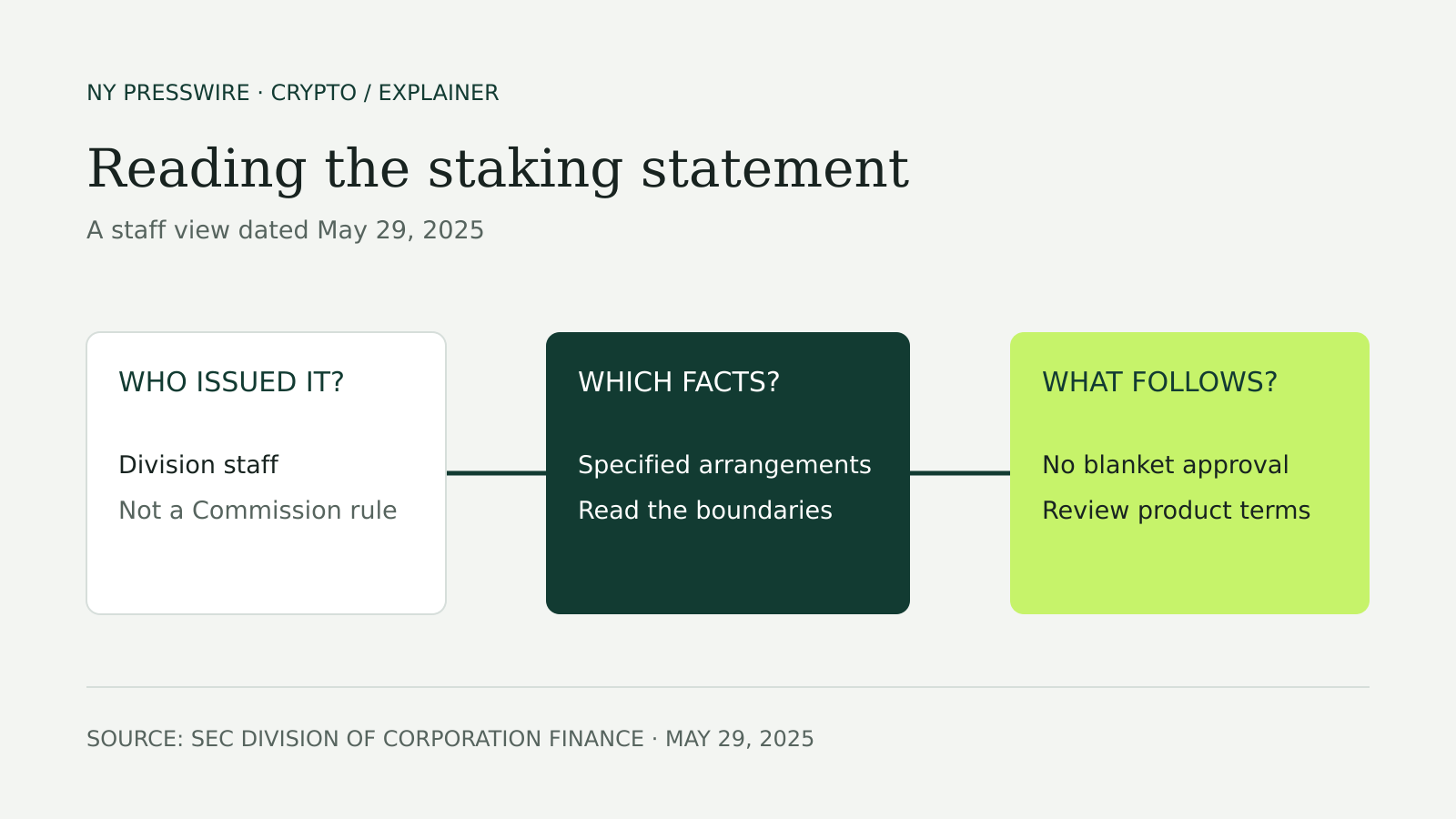
The SEC protocol staking statement of May 29, 2025 is a staff view about specified arrangements. It is not a blanket approval of products marketed as staking. Reading it requires separating the document’s author, the activities described and the actual terms of a service.
This explainer examines that dated statement and the disagreement published alongside it. For the later Commission-level framework, see our separate guide to the SEC crypto asset interpretation of 2026. The two documents should not be cited interchangeably.
Start with the document’s status
The Division of Corporation Finance statement says it has no legal force, does not amend law and was neither approved nor disapproved by the Commission. Its conclusion depends on the facts described.
That distinction changes how a product team should write a compliance memo. “Staff expressed a view about this arrangement” identifies the evidence. “The SEC approved our product” asserts something different. A link to an official website does not make those sentences equivalent.
Keep the issuing body and date beside any summary. A dated staff statement, a Commission interpretation, a court decision and a provider’s marketing page belong in separate rows of a source list. Record which question each document answers before using it in a product decision.
What the May statement describes
The staff addressed covered assets used in public, permissionless proof-of-stake networks. It considered solo staking, self-custodial delegation and specified custodial arrangements. In its analysis, the described activities were administrative or ministerial rather than entrepreneurial or managerial.
The custodial description excludes lending or reusing deposited assets for the provider’s business. A custodian deciding whether, when or how much to stake falls outside the statement’s scope. Liquid staking, restaking and liquid restaking were not addressed by that May text.
For readers, these boundaries make a service description more useful than a label. Ask for an explanation of what happens to the assets after deposit. Then compare that explanation with the documents being cited. Do not assume two services operate alike because both place a “staking” button beside an account balance.
Why Peirce welcomed the statement
In her May 29 response, Commissioner Hester Peirce argued that regulatory uncertainty had discouraged Americans from participating in network consensus. She welcomed clarification for individual stakers and service providers.
Her account also highlighted ancillary services: slashing coverage, early unbonding, different reward-delivery schedules and aggregation to meet network minimums. She viewed the statement as useful clarification of staff’s position, while anticipating further work on other consensus-related products.
This is an identified commissioner’s supportive position. It helps explain the policy rationale; it is not an additional product license. A provider quoting the response should retain that authorship rather than turning it into a unanimous institutional endorsement.
Why Crenshaw objected
Commissioner Caroline Crenshaw’s response on the same date challenged the staff’s application of the investment-contract analysis. She argued that earlier court decisions had treated the alleged services’ pooling, technical infrastructure and profit-enhancing features as potentially managerial efforts.
She also warned against reading the word “custodian” as a promise of securities-law protections. In her account, user agreements, insolvency treatment, slashing and theft risks remained material. She considered the statement an unreliable map for applying the law to actual services.
The disagreement matters when assessing the certainty of a claim. A summary that quotes only the favorable response loses evidence about contested assumptions. Conversely, her criticism is a commissioner’s argument; this article does not turn it into a new judicial holding about every staking service.
Build a product-specific evidence file
A useful review can be organized around four documents:
| Document | Question to answer |
|---|---|
| Product terms | What has the customer actually agreed to? |
| Operational description | Who makes decisions and performs each step? |
| Risk disclosure | Which losses or delays does the provider describe? |
| Cited legal material | What author, date and factual scope support the claim? |
This is an editorial reading framework, not a statutory checklist. It makes missing evidence visible without pretending to decide a product’s legal classification. Save the version reviewed, because later edits can change the arrangement being assessed.
Keep tax treatment separate as well. Our staking rewards tax explainer addresses a different question from the securities-law status of a service.