Treasury STRIPS explained: the principal and interest payments of an eligible Treasury security become separate zero-coupon securities. Each component trades individually and makes one payment at its own maturity.
A conventional Treasury bond pays interest along the way and returns principal at maturity. STRIPS separate those promised payments so each can trade on its own. An investor holds a security tied to one payment date rather than the original bond’s whole payment schedule.
The acronym means Separate Trading of Registered Interest and Principal of Securities. TreasuryDirect describes each separated component as a zero-coupon security: it makes one payment at its own maturity. “Zero coupon” describes that payment structure, not a promise that the security costs nothing or cannot change in value.
Start with the payments, not the acronym
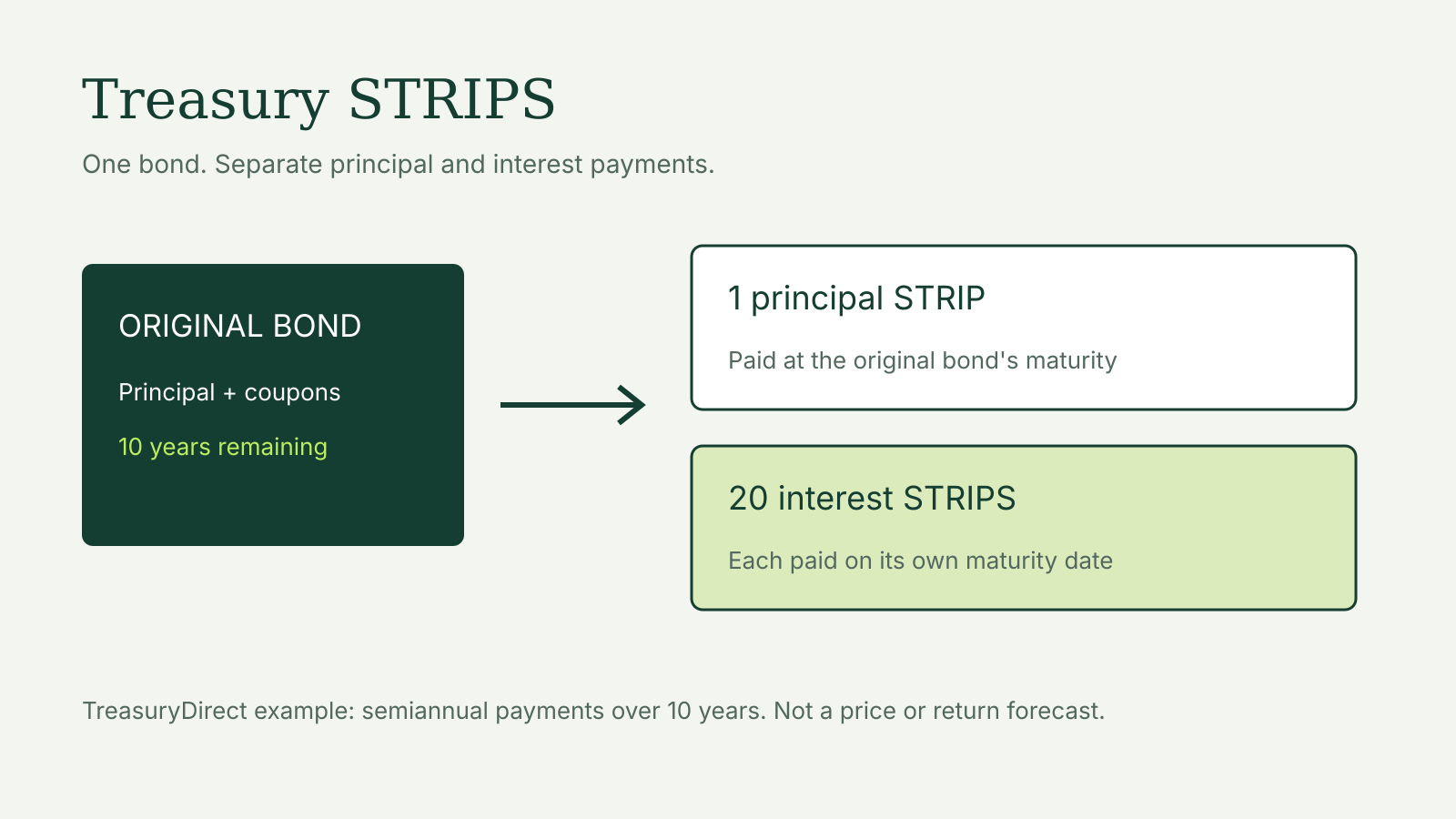
TreasuryDirect illustrates the process with a bond that has ten years left to maturity. The bond has one principal payment still due and twenty interest payments, one every six months. Stripping that bond creates twenty-one separate securities.
The principal component retains the original bond’s final payment date. Each interest component has the date on which that coupon was due. Every new component receives its own CUSIP, the identifier used to distinguish the security.
| Before separation | After separation |
|---|---|
| One bond with ten years remaining | Twenty-one separately identified securities |
| One principal payment at maturity | One principal STRIP |
| Twenty remaining semiannual interest payments | Twenty interest STRIPS |
| One combined payment schedule | Each component has one payment at its maturity |
This is TreasuryDirect’s example, not a quote for an available security. The number of pieces depends on the payments still outstanding when a security is stripped. A bond with a different remaining term will not necessarily produce twenty-one pieces.
Which Treasuries can be stripped?
Treasury lists notes, bonds and Treasury Inflation-Protected Securities, or TIPS, as eligible. Treasury bills and floating-rate notes cannot be stripped.
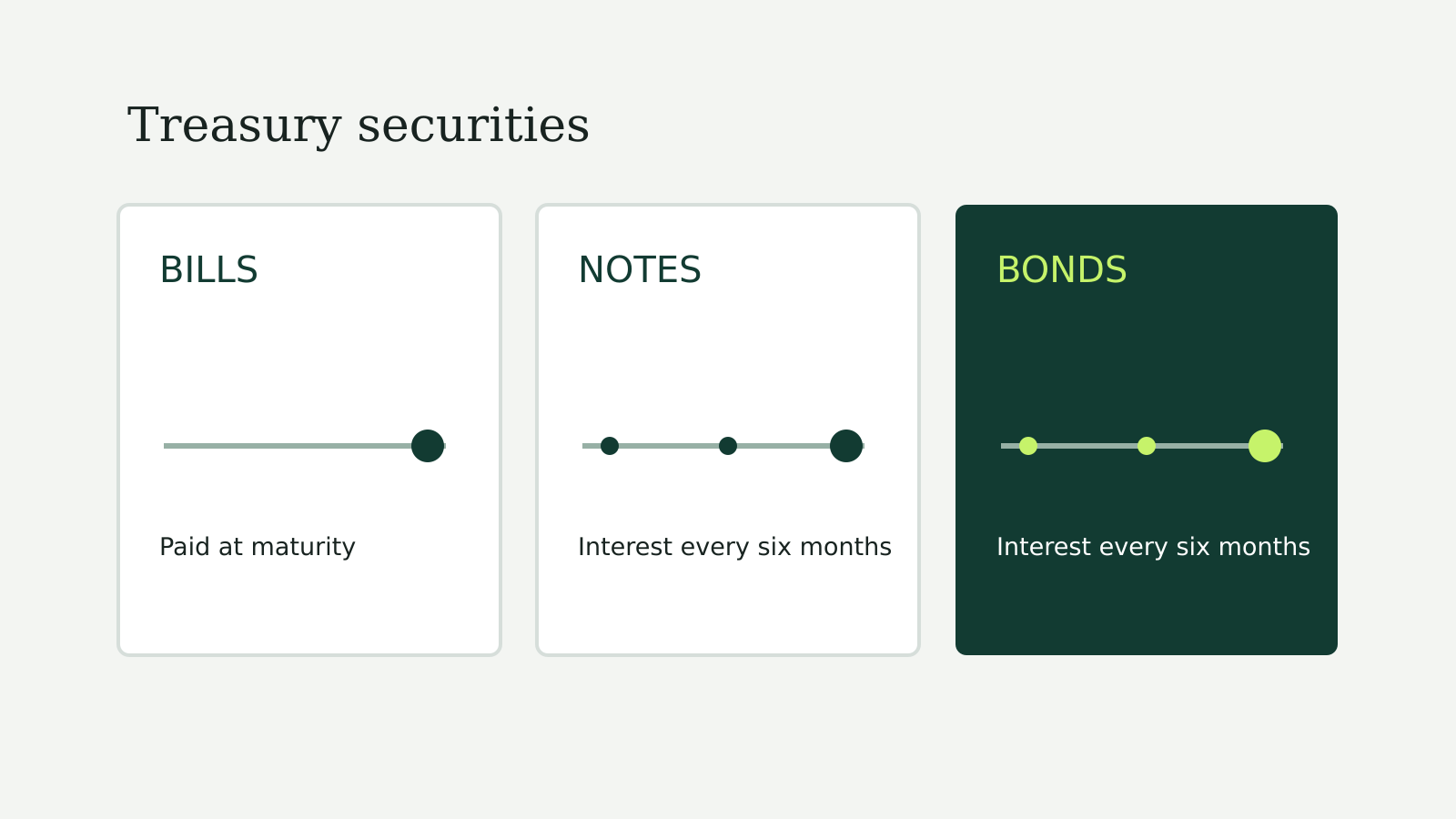
That distinction matters because a Treasury bill already has a different payment structure from a conventional coupon bond. Calling a bill a STRIP because both lack recurring coupon payments would confuse two different instruments. Our comparison of Treasury bills, notes and bonds explains the original securities before any separation occurs.
TreasuryDirect says the minimum face amount needed to strip is $100. Amounts above that minimum must be multiples of $100. Face amount is the amount used to define the security’s principal; it should not be read as a live purchase price or a broker’s minimum order.
Where STRIPS are held
You cannot create or reassemble STRIPS in a TreasuryDirect account. Treasury says these operations take place in the commercial book-entry system, through financial institutions, brokers and dealers handling government securities.
Investors likewise buy, hold, sell and redeem STRIPS through those intermediaries. This is a different access route from buying an eligible new Treasury security directly at auction through TreasuryDirect.
Before placing an order, distinguish the intermediary’s transaction process from Treasury’s description of the security. An account may have its own order sizes, charges and procedures. Treasury’s $100 face-amount rule does not establish that every broker will accept a $100 retail order on identical terms.
For the auction route used by original securities, see how Treasury bill auctions work. A STRIP purchased from an intermediary is not a new bill auction submission.
“No coupon” does not mean “no tax reporting”
A STRIP does not send the holder periodic coupon cash. That does not mean all tax reporting waits until the maturity payment arrives.
TreasuryDirect says interest earned on STRIPS must be reported in the year it is earned. It also identifies annual reporting of inflation adjustments to TIPS principal. The financial institution, broker or dealer holding the securities sends the investor a Form 1099 with tax information each year.
The practical distinction is between cash arriving and income being reported. A holder can have annual reporting obligations even when the security has not made its maturity payment. The Treasury page links IRS Publication 550 for further tax detail.
This article explains the Treasury program’s published mechanics. It does not determine an individual holder’s tax liability, account treatment or filing position. Use the actual tax documents and current IRS instructions for those questions.
Reassembling the original security
Stripping is not necessarily permanent. Treasury says a financial institution, broker or dealer can reassemble a security if it obtains all the remaining separate components.
Return to the ten-year example. Five years later, ten of the twenty coupon payment dates have passed. Eleven components remain: ten interest STRIPS and the principal STRIP. The intermediary must have all eleven to reassemble the bond. The reassembled security again has one CUSIP.
The word “remaining” is doing useful work here. Reassembly does not require retrieving a component that has already matured. It requires the outstanding pieces needed to restore the future payment schedule.
What to check in a STRIPS description
A useful description should identify the actual component and the date it pays. Read the security details rather than relying only on the label “Treasury.”
Check whether you are looking at a principal or interest component, its CUSIP, maturity date and face amount. Then check how the intermediary presents the price, settlement and any charges. Those order details are separate from the Treasury program’s eligibility rules.
If the position is derived from TIPS, make sure the inflation-linked treatment is clear. Do not assume a plain-language reference to a “bond payment” explains every feature of the underlying security.
Source
TreasuryDirect: STRIPS, documentation checked October 31, 2026. The payment-count example and program mechanics above come from this official Treasury page.