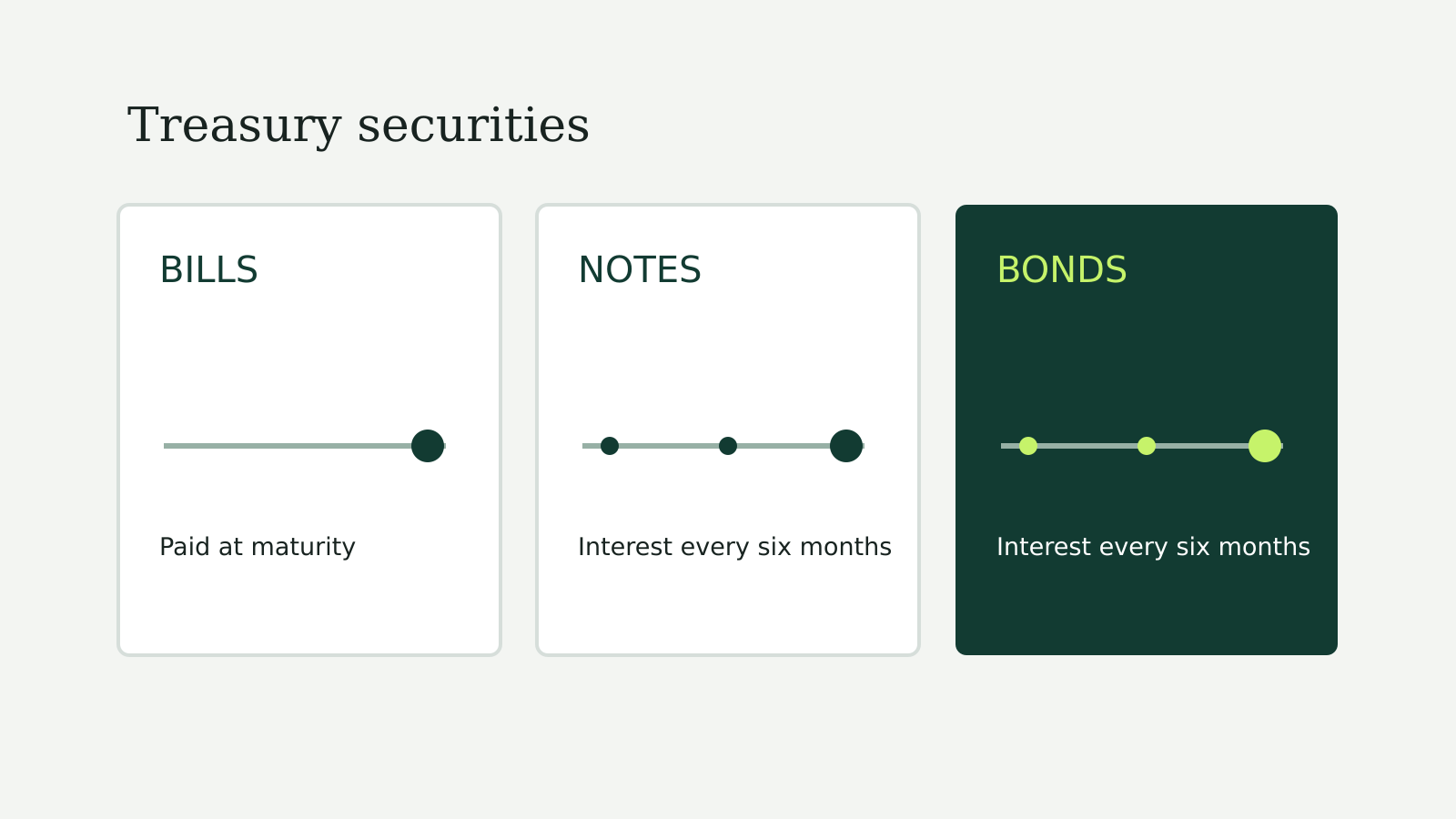
Treasury bills, notes and bonds are marketable US government securities with different original terms and payment patterns. Bills are short-term securities generally sold at a discount or at face value. Notes and bonds pay fixed interest every six months until maturity.
The distinction affects when an investor receives cash and how long a security remains outstanding. All three can be held to maturity or sold earlier, but an early sale is at a market price rather than a guaranteed return of the purchase price.
Bills, notes and bonds at a glance
| Security | Original terms listed by Treasury | Interest |
|---|---|---|
| Treasury bill | 4, 6, 8, 13, 17, 26 or 52 weeks | Difference between purchase price and face value paid at maturity |
| Treasury note | 2, 3, 5, 7 or 10 years | Fixed interest every six months |
| Treasury bond | 20 or 30 years | Fixed interest every six months |
TreasuryDirect lists these terms for current offerings. The Treasury also issues cash management bills with variable terms; those are available through banks, brokers or dealers, not directly in TreasuryDirect. See the official pages for bills, notes and bonds.
How a Treasury bill pays
A bill does not make the semiannual coupon payments associated with notes and bonds. Treasury sells bills at a discount or at par, and pays face value when they mature. The difference between the amount paid and the face value is the bill’s interest.
As a simple illustration, a bill bought for $980 and redeemed for its $1,000 face value produces a $20 difference before taxes and any transaction costs. The example is not a current auction quote. The annualized rate depends on the price and time remaining, so $20 on its own is not enough to compare bills with different maturities.
Our Treasury bill calculator shows the relationship between price, interest and investment rate. For the auction process, see how Treasury bill auctions work.
How notes and bonds pay
Treasury notes have original terms of two to ten years, while Treasury bonds have original terms of 20 or 30 years. Both pay a fixed rate every six months until maturity, when principal is due. Treasury sets the fixed rate at auction.
A coupon rate and an investor’s yield are different measures. The coupon determines the stated interest payments on face value; the price paid affects the return. A note or bond can trade above or below face value, including when it is sold before maturity.
A reopening is another way Treasury sells an existing security. Its terms should be checked in the auction announcement: the original maturity and coupon remain attributes of the security, while the price and yield at a later sale can differ. Treasury explains prices and yields in its pricing guide.
Buying and selling
TreasuryDirect says current bills, notes and bonds are issued electronically, with a $100 minimum and $100 increments. Its auction pages distinguish competitive and noncompetitive bids. The latter accepts the yield determined at auction; the detailed limits and conditions are in Treasury’s buying guide.
A security can also be sold before maturity. New marketable securities bought through TreasuryDirect must be held for at least 45 calendar days before they are transferred or sold; the buying guide says this holding period does not apply when the new security is bought with proceeds from reinvesting a maturing one. A security’s market price can change as yields and other conditions change, so the proceeds may be more or less than the amount originally paid. The longer period until a bond matures does not itself promise a higher return.
TreasuryDirect says interest on these securities is subject to federal tax and exempt from state and local income tax. Individual circumstances vary; check the applicable tax information rather than using a headline yield as an after-tax result.
Treasury bonds and savings bonds are different
Treasury bonds in this comparison are marketable securities with 20- or 30-year original terms. TreasuryDirect distinguishes them from EE, I and HH savings bonds. Those savings products have different rules and should not be treated as interchangeable just because both use the word “bond.”