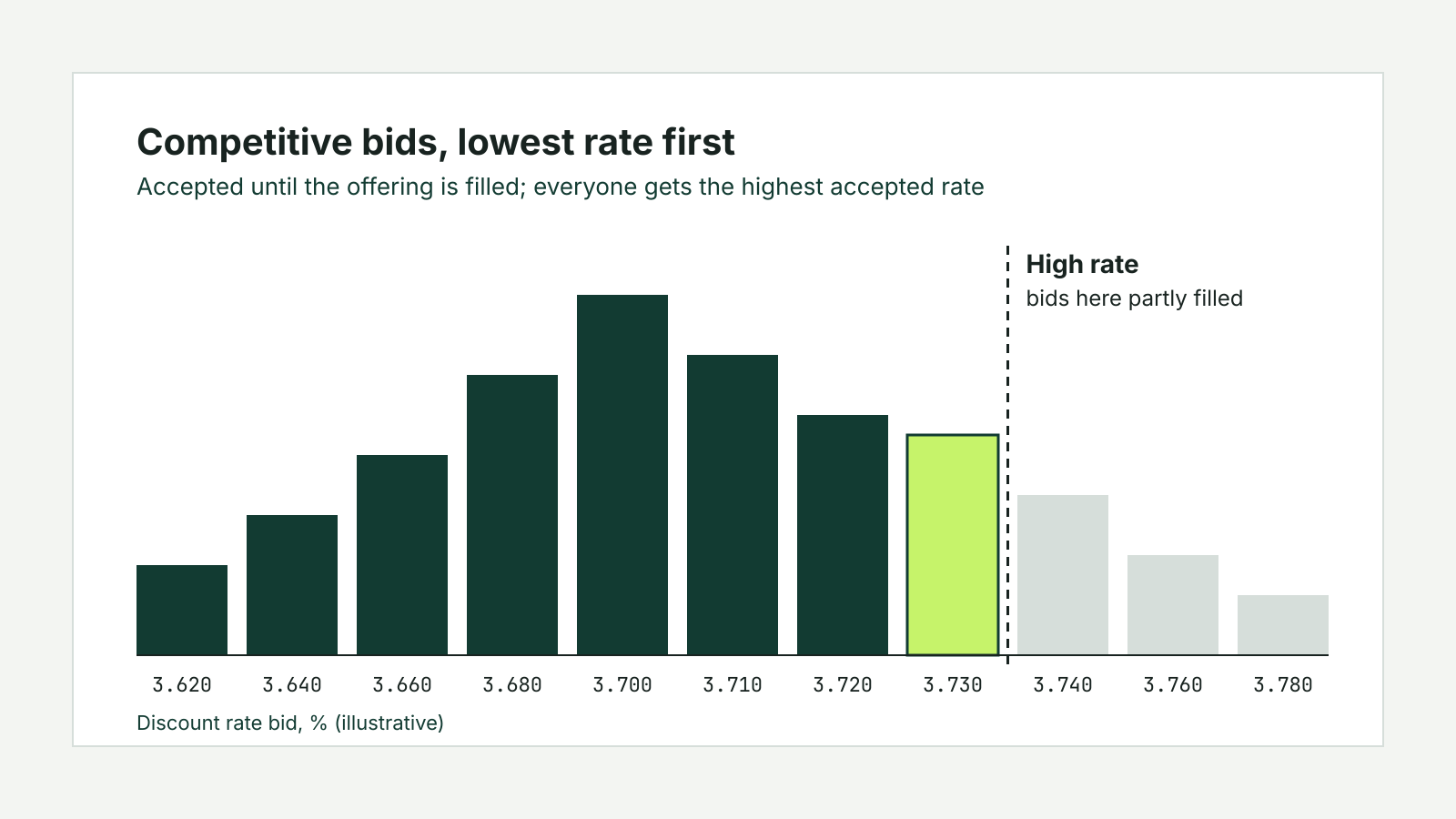
The U.S. Treasury sells bills every week, and it does not choose the interest rate on any of them. Bidders do. Understanding how Treasury bill auctions work comes down to one rule: Treasury fills the offering from the lowest rate bid upward, and everyone who wins pays the same price, set by the highest rate it had to accept.
The rules sit in the Uniform Offering Circular, 31 CFR Part 356. TreasuryDirect’s auction FAQs call the format a single-price auction: all successful competitive and noncompetitive bidders get the price based on the highest accepted rate.
The product and the calendar
A bill is sold at a discount or at face value, and Treasury pays the face value at maturity. The difference is the interest. TreasuryDirect’s bill page lists terms of 4, 6, 8, 13, 17, 26 and 52 weeks. The shorter terms are auctioned weekly and the 52-week bill every four weeks. Cash management bills come at irregular times and only through a bank, broker or dealer.
Each auction has three dates. Treasury announces the offering amount, auction date, issue date, maturity and bid closing times, then holds the auction, then issues the bills. In the tentative schedule for the third quarter of 2026, a typical 13-week bill was announced on a Thursday, auctioned the next Monday and issued that Thursday. Treasury usually publishes the tentative schedule on the first Wednesday of February, May, August and November, and says the dates seldom change.
Two ways to bid
Noncompetitive. The bidder names an amount and accepts whatever rate the auction sets. Under Section 356.12, the limit is $10 million per auction. A TreasuryDirect account can only bid this way, and the minimum is $100 in $100 steps.
Competitive. The bidder names the discount rate it will accept, with three decimals in 0.005 increments, such as 5.320 or 5.325. A bid at a single rate above 35% of the offering is cut to 35%, and the maximum award is 35% of the offering minus the bidder’s reportable net long position. Competitive bids go through a bank, broker or dealer, or directly through Treasury’s Debt Financing System.
No one may bid both ways in the same auction. The July 16, 2026 announcement of a 13-week bill shows the usual cutoffs: 11:00 a.m. Eastern for noncompetitive bids and 11:30 a.m. for competitive ones.
How the high rate is found
Section 356.20 describes the steps:
- Treasury accepts every valid noncompetitive bid in full.
- It accepts competitive bids from the lowest discount rate upward until the offering amount is covered.
- The last rate it needs is the high rate. Bids above it get nothing.
- Bids at the high rate usually exceed the remaining amount, so each is filled by the same percentage, rounded up to the next hundredth of a percent.
The regulation gives an example of that proration. If 88.27% is awarded at the high rate, an $18,000 bid at that rate receives $15,900: 88.27% of $18,000 is $15,888.60, rounded up to the next $100 multiple.
Everyone then pays the price that corresponds to the high rate, including bidders who offered to accept less. That is why a low competitive bid is not a penalty: it raises the chance of a full award without lowering the return.
Reading a results sheet
The results for that 13-week bill, auctioned July 20, 2026, show each piece:
- High rate 3.730%, allotted at high 73.01%. All bids below 3.730% were filled in full; bids at exactly 3.730% got 73.01% of what they asked for.
- Median rate 3.710% and low rate 3.620%. Half of the accepted competitive amount was bid at or below the median, and 5% at or below the low rate.
- Price 99.057139 per $100 of face value for a 91-day bill.
- Investment rate 3.818%, the equivalent coupon-issue yield.
- Bid-to-cover 3.00: $275.8 billion tendered against $92.0 billion accepted from the public. Treasury computes it without the Federal Reserve’s SOMA amount, which is listed separately.
- Bidder groups. Primary dealers tendered $180.3 billion and were awarded $33.3 billion, indirect bidders $49.7 billion and direct bidders $6.0 billion.
The FAQs define the groups. A primary dealer bids for its own account; the New York Fed keeps the list of these firms. A direct bidder is any other firm bidding for itself in Treasury’s system. An indirect bidder places a competitive bid through a primary dealer or direct submitter, which includes foreign monetary authorities bidding through the New York Fed. Neither label says where a bidder is based.
These are one past auction’s numbers, used to show the format. For the latest rates by term and recent history, use our Treasury bill calculator.
Discount rate, price and investment rate
The rate bidders compete on is a discount rate, quoted on face value over a 360-day year. TreasuryDirect’s pricing page gives the formula:
Price = Face value × (1 − discount rate × days to maturity / 360)
The check works on the July bill: 100 × (1 − 0.0373 × 91 / 360) is about 99.0571, matching the published price. The investment rate is a different measure, the coupon-equivalent yield, which is why the results sheet shows a higher number beside the same price. The formulas for both are in Appendix B to Part 356. Interest on bills is subject to federal tax but exempt from state and local income tax.
Treasury’s own discretion
Section 356.33 lets Treasury reject any bid, award more or less than the announced amount and change an auction’s terms, with public notice. Under Section 356.34, a bidder that fails to pay may owe liquidated damages of up to 1% of the par amount awarded.
Questions readers ask
Can an individual bid competitively?
Yes, but not through TreasuryDirect. A competitive bid has to go through a bank, broker or dealer.
Why did my noncompetitive bid get the high rate?
Because it is a single-price auction. Noncompetitive bids are filled in full at the price set by the highest accepted competitive bid.
When are results out?
Treasury posts results on TreasuryDirect after the auction closes. Account holders can see their own pending purchase after 5 p.m. Eastern on auction day, according to TreasuryDirect.
Sources
- 31 CFR Part 356, Subpart C: auction awards; Section 356.12: bids; Subpart D; Appendix B.
- TreasuryDirect: Treasury Bills; How Auctions Work; Auction FAQs; Understanding pricing.
- Treasury offering announcement, 13-week bill, July 16, 2026; auction results, July 20, 2026.
- U.S. Treasury: Tentative auction schedule, Q3 2026.
- Federal Reserve Bank of New York: Primary dealers.
Sources reviewed October 2, 2026. This article explains the auction process; it is not investment advice.