A Treasury CUSIP is the nine-character code that identifies one Treasury security, and most of its meaning sits at the front. The first six characters name the issuer and, for Treasury, the kind of security: 912797 is the root on every Treasury bill sold today, 91282C marks current notes, TIPS notes and floating rate notes, and 912810 marks bonds. The next two characters pick out the specific issue, and the last character is a check digit calculated from the first eight.
That answers the question most people bring to a code like 912797WM5. The second question usually arrives when a brokerage statement shows a 4-week bill with a 17-week term and an issue date months in the past. Treasury sells the same bill CUSIP at several auctions, and the auction data below shows how regular that pattern is.
The three parts of a CUSIP
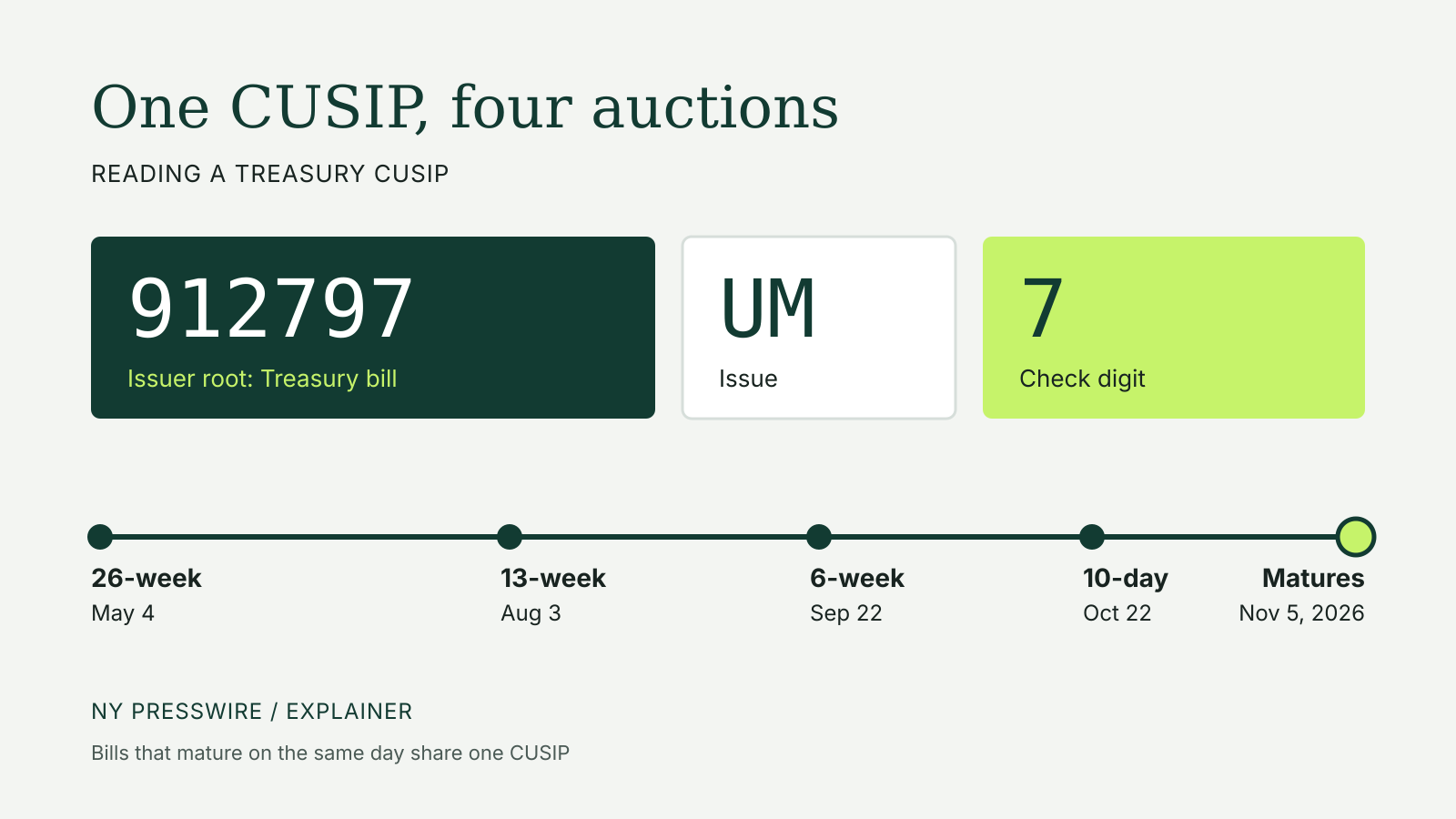
CUSIP Global Services, which assigns the codes, describes the structure as six issuer characters, two issue characters and one check character that “checks accuracy of the previous 8 characters” (CGS identifiers page). Read against a bill that matured today, November 5, 2026:
| Part | 912797UM7 | What it tells you |
|---|---|---|
| Issuer root (characters 1 to 6) | 912797 | A U.S. Treasury bill |
| Issue (characters 7 and 8) | UM | This particular bill among all bills with that root |
| Check digit (character 9) | 7 | Catches a mistyped code |
The issue characters carry no readable meaning. UM does not encode a date or a term; you need Treasury’s records to learn that 912797UM7 matured on November 5, 2026.
Which root belongs to which security
We pulled every auction record in TreasuryDirect’s securities data, which starts in 1979 and 1980, and grouped the CUSIPs by root. The dates are the first and last issue dates recorded for each root, checked November 5, 2026.
| Root | Used for | Issue dates in Treasury’s auction data |
|---|---|---|
| 912793 | Bills | January 1980 to June 1982 |
| 912794 | Bills | July 1981 to September 1998 |
| 912795 | Bills | January 1998 to September 2013 |
| 912796 | Bills | August 2011 to November 2024 |
| 912797 | Bills | January 10, 2023 to now |
| 912827 | Notes, first TIPS notes | November 1979 to May 2002 |
| 912828 | Notes, TIPS notes, FRNs | April 2002 to January 2022 |
| 91282C | Notes, TIPS notes, FRNs | July 31, 2020 to now |
| 912810 | Bonds, including TIPS bonds | November 1979 to now |
Each bill root overlaps the next for a year or two. The Federal Reserve Banks explained why when Treasury added 912797. Their Clearing Memo 277, dated November 2, 2021, said new bills could get either root from December 2021 because the assignment “is random,” and that 912796 would keep being used until its numbers ran out. In the auction data, the first 912797 bill was a 17-week bill issued January 10, 2023. The last new 912796 bill was issued January 4, 2024, and the last bill with that root, 912796ZV4, matured December 26, 2024.
One primary source has not caught up. TreasuryDirect’s Table of Treasury Securities still listed the bill roots as 912795 and 912796 when we checked on November 5, 2026. Neither root is on a bill that is still outstanding. If you are building a filter or a spreadsheet rule from that table, add 912797.
The same table lists 912820, 912821 and 912803 for principal STRIPS and 912833 and 912834 for interest STRIPS. Those are the codes a Treasury STRIPS position carries after a note or bond is split.
Why your 4-week bill says 17-week
Every bill that matures on the same day shares one CUSIP. When Treasury sells a shorter bill that matures on a date an older bill already uses, it reopens the older bill. TreasuryDirect says a reopened security has “the same CUSIP, maturity date, and interest payment dates as the original offering” but “a different issue date and usually a different price” (buying a marketable security).
912797UM7 shows the whole life of one bill. Treasury sold it four times:
| Auction | Sold as | High rate | Investment rate | Awarded |
|---|---|---|---|---|
| May 4, 2026 | 26-week | 3.610% | 3.728% | $81.9 billion |
| Aug 3, 2026 | 13-week | 3.750% | 3.838% | $99.3 billion |
| Sep 22, 2026 | 6-week | 3.870% | 3.942% | $80.1 billion |
| Oct 22, 2026 | 10-day cash management bill | 3.925% | 3.984% | $25.0 billion |
Figures from Treasury’s results for the 26-week, 13-week, 6-week and 10-day sales. Awarded amounts include Federal Reserve add-ons where Treasury reports them.
Someone who bought at the September auction holds a 6-week bill, yet the CUSIP’s record also shows the 26-week original from May. All four groups of buyers were repaid on the same day, November 5. What differed was the price each paid, so the rate in the row for your own auction is the one that applies to you.
How often a bill CUSIP is reused
UM7 is a typical case. We took the 106 bill CUSIPs that matured between November 5, 2025 and November 5, 2026. Treasury sold them at 331 auctions, and every regular weekly or four-weekly original was reopened later:
| Original term | Originals | Later sold as |
|---|---|---|
| 17-week | 52 | 8-week and 4-week, all 52 |
| 26-week | 40 | 13-week and 6-week, all 40; two also as cash management bills |
| 52-week | 13 | 26-week, 13-week and 6-week, all 13 |
| Cash management bill | 1 | Not reopened |
There are only 40 original 26-week bills in a year of weekly auctions because the other weeks’ 26-week bills matured on dates already held by a 52-week bill, so those auctions reopened the 52-week CUSIP instead. The median CUSIP in the set was sold three times.
This is why a bill you are about to buy may already have a CUSIP and a history. 912797WM5, a 26-week bill issued October 1, 2026, matures April 1, 2027. If Treasury follows the past year’s pattern, a 13-week bill maturing April 1 would be a reopening of WM5 rather than a new code. Treasury publishes the CUSIP of each upcoming bill in its Treasury CUSIP Release, which marks reopenings and gives the original issue date.
Checking the check digit
The ninth character follows the standard CUSIP modulus-10 rule. Convert letters to numbers (A is 10, B is 11 and so on to Z at 35), double every second value, add the digits of each result, and take the amount needed to reach the next multiple of 10.
For 912797UM, where U is 30 and M is 22:
| Character | 9 | 1 | 2 | 7 | 9 | 7 | U | M |
|---|---|---|---|---|---|---|---|---|
| Value | 9 | 1 | 2 | 7 | 9 | 7 | 30 | 22 |
| Doubled every second | 9 | 2 | 2 | 14 | 9 | 14 | 30 | 44 |
| Digits added | 9 | 2 | 2 | 5 | 9 | 5 | 3 | 8 |
The digits sum to 43. The next multiple of 10 is 50, so the check digit is 7, giving 912797UM7. We ran the same calculation on all 5,112 distinct CUSIPs in Treasury’s auction data for bills, notes, bonds, TIPS and FRNs, and every one matched its published ninth character. If a code you typed fails the check, a character is wrong.
Looking up a Treasury CUSIP
- Any security sold at auction since 1979: TreasuryDirect’s auction query filters by CUSIP and returns each sale with its term, dates and rates. Expect several rows for a bill.
- A bill or note not yet auctioned: the Treasury CUSIP Release linked above lists codes for announced auctions.
- This week’s bills: our Treasury bill calculator shows the latest auction for each term with its CUSIP, price and rates.
How a single auction sets the rate on these bills is covered in our guide to how Treasury bill auctions work.