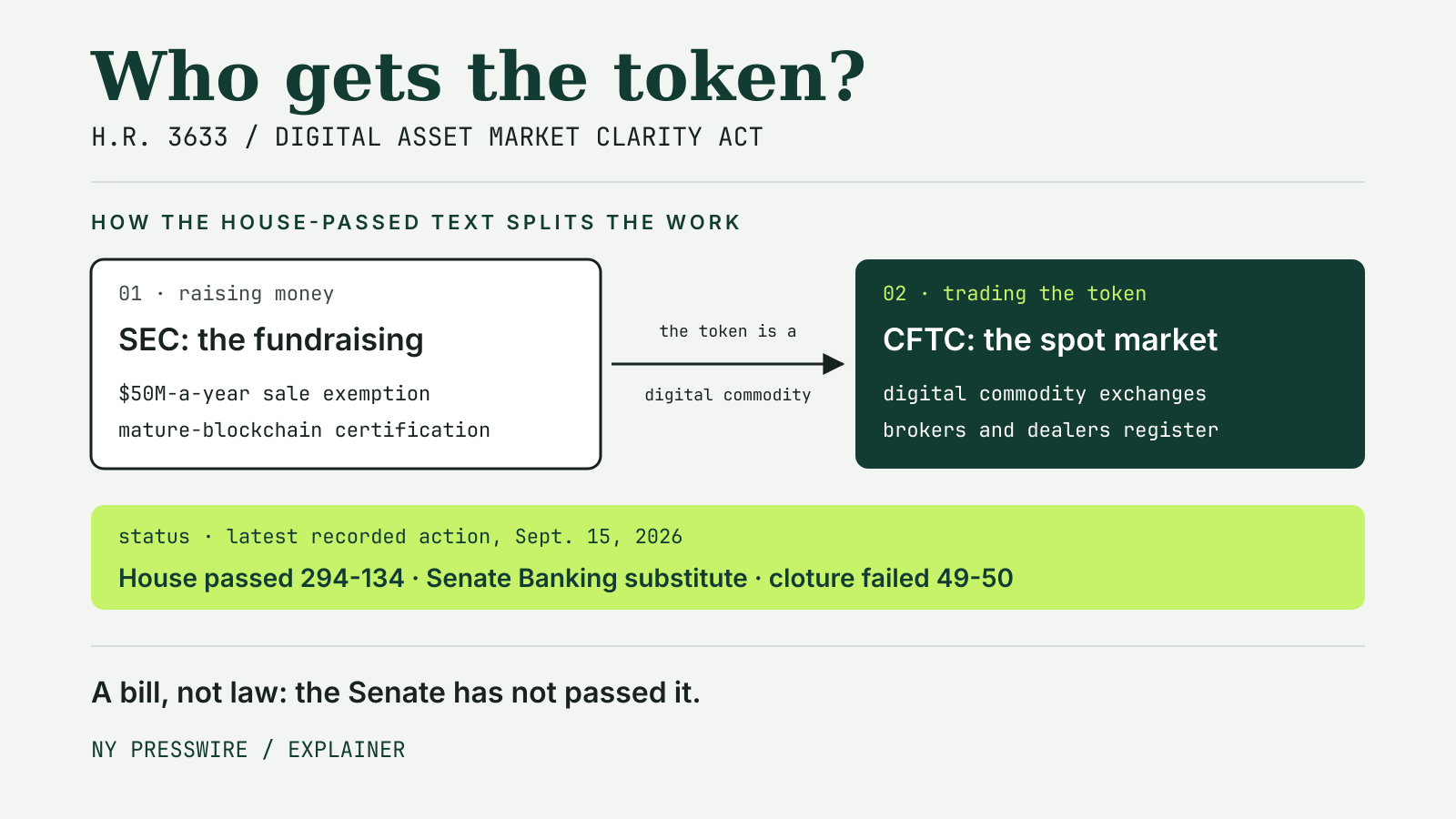
The CLARITY Act is Congress’s most advanced attempt to settle the question that runs through every crypto market structure fight: when a token changes hands, is the Securities and Exchange Commission or the Commodity Futures Trading Commission in charge? H.R. 3633, the Digital Asset Market Clarity Act, passed the House in July 2025. It has not passed the Senate. The latest action in the official bill status record is a failed September 15, 2026 vote to start Senate debate.
This explainer reads the bill text itself: the version the House passed and the substitute the Senate Banking Committee reported on June 1, 2026. None of it is law.
Where the bill stands
The bill status file published on govinfo records these steps:
- May 29, 2025: introduced and referred to the House Financial Services and Agriculture committees.
- June 23, 2025: reported by both committees (H. Rept. 119-168).
- July 17, 2025: passed the House, 294 to 134 (Roll no. 199).
- September 18, 2025: received in the Senate and referred to the Banking Committee.
- June 1, 2026: reported by Banking with an amendment in the nature of a substitute, after the committee ordered it reported on May 14; placed on the Senate calendar.
- August 8, 2026: motion to proceed made and cloture motion filed.
- September 15, 2026: cloture on the motion to proceed failed, 49 to 50 (Record Vote 234). Senator Tillis entered a motion to reconsider that vote.
The House design: token sales to the SEC, token trading to the CFTC
The House-passed text builds everything on a new Commodity Exchange Act term, “digital commodity”: a digital asset intrinsically linked to a blockchain system whose value comes, or is expected to come, from the use of that system. The bill lists what counts as intrinsic, such as a token generated by the network itself, used to pay fees, used in governance or paid to validators. It excludes instruments that give holders an interest in an issuer’s revenues, profits, debts or assets.
The SEC keeps the fundraising. Section 201 creates the “investment contract asset,” a digital commodity that can be held and transferred person to person without an intermediary and is sold under an investment contract, and it removes such assets from the meaning of “investment contract.” In practice, the deal that raises money can be a securities transaction while the token sold in it is not itself the security.
Section 202 adds a Securities Act exemption for an issuer’s own token sales. Its conditions include a cap of $50 million raised in any 12 months, adjusted for inflation; no buyer holding more than 10% of the outstanding units after the sale; and a blockchain that is either certified as “mature” or intended to become mature within four years.
“Mature” carries the weight. The bill defines a mature blockchain system as one not controlled by any person or group under common control. A new Section 42 of the Securities Exchange Act lets the issuer, related parties, a decentralized governance system or a registered digital commodity exchange certify maturity to the SEC. The certification takes effect after 60 days unless the SEC rebuts it or stays it, and one stay can add up to 120 days. The SEC must publish each certification and stay and send copies to the CFTC.
The CFTC gets the spot market. Section 404 requires any trading facility that offers a cash or spot market in at least one digital commodity to register with the CFTC as a digital commodity exchange, and gives the CFTC exclusive jurisdiction over registered exchanges for activities under the Commodity Exchange Act. Section 406 sets up the same registration for digital commodity brokers and dealers, and Section 405 defines qualified digital asset custodians.
The Senate Banking substitute: ancillary assets and network tokens
The Banking Committee’s version strikes the House text and starts over. Its Title I, called the Lummis-Gillibrand Responsible Financial Innovation Act of 2026, adds a Section 4B to the Securities Act.
Two terms do the work. A “network token” is a digital commodity intrinsically linked to a distributed ledger system that derives its value from that system’s use, and it is treated as a non-security under the securities laws. Tokens that carry debt or equity interests, liquidation rights, a right to payments from a person, or an interest in an investment company are excluded. An “ancillary asset” is a network token whose value depends on the entrepreneurial or managerial efforts of the party that launched it, its “ancillary asset originator,” or a related person, as the SEC will define by rule.
Sales of an ancillary asset by its originator count as offers of an investment contract, except “gratuitous distributions,” a category the text defines to include staking rewards and programmatic, rules-based distributions. Secondary trading in network tokens is treated as not involving a security unless the tokens move as part of a securities offering by the originator or an underwriter.
Originators owe initial and semiannual disclosures once they sell under a new SEC “Regulation Crypto,” a registration statement, a Regulation A offering or crowdfunding, or once the first U.S. public secondary offering occurs. Projects that raised $5 million or less in the first 12 months, or whose average daily U.S. spot trading is $5 million or less, are excluded. The disclosure duty ends when a certification takes effect stating, among other things, that no covered party has made more than nominal entrepreneurial or managerial efforts for 180 days. That is the Senate text’s counterpart to the House’s mature-blockchain test.
The Banking text does not contain the House bill’s registration regime for digital commodity exchanges, brokers and dealers. It refers to a Commodity Exchange Act definition of “digital commodity” and, in Section 902, directs the SEC to sign a memorandum of understanding with the CFTC on coordinated supervision, enforcement and information sharing. It would take effect 360 days after enactment, or later where a provision needs a final rule.
What it would mean for state law
The Senate text’s non-security treatment also reaches state requirements that are “functionally equivalent” to the federal securities provisions, where they restrict network tokens in ways not substantially similar to how the state treats commodities. That matters for state enforcers such as New York’s Attorney General, whose powers we covered in our explainer on the Martin Act in crypto cases. The bill does not name any state statute.
What to watch
The Senate could take up the motion to reconsider and vote on cloture again. Any Senate version would still have to be reconciled with the House-passed text before it could reach the President. If a version is enacted, much of the detail moves to SEC rulemaking: the definition of entrepreneurial or managerial efforts, coordinated control and Regulation Crypto itself. For the SEC’s current approach without new legislation, see our explainers on the 2026 crypto asset interpretation and the Regulation Crypto Assets proposal.