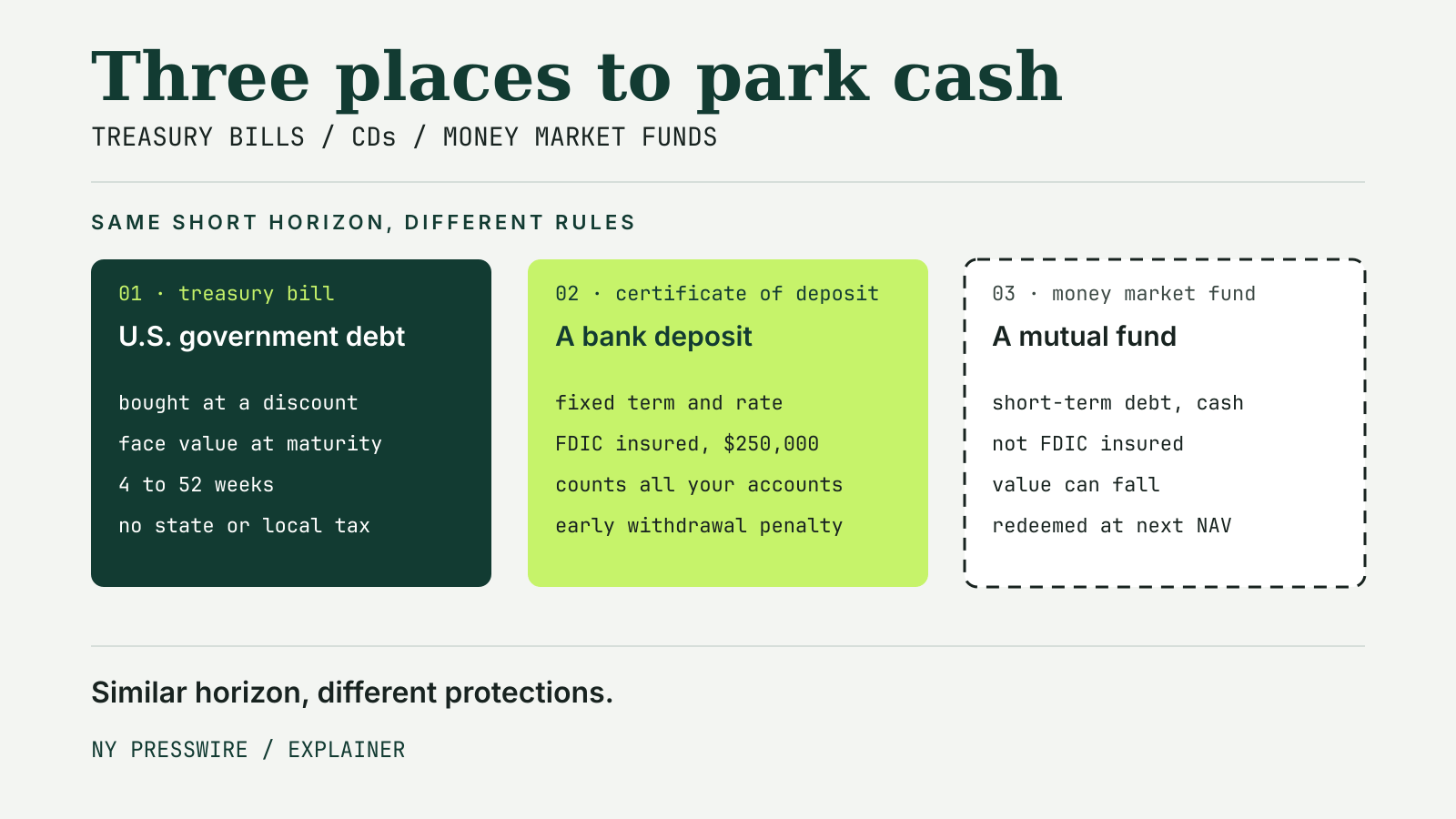
People comparing Treasury bills vs CDs usually want to know where cash can sit for a few months, and a money market fund often joins the list. The three rest on different legal promises: a Treasury bill is U.S. government debt, a certificate of deposit is a bank deposit, and a money market fund is a mutual fund that owns short-term debt. That difference decides what protects the money, how the interest is taxed and how quickly it can be reached.
This explainer covers the mechanics only. It does not quote current yields and it does not say which product suits any particular reader.
Treasury bills: a discount you collect at maturity
TreasuryDirect sells bills for terms of 4, 6, 8, 13, 17, 26 and 52 weeks. A bill is sold at a discount or at par, and at maturity the holder receives its face value. There is no coupon: for a bill, the “interest” is the difference between the price paid and the face value. The minimum purchase is $100, in $100 increments, and a noncompetitive bid can buy up to $10 million in one auction.
The rate is fixed at auction. Our explainer on how Treasury bill auctions work walks through that process, and the T-bill calculator turns a price into a discount rate and an investment rate using the latest auction results.
The tax treatment is the feature most often missed. TreasuryDirect states that federal tax is due on the interest, but there are no state or local taxes on it.
Getting out early is possible but not automatic. TreasuryDirect’s page on selling a marketable security says a sale has to go through a bank, broker or dealer. A bill bought in a TreasuryDirect account must stay there for 45 days before it can be sold or transferred, so a 4-week bill held in TreasuryDirect cannot be sold before it matures. A bill sold before maturity goes at the market price of the day, which can be above or below what the buyer paid.
CDs: a bank deposit with a term
The SEC’s Investor.gov describes a certificate of deposit as a savings account that holds a fixed amount of money for a fixed period, such as six months, one year or five years, in exchange for interest from the bank. At redemption, the holder gets the original deposit plus interest.
Because a CD is a deposit, deposit insurance applies. The FDIC lists CDs among the traditional deposit accounts it covers and says deposits are insured to at least $250,000 at each FDIC-insured bank. Investor.gov adds the detail that trips people up: the $250,000 covers all accounts in your name at the same bank, not each CD separately. The FDIC’s BankFind tool confirms whether a bank is insured.
Access is the trade-off. Investor.gov says a CD’s disclosure statement should give the maturity date, any penalties for early withdrawal, whether the rate is fixed or variable, and when interest is paid. The real cost of breaking a CD early sits in that document, not in the headline rate.
CD interest is taxable. The IRS lists interest on certificates of deposit among its examples of taxable interest in Topic 403, and says a person who receives $10 or more in interest should get a Form 1099-INT.
Investor.gov also flags brokered CDs, which are sold through brokerage firms or “deposit brokers.” It notes that deposit brokers are not licensed or certified and that no state or federal agency approves them, and it advises checking the background of both the issuing bank and the broker.
Money market funds: a fund, not a deposit
Investor.gov’s page on mutual funds describes money market funds as funds that invest in liquid, short-term debt securities, cash and cash equivalents, and notes that many investors use them to store cash or as an alternative to bank savings vehicles.
The legal category is what matters. The same page says mutual funds are not guaranteed or insured by the FDIC or any other government agency, and that investors can lose some or all of the money they put in. The FDIC lists mutual funds among the products it does not insure, even when a bank sells them. Fund shares are bought at the next calculated net asset value plus any purchase fees, and redeemed at the next net asset value minus any redemption fees.
Watch the names. The FDIC covers a money market deposit account, which is a bank deposit. A money market fund is not a deposit, even though the words overlap.
Side by side
| Treasury bill | CD | Money market fund | |
|---|---|---|---|
| What it is | Short-term U.S. government security | Bank deposit with a fixed term | Mutual fund holding short-term debt and cash |
| Protection | Issued by the U.S. Treasury | FDIC insurance to at least $250,000 per insured bank, counting all your accounts there | Not FDIC insured; value can fall |
| How you earn | Buy below face value, receive face value at maturity | Interest at the rate in the disclosure | Fund income; share value can change |
| Term | 4 to 52 weeks | Set by the bank, such as six months to five years | No maturity |
| Leaving early | Sell through a bank, broker or dealer; 45-day hold in TreasuryDirect | Early withdrawal penalty set in the disclosure | Redeem at next net asset value, minus any fees |
| Tax on interest | Federal yes; state and local no | Taxable interest | See the fund’s prospectus |
What to check before moving cash
- When might the money be needed, and can it wait until maturity?
- Is the product a Treasury security, a deposit or a fund?
- For a CD, what exactly is the early withdrawal penalty, and is the total at that bank under the insurance limit?
- For a bill, where will it be held, and how would it be sold if needed?
- For a fund, what do the prospectus and shareholder report say about fees and holdings?