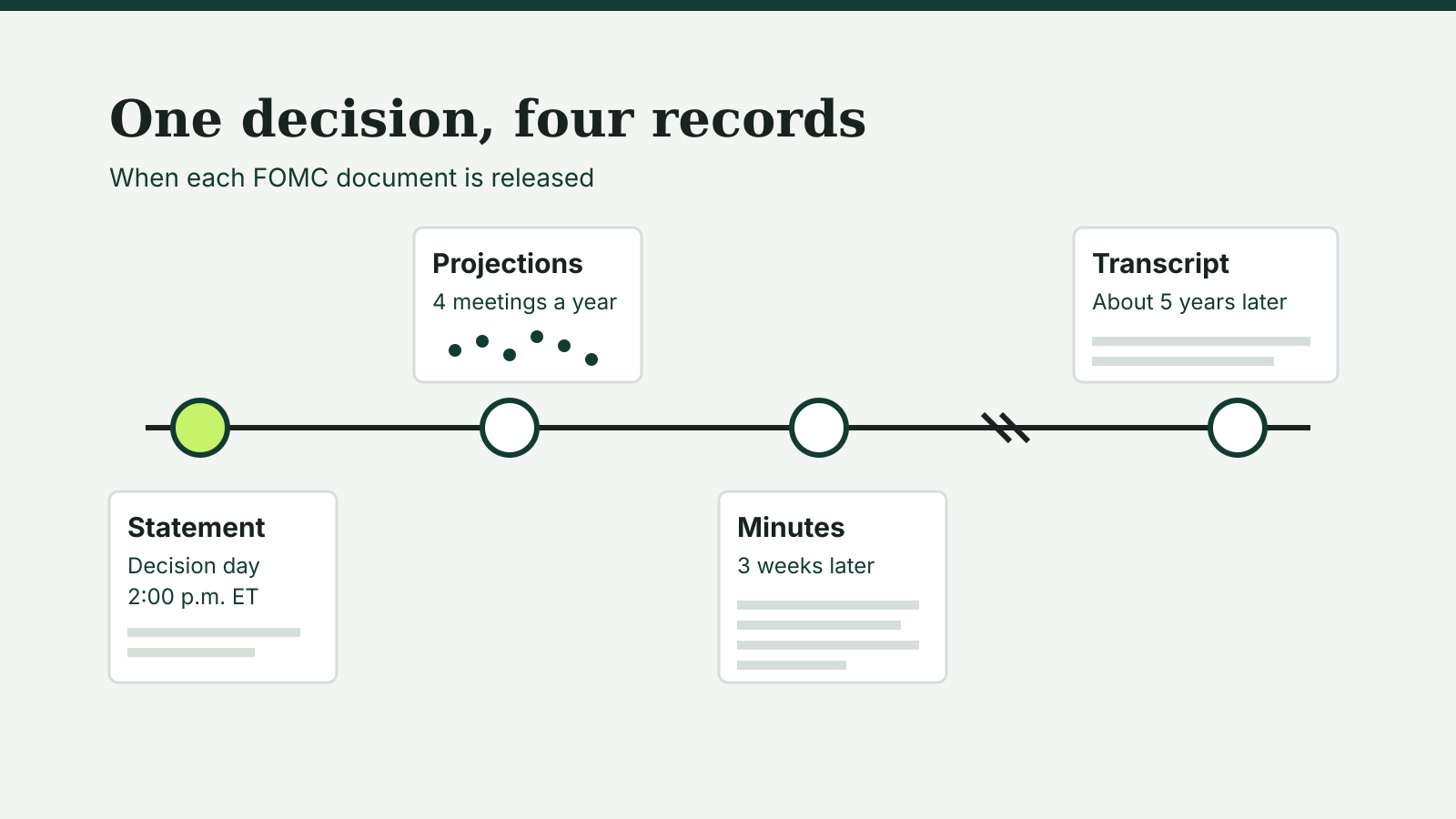
Every Federal Reserve rate decision produces several documents, and they do not arrive together. The statement comes out at 2:00 p.m. Eastern on decision day. The minutes follow three weeks later. Projections appear at only four meetings a year, and the full transcript waits about five years. Knowing the FOMC statement vs minutes difference, and where the projections fit, tells you which document can answer which question.
The Federal Open Market Committee holds eight regularly scheduled meetings a year. It has twelve voting members: the seven Fed governors, the president of the New York Fed and four of the other eleven Reserve Bank presidents on a rotating basis, according to the Fed’s FOMC page. The nonvoting presidents attend and take part in the discussion. That split between voters and participants shows up in every document below. For upcoming meeting dates, see our FOMC meeting schedule.
The statement: the decision, on the day
The statement is the Committee’s official account of its decision, approved by a vote of the members. The September 16, 2026 statement is a typical example of its scope. It was marked for release at 2:00 p.m. EDT, said it was approved by a 12–0 vote, gave the new target range for the federal funds rate and described economic activity, the labor market and inflation in a few sentences.
What the statement offers is precision about the decision itself. What it leaves out is the debate: there is no account of how many officials wanted a different move or why.
The statement travels with a companion document, the implementation note. The note for September 16 sets out the technical settings that put the decision into effect: the interest rate on reserve balances set by the Board of Governors, the directive to the New York Fed’s trading desk, the rates on standing repo and reverse repo operations and the primary credit rate. Anyone who models money market rates needs the note as well as the statement.
The calendar page lists a press conference for each 2026 meeting held so far, where the Chair answers questions on the day. It is an explanation of the decision by one official, not a document the Committee votes on.
The projections: four times a year
At four meetings a year, marked with an asterisk on the FOMC calendar, the release also includes the Summary of Economic Projections. In 2026 they are the March, June, September and December meetings.
The September 2026 projections show what the document contains. Each participant, voter or not, submits projections for real GDP growth, the unemployment rate, PCE inflation and core PCE inflation for each year through 2029 and over the longer run, along with the federal funds rate path they consider appropriate. Eighteen participants submitted in September.
Three details matter when reading the tables:
- These are individual views, not a Committee forecast. Each projection rests on that participant’s own idea of appropriate policy.
- The median is only the middle submission. The central tendency drops the three highest and three lowest projections; the range shows all of them.
- The rate projection is a midpoint. Each participant’s federal funds rate figure is the midpoint of the target range they see as appropriate at the end of each year. Plotted one dot per participant, these form the chart most readers call the dot plot.
The projections are released without names. The Fed says the compilation of individual projections, with randomized participant numbers, is published after about five years, and since March 2016 the key linking numbers to names is released with a five-year lag as well, according to its page on historical materials.
The minutes: the debate, three weeks later
The Fed releases the minutes of regularly scheduled meetings three weeks after the date of the policy decision. Before December 2004, they came out about three days after the following meeting.
The minutes summarize the whole meeting: market developments reported by the manager of the System Open Market Account, the staff’s review of the economy and financial conditions, the staff outlook, participants’ views and the Committee’s policy actions. They do not attribute views to named participants, except in the vote.
The minutes of the July 28–29, 2026 meeting, released August 19, show what they add to the statement:
- The size of the disagreement. “Most participants” supported holding the rate, while “several participants” favored a quarter-point increase.
- The roll call. Nine members voted to hold and three, named in the minutes, voted against, preferring an increase.
- Issues that never reached the statement. Participants discussed balance sheet policy, and the Chairman raised the idea of six scheduled meetings a year instead of eight. The minutes record that no decision was made and that any change would not affect the rest of 2026.
- The staff view. The staff saw risks to employment and growth as skewed to the downside and risks to inflation as skewed to the upside.
Words such as “several,” “some,” “many” and “most” do the work of numbers in the minutes. They describe the balance of opinion among all participants, not only voters, so they can differ from the vote count.
Transcripts and other records
The most detailed record is the transcript, produced from an audio recording and lightly edited. The Fed says transcripts, along with staff briefing documents and agendas, are made available with about a five-year lag. They matter to historians and researchers, not to anyone reacting to this year’s decisions.
Which document answers which question
| Question | Where to look | When |
|---|---|---|
| What did the Fed decide? | Statement | Decision day, 2:00 p.m. |
| What rates take effect, and when? | Implementation note | Decision day |
| How does the Chair explain it? | Press conference | Decision day |
| Where do officials see rates and inflation heading? | Summary of Economic Projections | Four meetings a year |
| How divided was the debate, and about what? | Minutes | Three weeks later |
| Who said what? | Transcript | About five years later |
Questions readers ask
Can the minutes contradict the statement?
The decision cannot change, but the minutes can show a split the statement does not describe, as the July 2026 minutes did.
Why do the projections include officials who do not vote?
The Summary of Economic Projections collects the views of all participants, including Reserve Bank presidents who are not voting members that year.
When are the minutes of the September 2026 meeting due?
Three weeks after the September 16 decision. Our FOMC meeting schedule keeps the meeting dates in one place.
Sources
- Federal Reserve: FOMC meeting calendars and information; Federal Open Market Committee; Transcripts and other historical materials.
- FOMC statement, September 16, 2026; Implementation note, September 16, 2026.
- Summary of Economic Projections, September 16, 2026.
- Minutes of the FOMC, July 28–29, 2026.
Sources reviewed October 4, 2026. This article explains Federal Reserve publications; it is not investment advice.