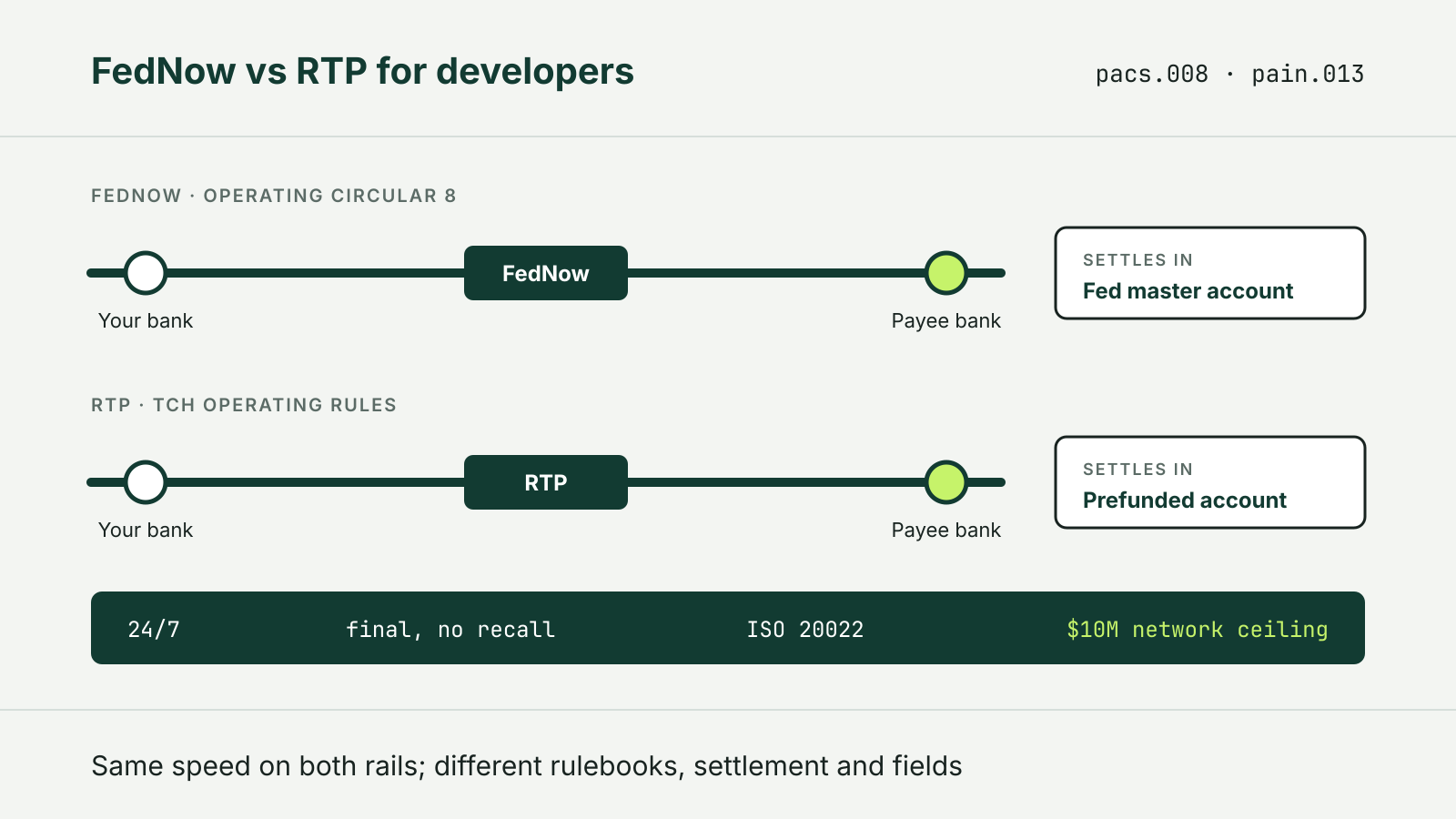
A product team that wants “instant payments” in the United States is really choosing between two interbank rails, or deciding to support both: the Federal Reserve’s FedNow Service and The Clearing House’s RTP network. For a developer, FedNow vs RTP is less a question of speed, since both settle in real time around the clock, than of rulebooks, message details and the bank that will carry your traffic. Those differences shape what an app can promise its users and what the integration has to handle.
Neither rail is something a fintech app calls directly. Both are networks for depository institutions, so your code talks to a bank, a processor or a payments platform that is a participant.
Two networks, two owners
RTP came first. The Clearing House launched it in 2017, and its FAQ says that in 2025, 98% of all US instant payments cleared and settled over RTP. Any federally insured depository institution can participate, and no ownership stake in The Clearing House is required. According to the network’s own page, it had more than 1,378 participants as of September 2026 and handled 150 million transactions worth $621 billion in the third quarter of 2026.
FedNow went live on July 20, 2023. The Federal Reserve’s launch announcement listed 35 early-adopting banks and credit unions, plus the Treasury’s Bureau of the Fiscal Service, and 16 service providers. By November 2025, Federal Reserve Financial Services reported more than 1,500 participants.
The participant counts and the volume figures measure different things, and a bank on one rail is not automatically on the other. That is the first practical issue: before promising an instant payout, an app has to know whether the receiving bank is on the rail its own bank uses. The Clearing House publishes a list of RTP-enabled routing numbers; FedNow offers participants a Participant List API, listed on its 2026 fee schedule at no charge.
Same speed, same finality
On the basics, the two rails behave alike.
Hours. FedNow’s rulebook, Operating Circular 8, gives the service “a 24-hour business day each day of the week.” RTP describes itself as available 24/7/365, including bank holidays and weekends.
Finality. Under Operating Circular 8, FedNow settlement is final at the earlier of when the service records the debits and credits and when it sends the receiving bank an advice of credit. RTP’s FAQ says settlement is “final and irrevocable” and that a sending bank cannot revoke or recall a payment once submitted.
Funds availability. Both rulebooks require the receiving bank to make funds available to the recipient immediately once it accepts the payment, subject to the exceptions each set of rules allows.
Limits. RTP lists a per-transaction limit of $10 million. FedNow raised its network limit from $1 million to $10 million in November 2025, according to the Fed’s fall announcements. A network figure is a ceiling, not a promise: an app’s real limit is whatever its bank allows.
For an app, the shared consequence that matters most is that there is no reversal. A payment sent to the wrong account cannot be pulled back by the sender’s bank. Both networks provide a message to request a return of funds, but the recipient’s bank answers it, and the payer’s money comes back only if that request succeeds.
Where the rulebooks differ
Who writes the rules. FedNow runs under a Federal Reserve operating circular issued under Regulation J, which binds participants the way the Fed’s other payment services do. RTP runs under The Clearing House’s Participation Rules and Operating Rules; the current Operating Rules took effect on October 4, 2026.
How money settles. A FedNow participant settles through a master account at a Reserve Bank, its own or a correspondent’s that agrees to the arrangement, under section 7 of Operating Circular 8. RTP settles against a prefunded balance account held for the joint benefit of its funding participants. Under the RTP Operating Rules, each sending participant must meet a prefunded requirement, directly or through a funding agent, before it can send. The Clearing House’s prefunding reference sheet adds that participants are expected to keep a position adequate for their expected RTP activity during Fedwire Funds off-hours.
Naming the payer. RTP has detailed payment transparency rules. A June 2026 compliance bulletin reminds participants that the debtor name field must carry the sender’s legal name, that payments made on behalf of another party must also name that payer, and that name fields generally cannot hold an email address, handle or reference number. A temporary exception lets account-validation payments carry a verification code in the debtor name field through January 31, 2027; from February 1, 2027, that code must move to the unstructured data field.
Price. Both networks charge the sending bank $0.045 per credit transfer and $0.01 per request for payment, according to the RTP fee schedule effective January 2025 and the FedNow 2026 fee schedule. RTP adds a $0.10 incentive fee that the bank initiating a request for payment owes the bank that pays it, and it says receiving banks pay no network fees. FedNow lists a monthly participation fee of $25 per routing number, discounted to zero in 2026, and a $1.00 fee for liquidity management transfers.
What this means for an integration
Both networks use ISO 20022 messages. FedNow’s fee schedule names them: pacs.008 for a customer credit transfer, pacs.004 for a return, pacs.009 for a liquidity management transfer and pain.013 for a request for payment. That gives developers a common vocabulary, but each network publishes its own message specifications, and code written for one should be checked against the other’s.
A few practical checks follow from the rulebooks:
- Reachability before promise. Check the receiving routing number against the rail before telling a user a payout will be instant, and decide what happens when it is not reachable.
- Names that match the account. Pass the payer’s legal name, not a username or email, so the payment meets RTP’s transparency rules.
- No reversal path. Confirm recipient details before sending, because neither network lets the sender undo a payment. Our explainer on idempotency keys in a payment API covers how to retry a timed-out request without sending twice.
- Requests for payment. Both rails carry them, and FedNow’s circular classifies them as nonvalue messages. Treat a request for payment as a prompt, not a debit: the payer’s bank still has to send a credit transfer.
- Limits below the ceiling. Read your bank’s own limits, not the $10 million network maximum.
For dated changes to the payment APIs built on these rails, see our payment API changelog tracker.
Sources
- Federal Reserve: FedNow Service is now live (July 20, 2023)
- Federal Reserve Banks: Operating Circular No. 8, Funds Transfers Through the FedNow Service (effective April 1, 2026)
- Federal Reserve Financial Services: FedNow Service 2026 fee schedule
- Federal Reserve Financial Services: FedNow Service fall announcements (November 2025)
- The Clearing House: RTP network
- The Clearing House: RTP frequently asked questions
- The Clearing House: RTP Operating Rules (effective October 4, 2026)
- The Clearing House: RTP Compliance Bulletin 2-2026, Payment Transparency Rules
- The Clearing House: RTP prefunded requirement reference sheet (January 2022)
- The Clearing House: RTP participant fee schedule (effective January 1, 2025)