New York has no statute written for crypto trading platforms, yet its attorney general has shut some of them out of the state, forced refunds and won settlements reaching into the billions. Most of that work runs through the Martin Act, a securities and commodities fraud law in Article 23-A of the state’s General Business Law. Understanding how the Martin Act reaches crypto explains why offshore platforms block New York users, why marketing copy gets scrutinized, and why state attorneys general are pushing back on federal market-structure legislation in 2026.
This explainer covers what the law lets the attorney general do, how New York courts and settlements have applied it to tokens, and what is at stake in the current fight over federal preemption.
What the Martin Act covers
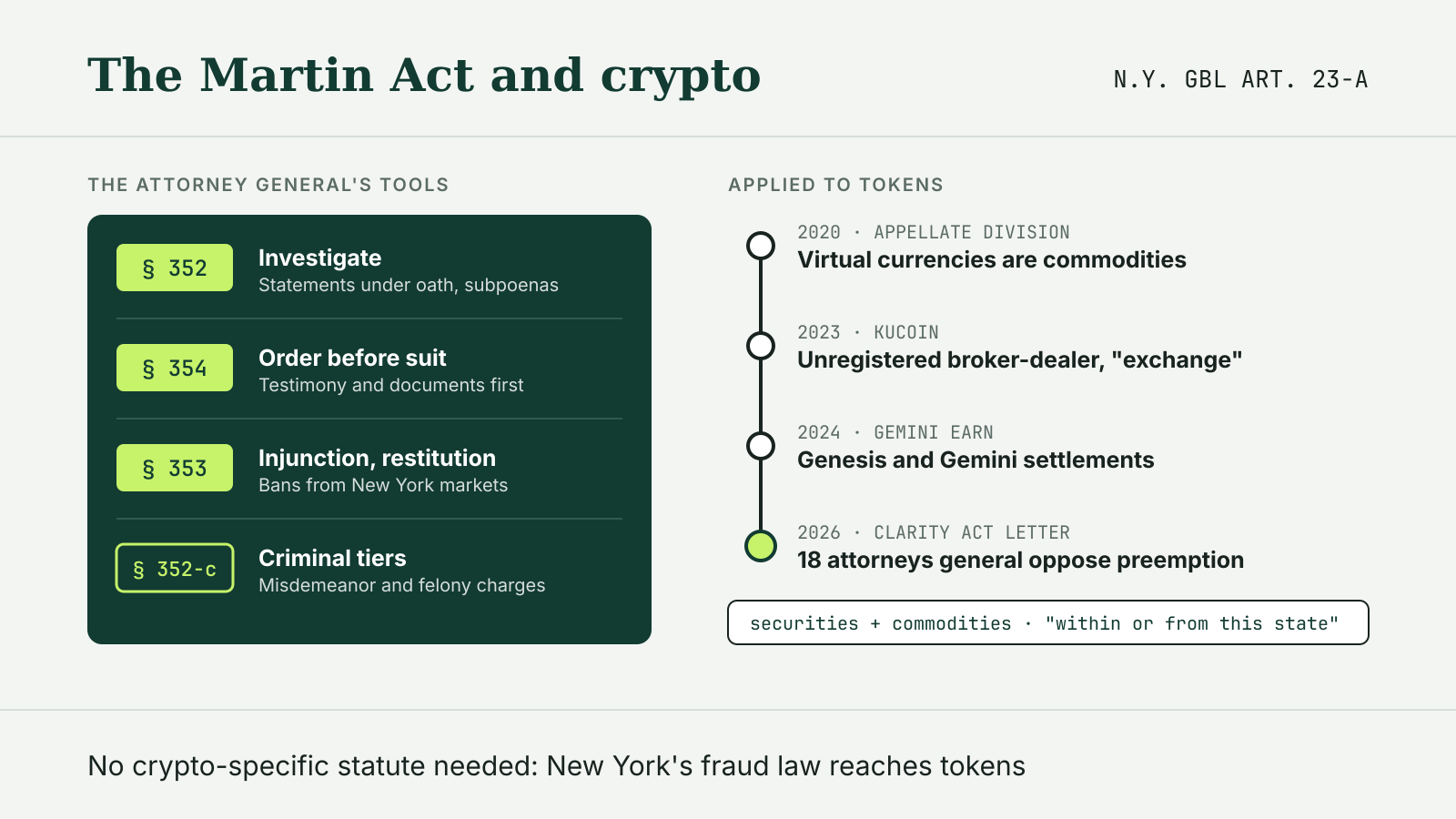
The core provision, General Business Law Section 352, lets the attorney general investigate fraud in the purchase or sale within the state of commodities “dealt in on any exchange” in the United States, and in the issuance, sale, promotion, advertisement or investment advice “within or from this state” of stocks, notes, evidences of interest and other securities. The list of what counts as a fraudulent practice is long: any device, scheme or artifice to defraud, any deception, misrepresentation, concealment or false promise, and fictitious purchases or sales.
Two features matter most for crypto. First, the statute covers commodities as well as securities, so the state does not have to win the federal argument over whether a given token is a security. Second, it reaches conduct “within or from” New York, which the attorney general has used against platforms based elsewhere that served New York customers.
How New York courts fit tokens into the statute
The key ruling came out of the attorney general’s investigation of iFinex, the operator of Bitfinex, and Tether. According to the attorney general’s February 23, 2021 announcement, the office obtained an injunction in April 2019 under Section 354 of the Martin Act, and a July 2020 decision by the Appellate Division, First Department, held that:
- virtual currency platforms operating from anywhere in the world remain subject to the attorney general’s jurisdiction if they do business in New York;
- the stablecoin tether and other virtual currencies were “commodities” under Section 352, and virtual currencies may also be securities under the act;
- the office had shown enough to uphold the injunction and require documents before filing a formal suit.
The 2021 agreement required Bitfinex and Tether to stop trading activity with New Yorkers, submit to reporting requirements and pay $18.5 million in penalties.
The attorney general’s tools
The Martin Act gives the attorney general unusually strong investigative and civil powers.
Investigation before any lawsuit. Section 352 lets the office require written statements under oath, subpoena witnesses and demand books and papers. Section 354 lets it ask a state Supreme Court justice, before filing an action, for an order compelling people to answer questions and produce documents, and says it is the justice’s duty to grant the application.
Refusal carries a cost. Under Section 353, if a defendant or an officer refuses to be sworn, answer a material question or produce a relevant document when ordered, that refusal is prima facie proof of fraudulent practices, and a permanent injunction may issue without further showing.
Civil remedies. Section 353 also authorizes injunctions, permanent bans on selling securities to the public in New York, and restitution of money or property obtained through a fraudulent practice.
Criminal liability without proof of knowledge at the lowest tier. Section 352-c makes it a misdemeanor to make a false representation to promote a sale of securities or commodities where the speaker knew the truth, could have known it “with reasonable effort,” made no reasonable effort to find out, or had no knowledge about the statement at all. Felony charges require more: a class E felony under subdivision 5 requires an intentional scheme to defraud ten or more people.
A rule about the word “exchange.” The same section bars anyone selling securities or commodities within or from New York from calling itself an “exchange” unless it is registered with the SEC as a national securities exchange or designated by the CFTC as a contract market.
Registration: the KuCoin case
The Martin Act also requires securities brokers and dealers to register with the state, under definitions in Section 359-e. That requirement, plus the “exchange” rule, was the basis for the attorney general’s case against KuCoin.
In its December 12, 2023 announcement, the office said an investigator had opened a KuCoin account from a New York IP address and traded tokens including ETH, LUNA and UST. It said KuCoin failed to register as a securities and commodities broker-dealer and called itself an exchange without SEC registration or CFTC designation. The consent order required more than $16.7 million in refunds to New York investors and more than $5.3 million paid to the state, barred KuCoin from trading securities and commodities in New York, and required it to block New Yorkers from its platform.
The lesson for platforms is practical: geofencing that does not actually stop New York users can leave a company exposed, regardless of where it is incorporated.
Fraud claims: the Gemini Earn litigation
The Martin Act’s fraud provisions drove the largest crypto recovery in the state’s history. In October 2023, the attorney general sued Gemini, Genesis and Digital Currency Group, alleging that Gemini misled investors about the risks of the Gemini Earn program and that Genesis and DCG concealed more than $1.1 billion in losses.
Genesis settled in a deal the office valued at up to $2 billion for a victims’ fund, approved in bankruptcy court and announced on May 20, 2024; Genesis neither admitted nor denied the allegations and was banned from operating in New York. Gemini settled on June 14, 2024, agreeing to return about $50 million in digital assets to Earn investors and accepting a ban on running a crypto lending program in New York.
More recent New York Attorney General crypto resolutions are logged in our enforcement tracker, including the Galaxy Digital settlement over Luna promotion and the Uphold settlement.
The Martin Act is not a license
The Martin Act is an enforcement statute run by the attorney general. Licensing of crypto businesses in New York sits with the Department of Financial Services, through the BitLicense or a limited purpose trust charter, which we compare in BitLicense vs trust charter. A firm can hold a DFS license and still face a Martin Act fraud claim: Gemini, a New York-based platform, was a defendant in the Earn case.
Why the Clarity Act matters to the Martin Act
On September 14, 2026, Attorney General James led 18 attorneys general, including her own office, in a letter to the leaders of the Senate Banking Committee opposing the Digital Asset Market Clarity Act as written. The office said the bill would let the SEC preempt state registration authorities and give the SEC discretion to reset the scope of federal preemption. The attorneys general asked Congress to preserve states’ enforcement role for tokenized and non-tokenized securities, codify states’ role as crypto regulators and keep state registration regimes.
If federal law narrowed state registration powers, the registration side of the Martin Act, the side used against KuCoin, would be the most directly affected. The attorneys general’s stated concern also extends to their anti-fraud work, which they argue the bill’s ambiguous language could complicate.
This article explains how the statute works. It is not legal advice about any particular business.
Sources
- New York General Business Law Section 352, Section 352-c, Section 353, Section 354 and Section 359-e
- NY Attorney General: Bitfinex and Tether agreement (February 23, 2021)
- NY Attorney General: KuCoin consent order (December 12, 2023)
- NY Attorney General: lawsuit against Gemini, Genesis and DCG (October 19, 2023)
- NY Attorney General: Genesis settlement (May 20, 2024)
- NY Attorney General: Gemini settlement (June 14, 2024)
- NY Attorney General: Clarity Act letter announcement (September 14, 2026)