The crypto wash sale rule question starts with the wording of the tax code. Section 1091 of the Internal Revenue Code disallows a loss on a sale of “stock or securities” when the seller acquires substantially identical stock or securities within 30 days before or after the sale. The IRS, for its part, treats digital assets as property. Those two facts explain why the rule is usually discussed differently for a token held as property than for a share of stock.
This explainer walks through what the statute says, what current IRS guidance and Form 1099-DA instructions say about digital assets, and where the analysis changes. It describes published rules, not a trading strategy or individual tax advice.
What section 1091 actually says
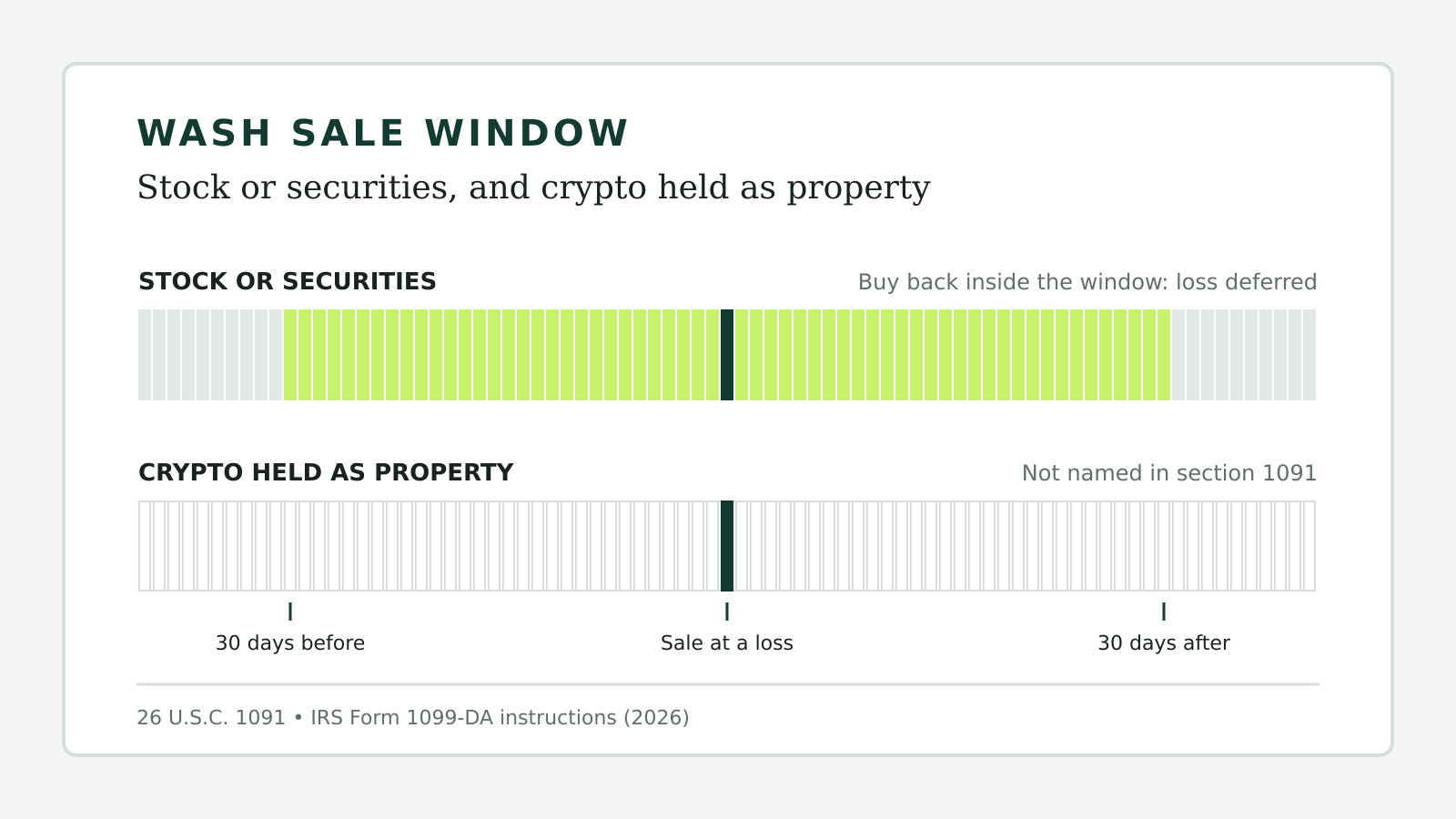
The text of 26 U.S.C. 1091 in the official 2024 edition of the US Code is built around stock or securities. Under subsection (a), no deduction is allowed for a loss from selling or otherwise disposing of shares of stock or securities if, within a period beginning 30 days before the sale and ending 30 days after it, the taxpayer acquired, or entered into a contract or option to acquire, substantially identical stock or securities. Dealers in stock or securities are excepted for losses in the ordinary course of that business.
The same subsection says “stock or securities” includes contracts or options to acquire or sell stock or securities, except as regulations provide. Later subsections cover short sales and securities futures contracts to sell, and say the rule still applies when such a contract or option settles in cash.
The window therefore spans 61 days: the 30 days before the loss sale, the sale date and the 30 days after it.
What happens to a disallowed loss
A wash sale does not erase the loss permanently for stock or securities. Subsection (d) sets the basis of the replacement shares by reference to the basis of the shares sold. IRS Publication 550 puts it in practical terms: add the disallowed loss to the cost of the new stock or securities, which postpones the deduction until the new position is sold. The holding period of the new shares also includes the holding period of the shares sold.
Publication 550 gives an example. A taxpayer buys 100 shares for $1,000, sells them for $750 and buys 100 shares of the same stock for $800 within 30 days. The $250 loss is not deductible on the sale, and the basis of the new shares becomes $1,050.
The publication also lists situations that count as wash sales for stock: buying substantially identical stock for an IRA or Roth IRA, and a purchase by the taxpayer’s spouse or by a corporation the taxpayer controls.
How the IRS classifies digital assets
The IRS has treated virtual currency as property since Notice 2014-21, which says general tax principles applicable to property transactions apply. Its current digital asset FAQs repeat that digital assets are treated as property, and that selling digital assets for US dollars produces a capital gain or loss subject to any limits on deducting capital losses. The IRS digital assets page states it plainly: for US tax purposes, digital assets are considered property, not currency.
Property is a broader category than stock or securities. Section 1091 names stock or securities, and the IRS guidance above describes cryptocurrency as property. That gap is the basis for the common observation that the 30-day disallowance, as written, is aimed at securities rather than at a token that is only property.
Where Form 1099-DA draws the line
Broker reporting shows how the IRS applies that distinction in practice. The 2026 Instructions for Form 1099-DA include box 1i, “Wash Sale Loss Disallowed.” The instructions say losses from wash sales of tokenized securities must be reported, and they limit the required reporting to tokenized securities treated as stock or securities under section 1091 when the sale and repurchase occur in the same account with the same CUSIP number.
The instructions’ example follows a customer who buys 100 units of a tokenized security for $1,000 in September 2026, sells them for $600 in October and buys 75 units with the same CUSIP in the same account within 30 days. Of the $400 loss, $300 is disallowed and added to the basis of the 75 new units.
Nothing in that box asks brokers to compute a wash sale adjustment for a digital asset that is not a stock or security. Our guide to Form 1099-DA covers the rest of the form.
The analysis changes when the asset is a security
The label “crypto” does not settle the question. A token that is a security for tax purposes, such as the tokenized security in the IRS example, falls inside section 1091’s wording. Whether a particular token is a security is a separate legal question; our explainer on the SEC’s 2026 crypto asset interpretation shows how the securities regulator approaches it, and that framework is not the same thing as the tax definition.
Products that hold crypto but are themselves stock or securities raise the same issue. Before applying any rule of thumb, identify exactly what was sold and exactly what was bought back.
Other loss rules still apply
Falling outside section 1091 does not make every loss deductible. Publication 550 describes a separate related-party rule: a loss on a sale or trade of property is not deductible if the transaction is directly or indirectly between the taxpayer and certain related parties, including a spouse, siblings, ancestors and lineal descendants, and corporations or partnerships in which the taxpayer owns more than 50%. That rule is written for property generally.
Capital loss limits, holding-period rules and accurate lot identification also continue to apply. Our guide to crypto cost basis wallet by wallet explains how lots are tracked by account, which determines which units a sale removes and what loss, if any, it produces.
Tax law can change. Section 1091’s reach depends on the statute Congress writes, so check the current text and the instructions for the tax year being filed rather than relying on a past year’s summary.