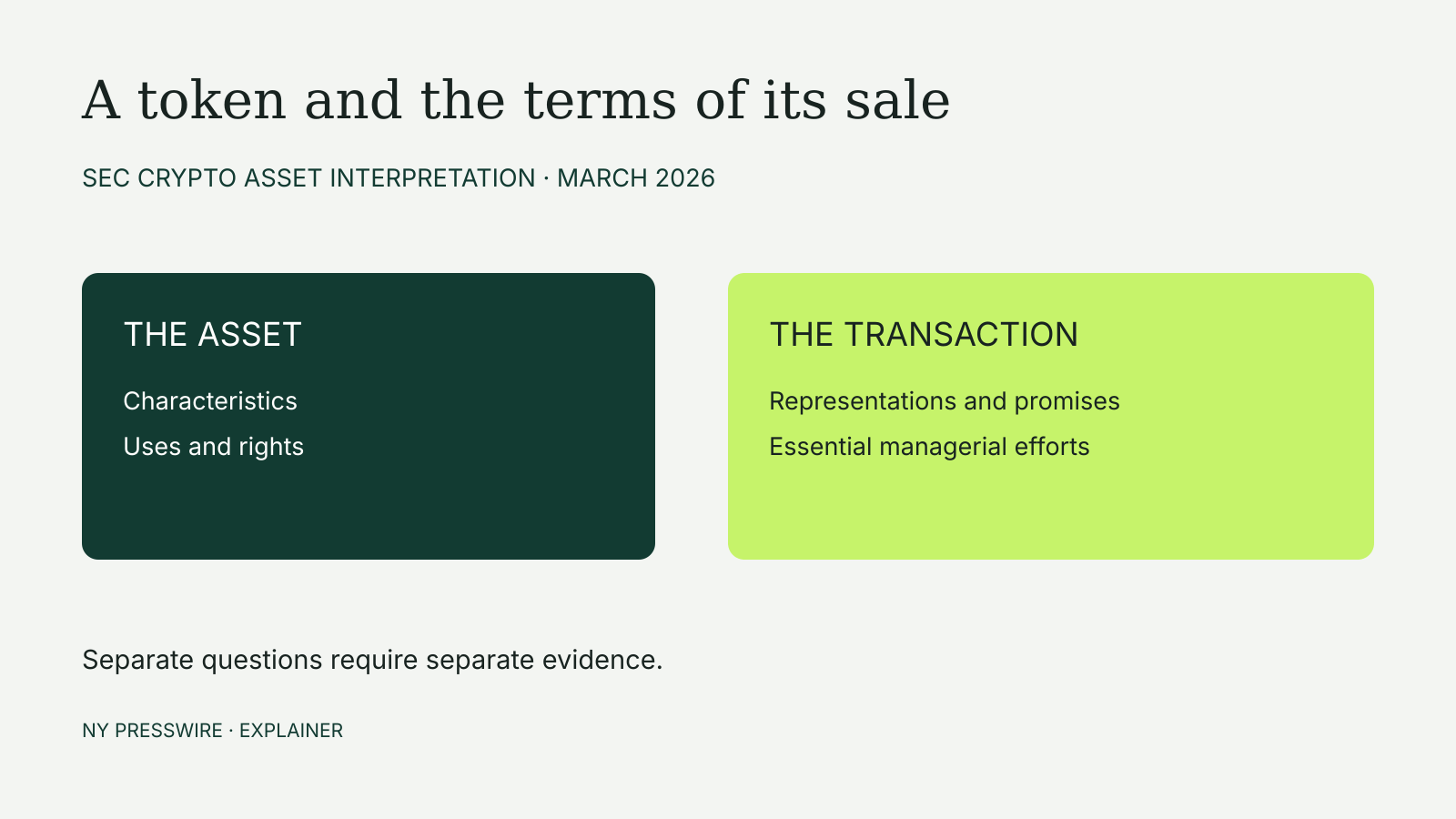
The SEC crypto asset interpretation of 2026 separates the status of a token from the circumstances in which it is offered or sold. That distinction matters when reading claims that a crypto asset is “not a security”: the asset and an investment contract associated with it are different questions.
What the SEC issued in March
The SEC announced the interpretation on March 17, 2026. The CFTC joined with guidance on administering the Commodity Exchange Act consistently with it. This is a Commission interpretation, rather than a company opinion or a statement by an individual member of staff.
The release page identifies file S7-2026-09 and release numbers 33-11412 and 34-105020. It gives March 23, 2026 as the effective date and Federal Register publication date. The explanatory material below was checked against those documents on October 6, 2026.
Those identifiers make a useful reference when checking another source’s claim. A commentary may discuss the announcement, the adopted interpretation, a later staff answer or a proposed change. They have different authors and roles. Follow the link to establish which document the commentary actually relies on.
The taxonomy has five categories
The SEC’s fact sheet describes five groups: digital commodities, digital collectibles, digital tools, stablecoins and digital securities. Its stablecoin statement specifically refers to payment stablecoins issued by permitted issuers under the GENIUS Act. It should not be shortened into a statement that every token called a stablecoin has the same treatment.
Digital securities remain securities. Recording ownership through a crypto network does not by itself remove an instrument from that category. At the other end, a practical token such as a credential belongs to a different part of the taxonomy.
For a reader assessing a product, the name chosen by its promoter is a starting point for questions. Ask what rights the holder receives, what the token does and what the purchase agreement says. A label such as “utility” cannot replace that description. Keep the product’s own claims separate from the regulator’s categories.
An asset and its sale can require separate analysis
The fact sheet explains that an issuer can offer a non-security crypto asset in circumstances creating an investment contract: an investment in a common enterprise, accompanied by representations or promises of essential managerial efforts from which a purchaser reasonably expects profits.
That makes the sales materials relevant alongside the token’s technical properties. An account of how a network functions answers one question. A promise about what a development team will build with buyers’ money answers another.
An illustrative document review would therefore collect the purchase agreement, launch materials, project roadmap and relevant communications together. This is a way to organise evidence, not a legal conclusion about a fictional or real offering. Record who made each representation and when. Preserve the exact version being evaluated so that later edits do not silently change the review.
The distinction also helps with news headlines. A statement about the underlying asset need not answer whether a particular offer, package or arrangement involves a security. Ask which of those propositions the cited source supports before repeating it.
The associated investment contract can end
The full interpretation addresses how an associated investment contract can terminate. Its discussion includes fulfillment of the issuer’s promised essential managerial efforts and failure or abandonment addressed under the conditions in the release. This is a factual analysis of the relationship, rather than a calendar rule under which a token automatically changes status.
The release says an issuer can remain liable for material misstatements or omissions despite the associated contract ending. It also explains that a subsequent offer can create a new investment contract. Completing one set of promises therefore does not settle every possible future transaction.
For someone researching a project’s chronology, an evidence table can help: list the representation, its date, the promised work and the material showing what happened. Mark conclusions that require further analysis. A roadmap checkbox or social-media claim may warrant investigation, but the review still needs the basis for deciding whether the relevant promises have been fulfilled.
Do not confuse the possible end of an investment contract with a guarantee of liquidity, reliability or value. Those are separate product and market questions. A regulatory classification does not answer whether a service can return funds or whether a holder can sell an asset at an expected price.
Mining, staking, wrapping and airdrops
The interpretation addresses specified forms of protocol mining, protocol staking and wrapping, as well as certain airdrops. The details of the arrangements matter; a marketing phrase is not enough to establish that a service matches the described activity.
For example, its discussion of custodial protocol staking describes restrictions on how deposited assets are used. A reader assessing an intermediary should compare the actual custody and use terms with the relevant section of the release. A service combining staking with lending or another activity needs its own analysis.
That produces a practical reading order: identify the precise activity in the product terms, find the matching section of the interpretation, then examine its assumptions and limits. Avoid extrapolating from one named mechanism to a package containing several mechanisms.
What the interpretation does not settle for a reader
An SEC classification does not provide a complete description of a provider’s permissions. New York licensing, for example, is a separate question. Our BitLicense and trust-charter explainer describes those routes; the site’s license directory links the underlying official records.
Custody and reserve evidence deserve separate examination too. If a product depends on an issuer holding assets, read the scope and date of its evidence using the reserve-report guide. A label alone cannot establish what assets are held, which obligations are covered or what a customer can redeem.
When checking a claim about the March interpretation, retain four things: the precise proposition, the official passage supporting it, the transaction to which it is being applied and any unresolved factual condition. That record makes the claim reviewable. It also makes it easier to spot a conclusion that has become broader than its source.