Before 2025, US crypto exchanges had no dedicated IRS form for reporting what their customers sold. Form 1099-DA, Digital Asset Proceeds From Broker Transactions, fills that gap. The first forms covered sales made in 2025 and went out in early 2026. For sales made from January 1, 2026, the form also carries cost basis for many assets, so the forms that report 2026 sales will contain more than the first ones did.
This explainer covers who files Form 1099-DA, what each part of the form reports, which assets and transactions are left out, and what changes between the 2025 and 2026 versions. It describes the reporting rules, not how any individual should file a return.
Where the form comes from
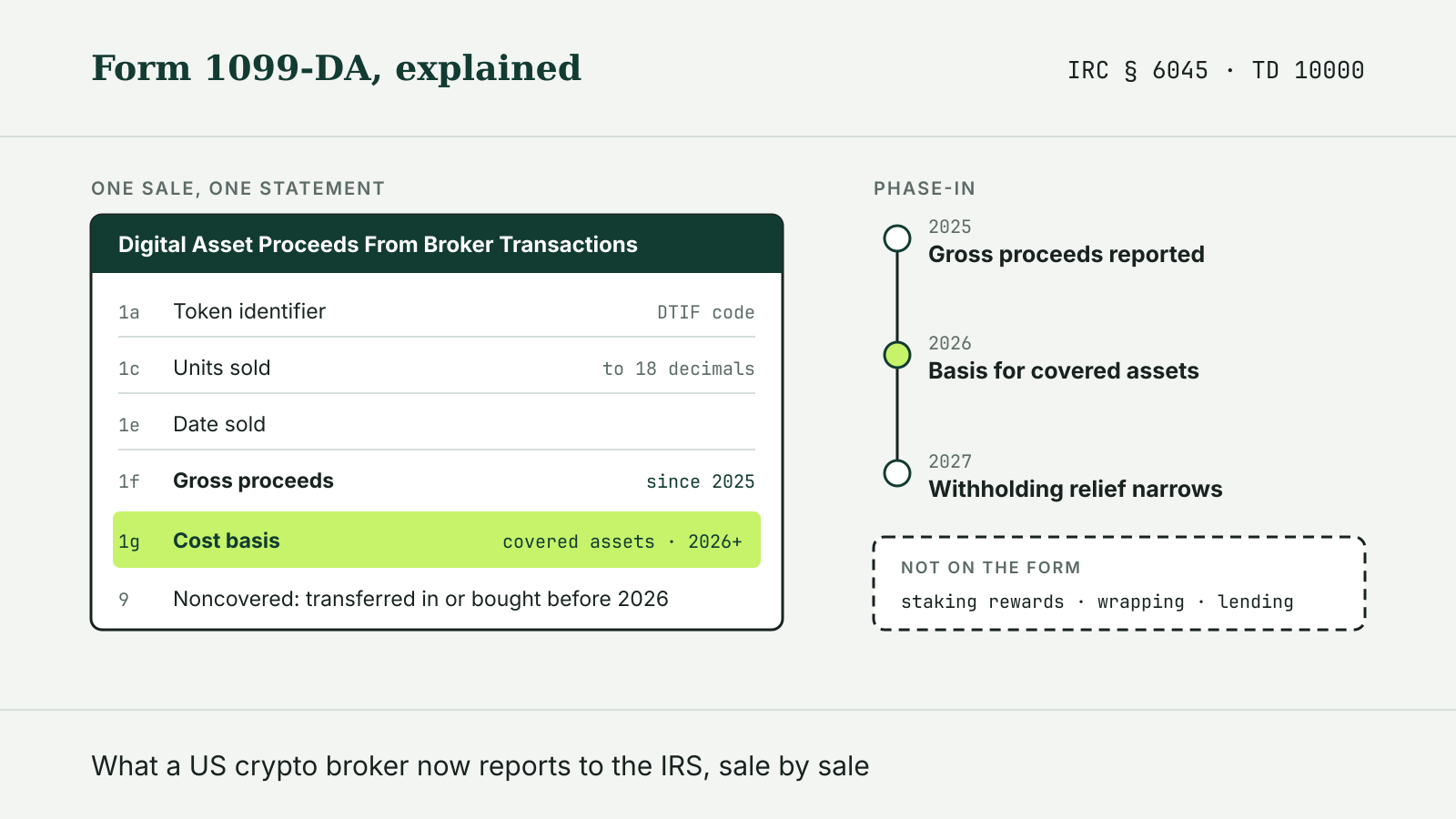
The requirement comes from changes to Internal Revenue Code section 6045 made by the Infrastructure Investment and Jobs Act, signed in late 2021. Treasury and the IRS issued final broker regulations in Treasury Decision 10000, published July 9, 2024. The IRS digital assets page sets out the phase-in:
- Brokers report gross proceeds for transactions on or after January 1, 2025.
- Brokers report basis on certain transactions on or after January 1, 2026.
- Real estate professionals treated as brokers report the fair market value of digital assets used in closings on or after January 1, 2026.
For tax purposes the IRS treats digital assets as property, not currency. The form covers any digital representation of value recorded on a cryptographically secured distributed ledger that is not cash, which takes in cryptocurrencies, stablecoins and NFTs.
Who files a 1099-DA
The 2026 Instructions for Form 1099-DA define a broker as anyone who, in the ordinary course of business, stands ready to effect sales of digital assets for others. Generally only a US digital asset broker has to file. The IRS lists the businesses the final rules reach: operators of custodial trading platforms, certain hosted wallet providers, digital asset kiosks and certain processors of digital asset payments.
The rules also name a “digital asset middleman”: a business that accepts digital assets as payment for securities or broker services, runs crypto kiosks, or processes digital asset payments while knowing what the transaction is. Two roles are expressly not brokers on that basis: validators who only provide proof-of-work or proof-of-stake validation, and companies that only sell or license hardware or software that lets users control their own private keys.
The IRS page states that the final regulations do not include reporting rules for decentralized or non-custodial brokers that never take possession of the assets being sold.
What the form reports
Each sale usually gets its own Form 1099-DA. The instructions fix the main boxes:
| Box | What it holds |
|---|---|
| 1a, 1b | Digital token identifier from the Digital Token Identifier Foundation, or 999999999 if unregistered, and the asset’s name |
| 1c | Number of units sold |
| 1d, 1e | Date acquired and date sold |
| 1f | Gross proceeds |
| 1g | Cost or other basis |
| 1i | Wash sale loss disallowed (tokenized securities) |
| 4 | Federal income tax withheld (backup withholding) |
| 8 | Broker relied on customer-provided acquisition information |
| 9 | Asset is a noncovered security |
| 12a, 12b | Units transferred in, and transfer-in date |
A one-letter code also tells the recipient which Form 8949 box applies: G or J for short-term or long-term sales with basis reported to the IRS, H or K when basis is not reported, and Y when the holding period is unknown.
Covered and noncovered: why basis is often blank
Basis reporting depends on whether an asset is a covered security. Under the instructions, that means a digital asset acquired after 2025 in an account where the broker provided custody, and held in that account until the broker sells it. Everything else is noncovered, including any asset acquired before 2026 and any asset transferred in from another wallet or platform.
For noncovered assets the broker does not have to report basis. If it checks box 9, it can leave basis, acquisition date and gain or loss blank, or fill them in voluntarily without penalty for errors. In practice, a customer who moved coins onto an exchange from a self-custody wallet should expect a 1099-DA for the sale with proceeds but possibly no basis. Box 12a records the transferred units to 18 decimal places so the inbound transfer stays traceable.
When a customer sells part of a position bought at different times, the broker follows the customer’s own adequate and timely identification of which units were sold. Without it, the broker generally reports the earliest units first.
What stays off the form
The instructions list several exclusions:
- Staking and rewards. “Do not report rewards and staking payments on Form 1099-DA.” That income is still taxable; the IRS directs it to Schedule 1 of Form 1040.
- Transactions under Notice 2024-57. Until further guidance, brokers need not report wrapping and unwrapping, liquidity provider transactions, staking transactions, crypto lending, short sales and notional principal contracts. Rewards earned in those activities are not covered by the exception.
- Exempt recipients. Brokers are not required to file for corporations (with an S corporation exception), charities, IRAs, HSAs, governments, other US digital asset brokers and exempt foreign persons, among others.
Two de minimis rules can also keep small amounts off the form. A broker using the optional method for qualifying stablecoins, meaning dollar or other fiat-pegged coins that meet the regulation’s tests, does not report designated stablecoin sales unless a customer’s proceeds exceed $10,000 for the year. For specified NFTs, the threshold is $600. Above those thresholds the broker reports aggregate totals instead of individual sales. Payment processors have a separate $600 threshold for payment sales.
Tokenized securities move to the 1099-DA
A tokenized security, meaning a digital asset that gives the holder an interest in a security otherwise reported on Form 1099-B, goes on Form 1099-DA rather than Form 1099-B. The broker enters the CUSIP number, reports accrued market discount, and must report a wash sale loss in box 1i when the sale and repurchase happen in the same account under the same CUSIP. That matters for the tokenized-stock venues discussed in our explainer on the SEC innovation exemption for tokenized stocks.
Penalty and withholding relief
The IRS gave brokers time to build the systems. Under Notices 2024-56 and 2025-33, for 2025 transactions reported in 2026, the IRS will not impose penalties for failing to file or furnish a 1099-DA if the broker made a good faith effort to file correctly and on time. Brokers also have relief from backup withholding for all transactions in 2025 and 2026. In 2027 that relief narrows, for example to customers whose name and taxpayer identification number match IRS records through the TIN-matching program.
The IRS also allowed a one-time transition: Revenue Procedure 2024-28 lets taxpayers allocate unused basis to the digital assets they held in each wallet or account as of January 1, 2025.
What it means for builders
A US platform that custodies and sells crypto for customers now runs a tax-reporting pipeline comparable to a securities broker’s. It needs a W-9 or W-8 from each customer, token identifiers for every asset, unit counts to 18 decimals, acquisition dates and lot tracking for assets bought on the platform after 2025, and a record of every transfer-in. Products that never take custody, such as self-custody wallet software, are outside the broker definition as the IRS describes it, though their users still owe tax on their own transactions.