The SEC’s Regulation Crypto Assets proposal would create two registration exemptions for certain investment contracts involving crypto assets. It is not a final rule. The Commission issued the proposal on August 18, 2026, the Federal Register published it on August 21, and comments are due October 20.
Status and source check: proposed rule Release Nos. 33-11434 and 34-106150; SEC pages checked October 12, 2026.
What the proposal covers
The proposal uses the term covered investment contract. In the proposed definition, a crypto asset must be subject to an investment contract, the crypto asset itself must not be a security, and no other asset may be subject to that contract.
That distinction matters. The proposal is not a blanket exemption for every token sale or digital security. It is a proposed framework for a specific contract around a crypto asset. The SEC’s March 2026 interpretation explains the Commission’s view of when a crypto asset can be tied to an investment contract and when that contract may later cease to exist. Our guide to the SEC’s March 2026 crypto asset interpretation covers that earlier step.
The proposed rules have four main pieces:
- a startup exemption;
- a two-tier fundraising exemption;
- a conditional investment-contract safe harbor; and
- federal preemption of specified state registration and qualification requirements.
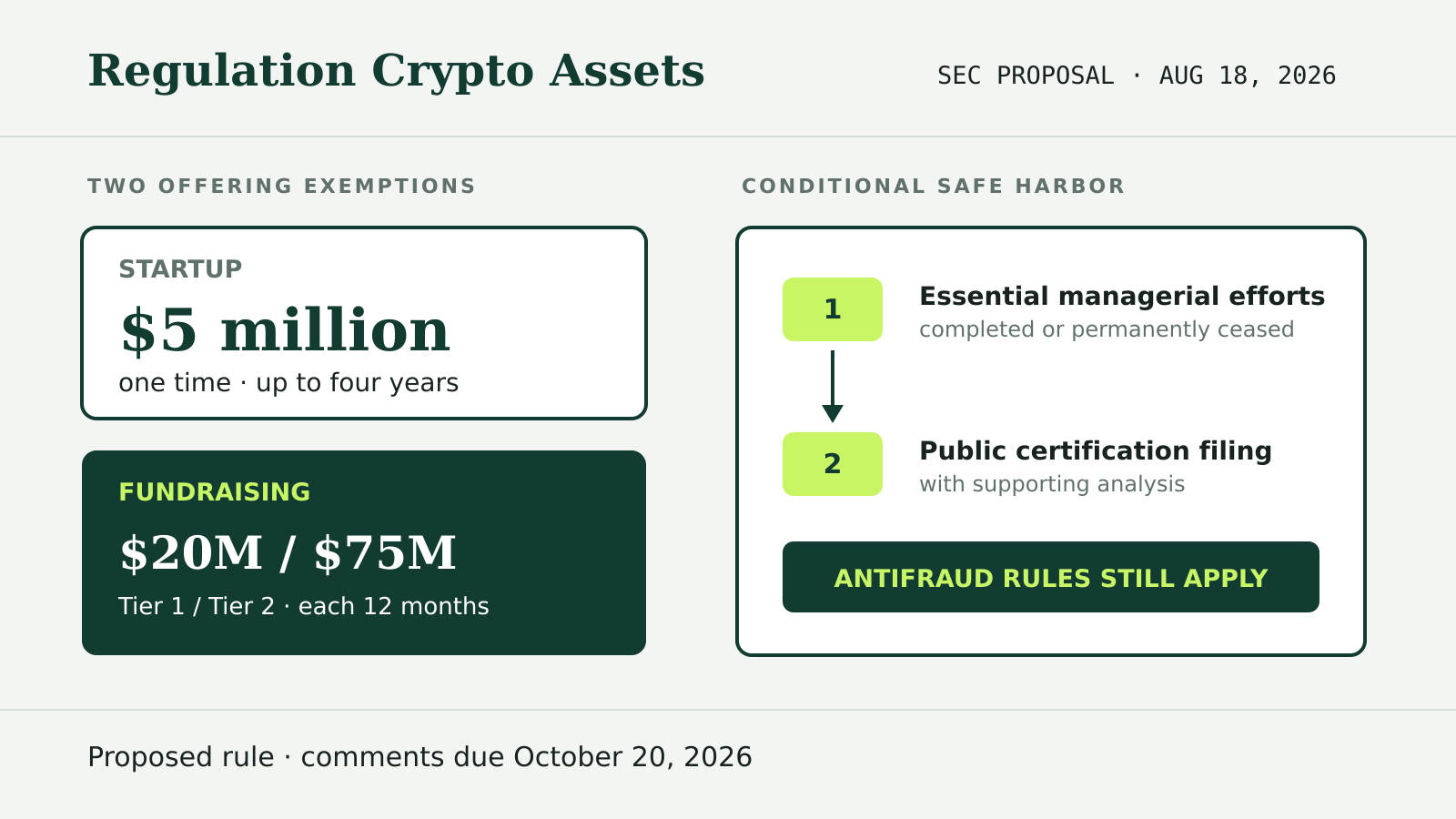
Issuers using either exemption would still be subject to federal antifraud and antimanipulation provisions.
Startup exemption: up to $5 million
The proposed startup exemption would be a one-time route for offerings of up to $5 million during a period of no more than four years.
An issuer would make public filings at the beginning and end of that period. During the period, it would also give investors principles-based narrative disclosures. The SEC describes this as temporary relief while an issuer works toward completing the essential managerial efforts it represented or promised to investors.
“One-time” and “four years” are separate limits. The exemption is not a fresh $5 million allowance every four years. It is designed as one temporary development period under the conditions in the proposed rule.
Fundraising exemption: two tiers
The fundraising exemption would be available for larger offerings and is modeled in part on Regulation A.
- Tier 1: up to $20 million in a 12-month period.
- Tier 2: up to $75 million in a 12-month period.
Both tiers would require publicly filed offering materials. Those materials would include the narrative disclosures required under the startup exemption, a discussion of the issuer’s financial condition, and financial statements.
Tier 2 would add an audit requirement for the financial statements. The issuer would also have ongoing reporting obligations modeled on Regulation A and adapted to covered investment contracts.
That makes the $75 million figure only one part of the comparison. An issuer choosing between the startup and fundraising routes would also need to consider the filing, financial-statement, audit and continuing-reporting conditions.
What investors would be told
The proposed disclosure framework is principles-based rather than a single short checklist. The SEC’s proposal discusses information about the issuer, the crypto asset, the related network or application, the promised managerial work and material risks.
The purpose is to make the promised work visible. A buyer should be able to see what the issuer says it will build or operate, how the crypto asset is intended to function, and which facts could change the value or use of the asset.
Financial information becomes more formal under the fundraising exemption. Tier 2 financial statements would need to be audited. Ongoing reports would keep information available after the offering instead of ending disclosure at the sale.
These are proposed requirements. The final text could change after the comment process.
How the safe harbor would work
The conditional safe harbor addresses the point at which a covered investment contract has ended.
An issuer would need to satisfy two central conditions:
- it has completed or permanently ceased all essential managerial efforts it represented or promised, and it does not make or intend to make new promises of essential managerial efforts for the crypto asset; and
- it makes a public filing certifying that those conditions are met and provides an analysis supporting the certification.
If the conditions were satisfied, the Commission would deem the covered investment contract to have ceased to exist. The crypto asset would be deemed not to constitute, represent or be subject to that investment contract for the statutory definitions of “security” addressed by the proposal.
The safe harbor is therefore not automatic at a fixed age or network milestone. It depends on the issuer’s promised managerial work and a public certification with supporting analysis.
State-law preemption is limited
The proposal would define certain buyers as “qualified purchasers” for Securities Act purposes. That definition would preempt state securities-law registration and qualification requirements for offers and sales made under a Regulation Crypto Assets exemption.
The proposal would also cover certain secondary-market transactions by people other than an issuer, underwriter or dealer. That secondary-market preemption would continue only while the issuer satisfies the relevant information, filing or periodic-reporting requirements.
Preemption of registration and qualification does not erase every state-law issue. New York’s licensing framework, for example, addresses a different regulatory question. Our BitLicense and trust charter comparison explains those operating permissions.
What the proposal does not do
It does not make every crypto asset a non-security. It does not replace the SEC’s analysis of whether a transaction is an investment contract. It does not remove federal antifraud rules, and it does not turn the proposed exemptions into effective law before rulemaking is complete.
It also does not settle questions assigned to other regulators or every state requirement. The proposal is an offering framework under the federal securities laws, not a universal crypto license.
The SEC’s separate Innovation Exemption proposal concerns a different proposed route for certain trading activity. The two proposals should not be treated as interchangeable.
Dates and documents to check
The SEC issued the proposal on August 18, 2026. The Federal Register published it on August 21, 2026. The comment deadline listed by the SEC is October 20, 2026.
The proposal is File No. S7-2026-27, Release Nos. 33-11434 and 34-106150. The SEC’s rule page links the full proposing release, a three-page fact sheet and the public comment file.
Readers following the rule should check the SEC rule page for amendments, extensions or a final action. A final rule, if adopted, may differ from this proposal.