Third-party AI risk in financial services starts with a plain fact: most banks, insurers and fintech companies will not build the models they use. Treasury’s December 2024 report on AI in financial services said firms “will need to rely on AI models and systems developed by others.” That turns vendor oversight into AI oversight, and the rules for it are being rewritten: on September 11, 2026, the federal banking agencies and the NCUA proposed replacing their 2023 third-party risk guidance.
What Treasury asked and heard
Treasury published a request for information on the uses, opportunities and risks of AI in financial services on June 12, 2024. Comments closed on August 12, 2024, and Treasury received 103 comment letters from financial firms, consumer groups, technology providers, fintech companies, trade associations and consulting firms. The report released on December 19, 2024 summarizes that feedback; it is a record of what respondents said plus Treasury’s suggested next steps, not a rule.
Respondents described AI used more and more across the sector, with generative AI widening the range of uses and making firms cautious about putting it in front of customers. Two themes in the full report (PDF) matter most for anyone buying or selling AI to a financial firm: concentration and third-party risk.
Concentration: a few model providers under many apps
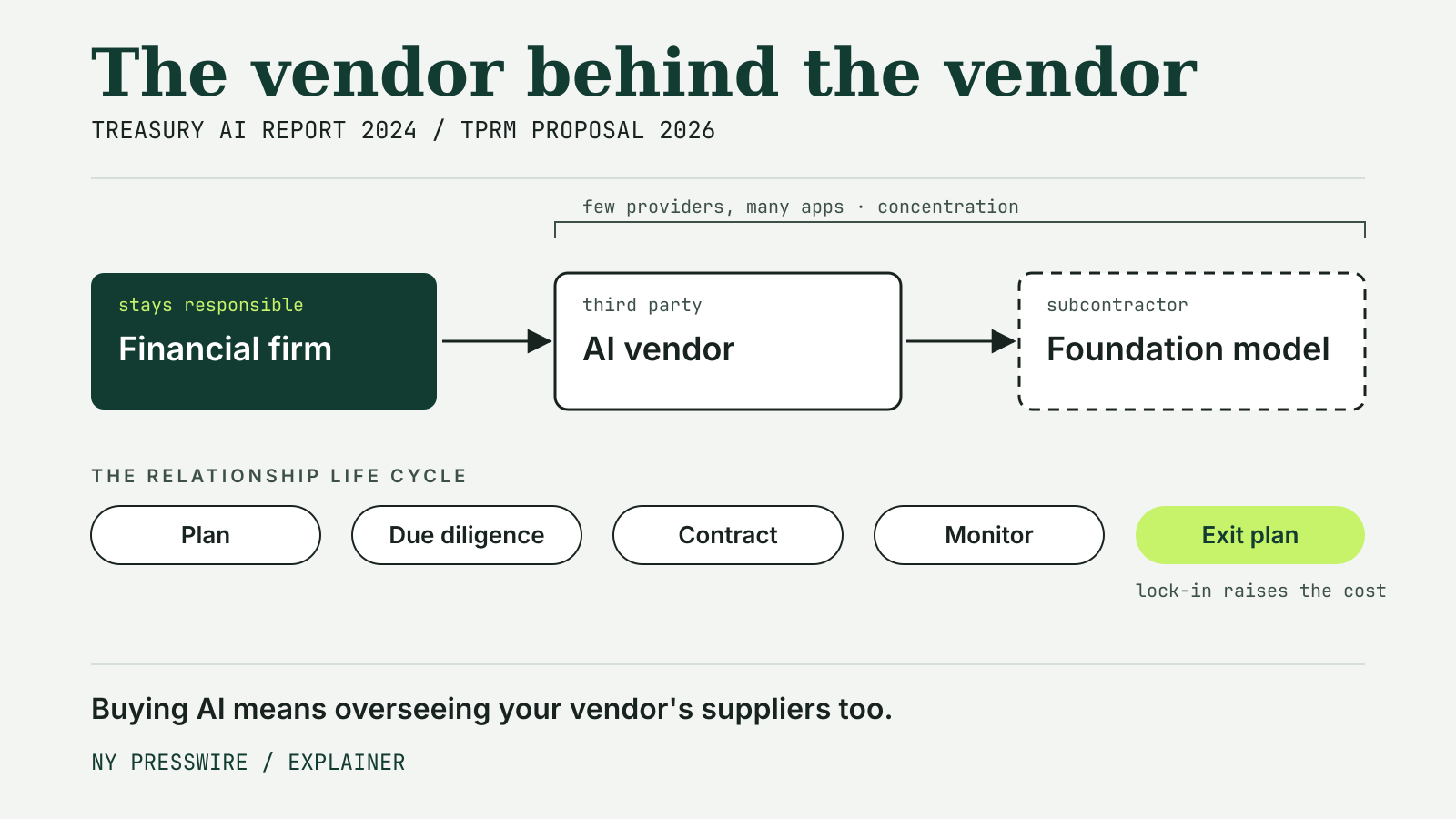
Respondents told Treasury that generative AI models need vast training data, heavy computing power and large investment, which pushes smaller institutions to depend on a few large companies. Many applications, they said, could sit on only a handful of foundation models. Their worry was systemic: an interruption at a single AI provider could spread across the financial system, and opaque links between models and data could produce herding.
The fixes respondents suggested were familiar risk tools applied to a new supplier: incremental rollouts, circuit breakers that limit the damage from a system behaving badly, stronger operational risk frameworks, support for open-source tools and monitoring of how concentrated AI providers become.
Third-party risk: due diligence when the vendor holds the cards
Respondents said AI vendor risk looks like the risk of other emerging technologies: operational, reputational, legal, compliance and data risks, including privacy breaches, unauthorized data sharing and slow incident response. They generally agreed that the banking agencies’ 2023 Interagency Guidance on Third-Party Relationships already covered many of these risks, while some asked for clarity on concentration, supply chains and the use of outside firms to help with due diligence.
The report records several practical problems:
- Bargaining power. Smaller firms may be unable to make a large AI provider accept their contract standards.
- Expertise. Many firms lack in-house AI skills to judge a tool’s risks and design controls.
- Validation. Training data may be proprietary and unavailable to the buyer, and open-source code tested for one use may be repurposed for another.
- Lock-in. Switching from one AI tool to another can be costly and slow.
Proposed answers included simple disclosures modeled on a nutrition label, requiring vendors to disclose when an AI tool is used, certification programs (one respondent warned that licensing could worsen concentration) and requirements that AI providers make it easier to move between competing systems.
Among Treasury’s own recommended next steps, two stand out for vendors. Firms should review AI use cases for compliance with existing laws before deployment and re-check them periodically. Treasury also repeated the Financial Stability Oversight Council’s call for Congress to give agencies adequate powers to examine and enforce against third-party service providers.
The framework those comments relied on
The 2023 interagency guidance, issued by the OCC, the Federal Reserve and the FDIC and announced in OCC Bulletin 2023-17 on June 6, 2023, organizes oversight around a relationship life cycle. As published in the Federal Register, the stages are planning, due diligence and third-party selection, contract negotiation, ongoing monitoring, and termination. An AI vendor fits every stage: what the model will decide, what evidence the vendor will share, what the contract says about data and subcontractors, how output drift is caught, and how the firm exits.
The September 2026 proposal
On September 11, 2026, the OCC, Federal Reserve, FDIC and NCUA proposed guidance that would rescind and replace the 2023 document. In OCC Bulletin 2026-46, the OCC says the proposal is meant to help banking organizations match their practices to the reasonably assessed risk of each relationship and avoid process-driven approaches that treat every vendor as high risk. The bulletin adds that the guidance would not set enforceable standards and that non-compliance with it would not lead to supervisory action. The NCUA lists November 16, 2026 as the comment deadline.
The proposed guidance (PDF) does not single out artificial intelligence. Two passages still bear on AI vendors. It says a third party connected to a bank’s systems through APIs or portals is not necessarily higher risk if those systems hold no critical data and are segmented, so some risk can be handled through cybersecurity controls. And it says a vendor’s subcontractors can heighten risk by reducing the bank’s control, which a bank can address through contract terms and by checking the vendor’s own oversight program, while remaining responsible for compliance either way. For an AI product built on someone else’s foundation model, that subcontractor language describes the model provider.
How this connects to model risk
Third-party guidance covers the relationship; model risk guidance covers the model. Our explainer on SR 26-2 and model risk management covers how the Federal Reserve treats AI models, and our guide to the NIST generative AI risk profile maps controls a product team can document for a buyer. The same vendor file usually has to satisfy both.