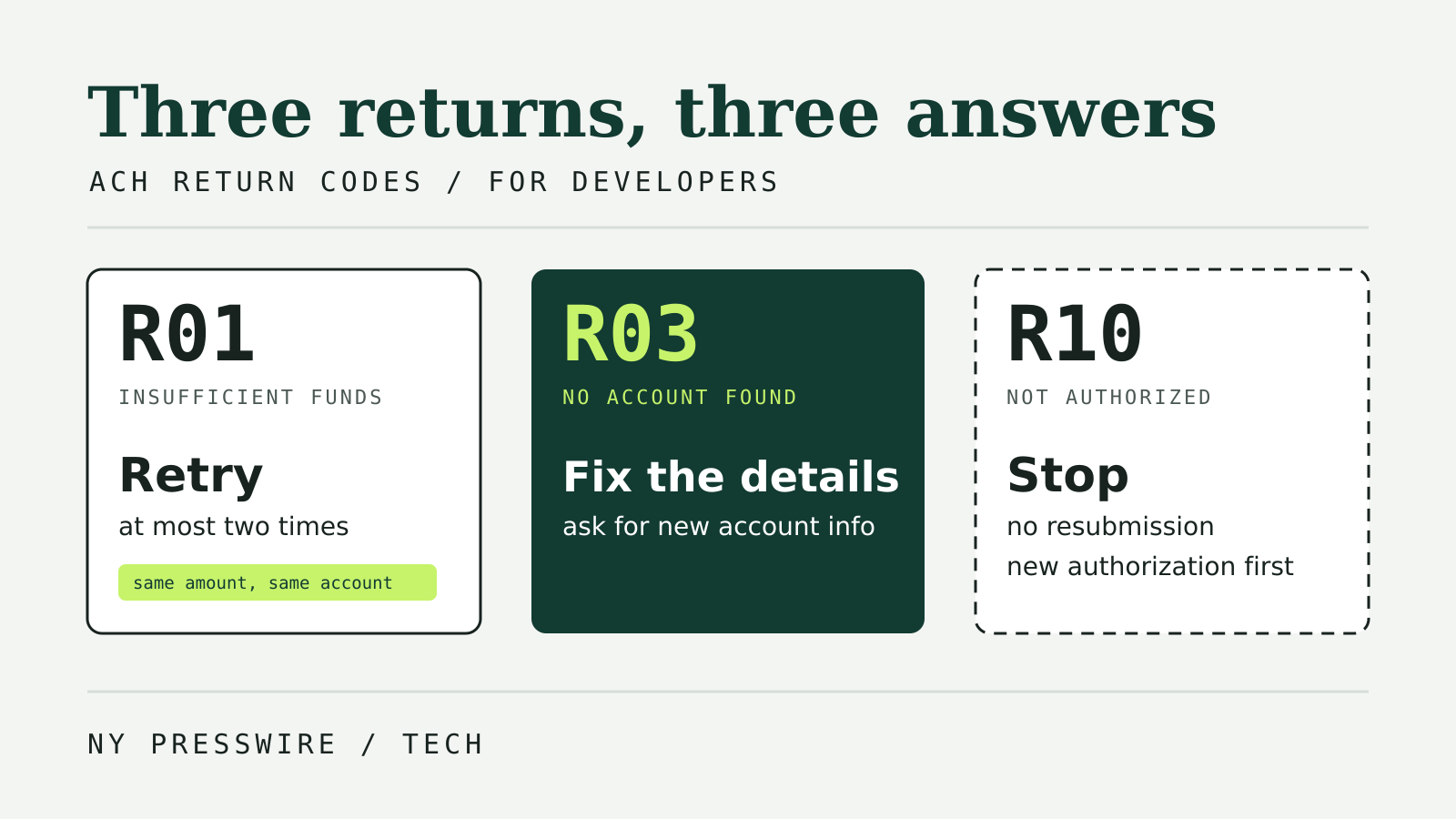
ACH return codes for developers come down to one decision per code: retry the same account, ask the customer for new details, or stop debiting that account altogether. A debit that looks finished on Monday can still come back on Wednesday, or weeks later, wearing a code such as R01 or R10. Payment providers translate the codes into their own statuses, and the translation hides distinctions that matter for retries and for the return rates the ACH rulebook watches.
This explainer is for developers who receive ACH returns through a payment API. It maps the common codes to a retry decision, shows where Stripe’s debit_not_authorized lumps different codes together, and works through the return-rate arithmetic. For the account holder’s side of the same system, see our guide to stopping ACH automatic payments.
A debit is not final when the API says it succeeded
Stripe’s ACH Direct Debit documentation describes a delayed-notification method that can take up to four business days to report success or failure. Plaid’s transfer troubleshooting guide says most returns, including every R01, must occur within two banking days of the transfer reaching settled. Returns where the consumer alleges the debit was unauthorized, such as R10 and R11, can arrive for 60 calendar days. Stripe gives the same shape: a customer can dispute through their bank for up to 60 calendar days on a personal account and two business days on a business account, and a rare late return after that is decided between the banks.
Two consequences follow for your code. A paid state is provisional, for two banking days at minimum and for 60 days on consumer debits. And a return can land after your own success event: Stripe says that in rare cases a bank’s failure arrives after a PaymentIntent has become succeeded, and Stripe then creates a dispute with the reason insufficient_funds, incorrect_account_details or bank_cannot_process and charges a failure fee.
Return codes, as the rulebook and the providers sort them
Nacha’s risk and enforcement page puts returns into three monitored groups. The table adds Stripe’s network decline code mapping and the next step that Plaid, Stripe and Increase document.
| Code | Meaning | Counts toward | Stripe decline code | Next step |
|---|---|---|---|---|
| R01 | Available balance too low | Overall (15%) | insufficient_funds | Retry, at most twice |
| R09 | Collected balance too low (uncollected funds) | Overall (15%) | insufficient_funds | Retry after holds clear, at most twice |
| R02 | Account closed | Administrative (3%) | bank_account_closed | Get new account details |
| R03 | No account found, or name does not match | Administrative (3%) | bank_account_invalid_details | Correct the details; Plaid suggests relinking another account |
| R04 | Account number incorrect or malformed | Administrative (3%) | bank_account_invalid_details | Correct the details |
| R08 | Stop payment on the debit | Overall (15%) | debit_not_authorized | Retry only with new valid authorization |
| R05, R07, R10, R29 | Unauthorized, revoked or not authorized (R07 is revoked, R29 is for corporate entries) | Unauthorized (0.5%) | debit_not_authorized | Stop. After R10 you cannot resubmit |
| R11 | Entry not in accordance with the authorization | Unauthorized, per Nacha’s originator guide | debit_not_authorized | If the error was yours, correct and resend within 60 days of the return’s settlement date |
| R16, R20 | Account frozen; debits blocked by the bank or customer (Stripe’s labels) | Overall (15%) | bank_account_frozen, bank_account_restricted | Contact the customer; retry only if the bank unblocks |
Nacha’s page lists R05, R07, R10, R29 and R51 for the 0.5% unauthorized level, R02, R03 and R04 for the 3.0% administrative level, and every debit return except RCK entries for the 15.0% overall level. Its originator guide also lists R11 among unauthorized returns, so a counter that leaves R11 out may understate your exposure. Nacha’s explanation of R10 versus R11 is the useful line to remember: R10 means there was no authorization, while R11 means an authorized payment went wrong, and the originator may correct the error and resend without a new authorization.
The provider’s code can hide the raw one
Stripe’s table maps R05, R07, R08, R10, R11, R29 and R31 to the same debit_not_authorized. That one string mixes codes that count toward the 0.5% unauthorized level (R05, R07, R10, R29) with R08, a stop payment, and R11, a correctable error. If you compute return rates from the provider’s decline code, you will get the wrong bucket.
Keep the raw code and the settlement date. Stripe exposes the raw ACH code for blocked accounts in us_bank_account.status_details.blocked.network_code, with a summary in reason, and says it blocks an account after returns other than insufficient funds because Nacha rules require originators to confirm the account before reinitiating. Confirming a PaymentIntent on a blocked account fails with HTTP 402 and the code bank_account_unusable, and Stripe sends payment_method.automatically_updated when a block is applied or lifted, which gives recurring-billing systems advance notice. A first unauthorized dispute revokes the mandate, and a second one blocks the account, according to Stripe’s blocked bank accounts guide.
Return-rate arithmetic
Nacha says the rates are calculated over the preceding sixty days or two calendar months, and that crossing a level is not automatically a rule violation: it triggers a preliminary inquiry. Take a business that originated 4,000 debits in the window.
| Level | Rate | Returns at 4,000 debits |
|---|---|---|
| Unauthorized | 0.5% | 20 |
| Administrative | 3.0% | 120 |
| Overall | 15.0% | 600 |
Now suppose 18 debits come back R10 and 3 come back R07. That is 21 unauthorized returns, or 0.525%, over the line even though the absolute number looks small. Suppose 70 come back R02 and 40 R03: 110 administrative returns is 2.75%, under 3.0%. And 30 R08 stop payments count toward neither of those two groups, only toward the overall rate. The arithmetic is simple; the work is in keeping the raw code per return so the three counters stay correct.
A retry policy that follows the codes
- Store the raw code, settlement date and original entry reference for every return, not only the provider’s summary status.
- Retry only R01 and R09, and at most twice. Plaid allows up to two retries, only for these two codes, and asks for the description
Retry 1orRetry 2. Stripe’s Billing retries for failed Direct Debit payments run up to two times, no more than 40 days after the original attempt. Increase’s ACH returns documentation states the rulebook limit as two reinitiations within 180 days of the original settlement date, markedRETRY PYMT. - Keep the retry identical. Nacha says a reinitiated entry must match the original on Company Name, Company ID and amount, and carry
RETRY PYMTin the Company Entry Description. Changing the amount is an improper reinitiation. Check how your provider sets that descriptor before you build your own retry on its API. - Treat R02, R03 and R04 as a data problem. Retrying the same details just produces the same return and adds to the administrative count. Ask the customer for corrected account information; Increase notes that retrying with corrected account information is not treated as a reinitiation.
- Stop on R10, R07 and R05. Nacha says an unauthorized debit cannot be remedied, and a new authorization obtained after the return is not a reinitiation. Plaid warns that you cannot resubmit after R10 and advises adding clear WEB debit authorization language to the payment flow.
- Make your own retries idempotent. A retry is a new entry that needs its own request key, and a return webhook can be delivered more than once. Our guides to idempotency keys in a payment API and payment webhook retries cover both, and payment decline codes covers the card side of the same decisions.
Sources
Checked on November 26, 2026.