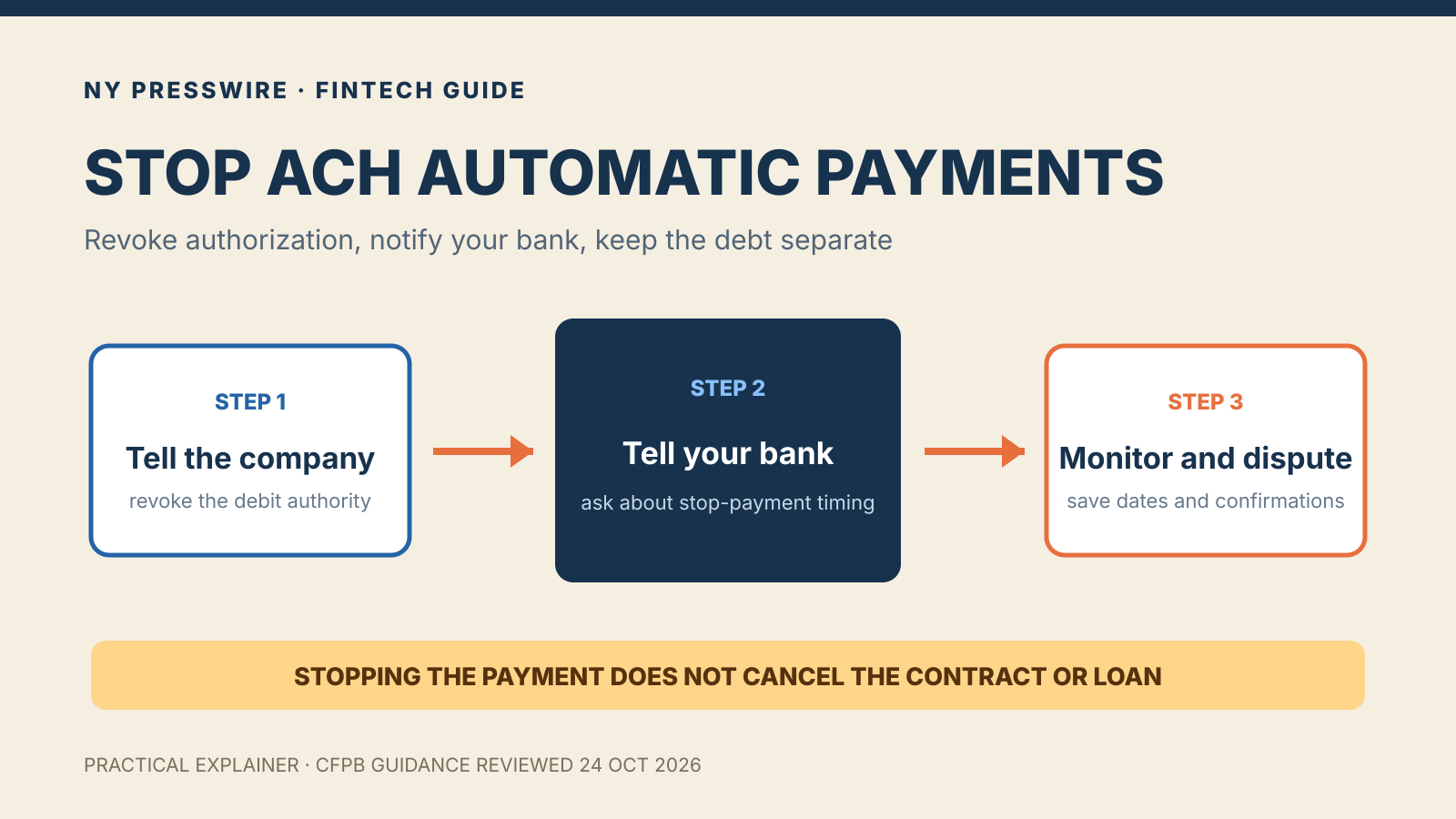
You can stop a company from taking automatic payments from your bank account even if you originally authorized the debits. The cleanest approach is to contact both the company and your bank, keep written records, and separate the payment instruction from the contract or debt underneath it.
The Consumer Financial Protection Bureau updated its public guidance on August 31, 2026. The steps below follow that guidance and the federal rules it summarizes.
First identify the payment
Start with a recent statement and note:
- the company name as it appears on the transaction;
- the amount and usual payment date;
- the bank account used;
- the contract, subscription or loan tied to the debit;
- the next expected withdrawal.
Automatic bank-account payments often travel through the ACH network, but the merchant name on the statement can differ from the brand you recognize. Ask your bank to identify the originator if the entry is unclear.
Step 1: Revoke authorization with the company
Tell the company that you are withdrawing permission to debit your bank account. The CFPB’s current guidance recommends calling first and then following up by letter or email. Some companies also provide an online form.
State whether you are ending the contract or only changing the payment method. That distinction prevents a common misunderstanding. You may want the service to continue while you pay invoices manually, or you may want both the automatic debit and the service to end.
Keep the date, the name of the representative, any confirmation number and a copy of the written notice.
Step 2: Tell your bank or credit union
Contact your financial institution and say that you revoked the company’s authorization to take automatic payments. Follow the institution’s procedure, which may include a written notice or online form.
According to the CFPB, once you have told the company and your bank that the authorization is revoked, additional payments initiated by that company are errors that you can raise with the bank.
Ask the bank to confirm:
- which originator or merchant is covered;
- when the revocation becomes effective;
- whether a separate stop-payment order is recommended;
- whether that order carries a fee;
- how long the instruction remains in place.
Do not send account credentials by ordinary email. Use the bank’s secure message center, branch or another verified channel.
Step 3: Consider a stop-payment order
A stop-payment order instructs the bank not to pay a specified company. The bank may recommend it when the next debit is close or when the merchant has not acknowledged the revocation.
The CFPB notes that banks and credit unions generally charge fees for stop-payment orders. Federal Regulation E also allows a financial institution to require written confirmation after an oral stop-payment request. If the institution asks for that confirmation, send it promptly and follow the deadline it gives you.
For a prescheduled electronic fund transfer, federal rules generally require the consumer to notify the financial institution at least three business days before the scheduled transfer. Earlier notice gives the bank more time to apply the instruction and resolve questions about the merchant identifier.
Step 4: Monitor the account
Watch the account through at least the next expected payment date. If another debit appears after authorization was revoked, tell the bank immediately and identify it as an unauthorized electronic transfer.
The CFPB advises consumers to report unauthorized transfers promptly. The exact investigation and refund rules depend on the facts and timing, so do not wait for another monthly statement if you already see the transaction online.
Keep a simple record:
| Date | Action | Confirmation |
|---|---|---|
| Day 1 | Revoked authorization with company | Email or letter copy |
| Day 1 | Notified bank or credit union | Secure-message receipt or call reference |
| Before next debit | Requested stop payment if needed | Order number and fee |
| Next cycle | Checked the account | Statement or transaction screenshot |
Stopping the debit does not cancel the debt
Stopping an automatic payment changes how money leaves the account. It does not automatically cancel a gym contract, insurance policy, loan or other obligation.
If you want to end a service, follow the contract’s cancellation process too. If the debit pays a loan, arrange another payment method. Missing the payment can still cause late fees, default or credit reporting even when the bank correctly blocks the automatic withdrawal.
This separation is especially important with payday loans and other high-cost credit. The CFPB’s payday-loan payment guidance repeats the right to revoke electronic authorization, while warning that stopping the debit does not erase what is owed.
If the company debits a different amount
A one-time amount change is not the same as canceling authorization. For varying recurring transfers, Regulation E has advance-notice rules unless the consumer agreed to a permitted range. If the amount is unexpected, ask both the company and bank which authorization they relied on.
Do not assume every difference is fraud. A tax, usage charge or contract change may explain it, but the company should be able to show the authorization and the bank should explain the dispute channel.
If the bank says it cannot help
Ask for the reason in writing and request the bank’s electronic-fund-transfer dispute process. Provide the revocation notice, bank notice, stop-payment order and transaction record.
If the issue remains unresolved, you can submit a complaint through the CFPB complaint portal. For a quick guide to which regulator handles which complaint, see CFPB vs FTC complaints. A complaint is more useful when it includes dates, confirmation numbers and the specific correction requested.