Whether stolen crypto is tax deductible depends on one sorting question: did you send the money to invest, or for some other reason? An IRS Office of Chief Counsel memo released on March 14, 2025 answers it for five common scams. A victim of a crypto “pig butchering” investment scam gets a theft loss deduction. A victim of a romance scam does not. This guide walks through the memo’s three tests with numbers, and notes what changed for 2026. It describes published IRS positions, not individual tax advice.
What the memo decided
Chief Counsel Advice 202511015 is dated January 17, 2025. It is non-taxpayer-specific advice, and the memo itself warns that “the actual scam may vary.” It covers five victims who discovered their losses in 2024: a compromised-account impersonation, a pig butchering crypto investment scam, a phishing scam, a romance scam and a kidnapping scam.
The memo found a theft loss in all five. Only the first three could deduct it, because only they incurred the loss “in a transaction entered into for profit” under section 165(c)(2). The romance and kidnapping victims had personal casualty losses, which section 165(h)(5) disallowed for 2018 through 2025 unless tied to a federally declared disaster or offset by personal casualty gains.
The three tests
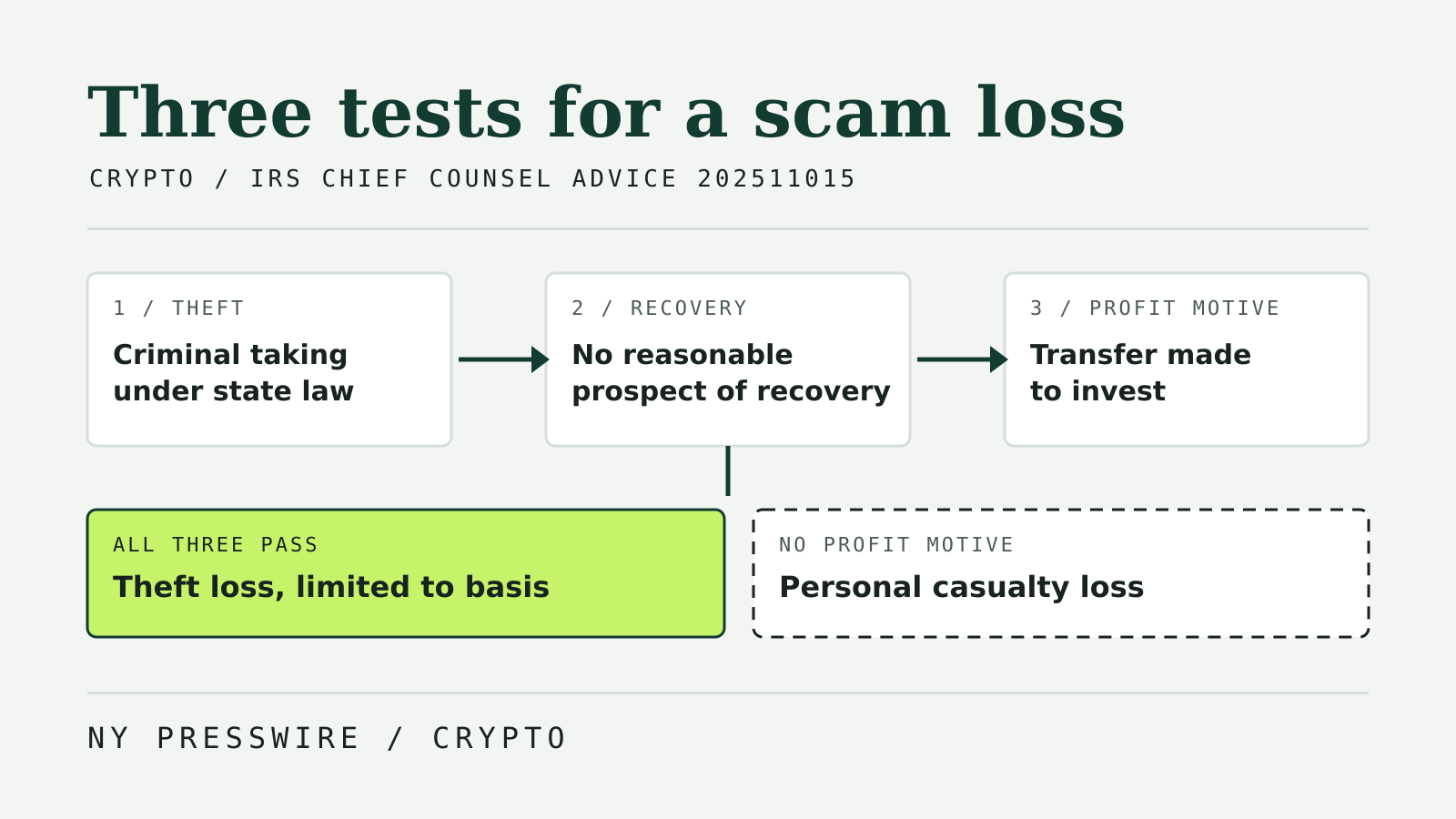
The IRS’s current Form 4684 instructions (2025 edition, read November 22, 2026) restate the conditions for financial scams. All three must hold:
- Theft under state law. The loss must come from conduct that is theft under the criminal law of the state where the victim lives. The memo defines theft broadly, including “theft by swindling, false pretenses and any other form of guile.”
- No reasonable prospect of recovery. Under section 165(e), a theft loss is sustained in the year you discover it, but not if a reasonable prospect of recovery remains at year end. In the memo, each victim had reported the scam to their financial institution and law enforcement and was told there was little to no prospect of getting the money back, and the scammer was unidentified.
- A transaction entered into for profit. The memo looks at why the victim authorized the transfer. If the motive was to invest or to move existing investments, the loss qualifies. If it was to pay a person under false pretenses, such as a romance partner or a fake kidnapper, it does not.
The pig butchering taxpayer in the memo was lured by an email about a cryptocurrency platform, made small deposits and withdrawals that worked, then moved much larger sums from IRA and non-IRA accounts. When the platform stopped honoring withdrawals, the taxpayer found other victims online. The memo treated the whole loss as a profit-motive loss.
Worked example: what the loss amount is
The deduction is limited to your basis, meaning what you paid, not what a screen showed. The memo says a taxpayer “generally may not take a loss deduction for income, or the unrealized gain from an investment, that has not been included in gross income.” The IRS’s digital asset FAQs (page reviewed June 29, 2026) say basis in crypto bought with cash includes the cash paid plus transaction costs.
Here is an illustration with invented figures, using the memo’s rules:
| Item | Amount | Counts toward the loss? |
|---|---|---|
| Bank transfers deposited to the fake platform | $12,000 | Yes, cash paid is basis |
| “Release fee” paid to unlock a withdrawal | $4,500 | Yes; the memo notes such fees add to the loss |
| Account balance the platform displayed | $31,000 | No, never income and never paid in |
| Theft loss on Form 4684 | $16,500 |
If the money came from a traditional IRA, the withdrawal itself is taxable. In the memo’s examples, the victim “is liable for Federal income tax on the IRA account distribution,” which gives the victim basis in the stolen funds. A $50,000 IRA withdrawal sent to a scammer therefore creates $50,000 of income and, if all three tests pass, a $50,000 theft loss. The memo’s examples put both events in 2024. If they land in different tax years, the loss is placed by the discovery year, so confirm the timing with a preparer.
For how basis is tracked on legitimate purchases, see crypto cost basis wallet by wallet.
Why romance scams fail the test
Romance scam victims often send crypto, but the memo does not care about the asset. It asks about motive. The romance scam victim in the memo sent money “to cover the purported medical expenses” of a relative, so there was no profit motive and the loss was a personal casualty loss.
Footnote 16 adds a twist: when a romance scammer steers the victim into a fake investment, “the analysis would be the same as for” the pig butchering case. The label of the scam matters less than what the victim thought they were doing when the money left.
What changed for 2026
Section 165(h)(5) used to run through 2025. According to the Legal Information Institute’s copy of 26 U.S.C. 165, Public Law 119-21, section 70109 removed the end date, added state-declared disasters as an alternative to federally declared ones, and applies to taxable years beginning after December 31, 2025. For a romance-type loss discovered in 2026, the personal casualty limit therefore no longer expires. The profit-motive test for investment scams did not change.
Where it goes on the return
Per the 2025 Form 4684 instructions, a theft loss on income-producing property goes in Section B. For individuals, if Form 4797 is not otherwise required, the Section B net amount goes to Schedule 1 (Form 1040), line 4, with the “4684” box checked. It does not go on Schedule A.
The Ponzi-scheme safe harbor in Rev. Proc. 2009-20 did not help any taxpayer in the memo. For the pig butchering victim, the scammer was never identified or charged, so the loss was not a “qualified loss.”
What the memo does not cover
The memo does not mention crypto wallets, exchange hacks or lost private keys. It says a “hacked” account has the same consequences as phishing, and it describes securities accounts, not wallets. The IRS FAQ page above says nothing about lost keys. Treat those cases as open questions for a tax professional, not as settled by this memo.