The NIST Cyber AI Profile is still a preliminary draft. On November 24, 2026, NIST’s publication page for IR 8596 lists a single document-history entry, the draft of December 16, 2025, and says the public comment period, which ended January 30, 2026, is closed. NIST has not posted an initial public draft, and neither its project page nor its roadmap gives a date for one.
The profile does not write new security rules. It lays AI-specific cybersecurity risks over the six functions of the Cybersecurity Framework (CSF) 2.0, the voluntary structure many companies already use to organize security programs. Use it as a planning aid for a CSF-based program, not as a compliance checklist.
Status of the Cyber AI Profile, checked November 24, 2026
| Date | What happened | Source |
|---|---|---|
| Dec. 16, 2025 | Preliminary draft of NIST IR 8596 published; 45-day comment period opened | NIST CSRC |
| Jan. 14, 2026 | Cyber AI Profile Workshop #2 | NIST CSRC |
| Jan. 30, 2026 | Public comments due; period now marked closed | NIST CSRC |
| Apr. 28, May 5 and May 12, 2026 | Three spring working sessions: profile elements and contents, extending the technical content, and usability | NIST NCCoE |
| Nov. 24, 2026 | NCCoE project page lists the profile as “Reviewing Comments”; no initial public draft listed | NIST NCCoE, CSRC |
NIST says comments on the preliminary draft “will inform the initial public draft.” The NCCoE roadmap lists an initial public draft and a final version without dates, so any date you see elsewhere is not NIST’s.
The name is changing
NIST’s pages now carry an announcement that, following the September 29, 2026 executive order “Inaugurating the Era of Super Intelligence,” the agency is updating its communications to use the term “super intelligence.” The NCCoE project page therefore calls the effort the “Cyber SI Profile” while the IR 8596 document keeps its published title, Cybersecurity Framework Profile for Artificial Intelligence. The CSRC project page for the companion overlays says previously issued documents have not been altered. If you search NIST’s site and find “Cyber SI Profile,” it is the same project.
What the profile covers
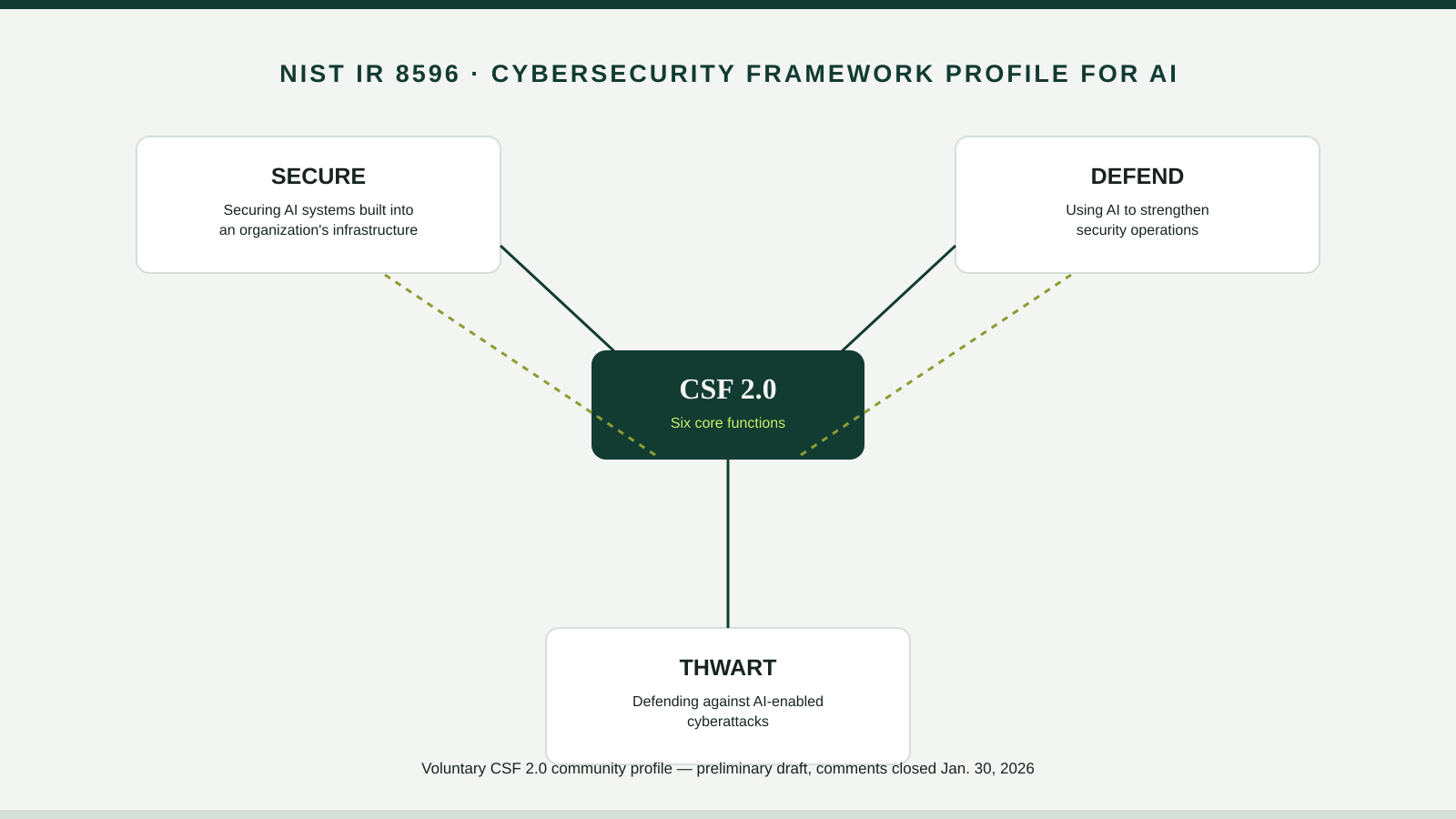
A CSF community profile is an optional lens built on the core framework for a particular technology. The Cyber AI Profile has three focus areas:
| Focus area | NIST’s label | In practice |
|---|---|---|
| Secure | Securing AI system components | Protecting training data, model weights, APIs and pipelines in your own systems |
| Defend | Conducting AI-enabled cyber defense | Using AI for security work such as log analysis and anomaly detection |
| Thwart | Thwarting AI-enabled cyber attacks | Preparing for AI-written phishing and automated probing |
The three areas are meant to feed each other. Hardening a system under Secure is what makes Defend tooling trustworthy, and attack patterns logged under Thwart should reshape priorities in the other two. The draft organizes its content by CSF 2.0 Functions, Categories and Subcategories (Govern, Identify, Protect, Detect, Respond and Recover) rather than adding a seventh function.
Voluntary, not a mandate
The CSF is voluntary guidance, and a profile inherits that status. A regulator or examiner has no independent authority to require the Cyber AI Profile unless a separate law or contract points to it. A team already mapping its program to CSF 2.0 can use the draft to see where AI-specific considerations attach to subcategories it already tracks, while expecting the text to change before a final version.
The profile differs from the NIST Generative AI Risk Profile, which sits on the AI Risk Management Framework and covers trustworthiness topics such as bias, transparency and safety. The Cyber AI Profile sits on the CSF and addresses security. For attacks on models themselves, see NIST’s adversarial machine learning taxonomy.
The companion overlays project
NIST’s SP 800-53 control overlays project was announced as Control Overlays for Securing AI Systems (COSAiS). The CSRC project page shows that on October 20, 2026 it was renamed Control Overlays for Super Intelligence Systems (COSIS). It still proposes five use cases: generative AI assistants and large language models, predictive AI, single-agent systems, multi-agent systems, and security controls for developers. It builds on SP 800-218A, draft NIST AI 800-1 and NIST AI 100-2e2025. The latest dated item on the page is an annotated outline for the predictive AI use case, published January 8, 2026, with feedback requested by February 13, 2026. No finished overlay is listed.
Where the profile tells you which CSF outcomes need an AI-specific look, the overlays are meant to tell a compliance team which SP 800-53 controls to adjust. Neither is final.
Questions readers ask
Has NIST finalized the Cyber AI Profile? No. As of November 24, 2026, the only published version of IR 8596 is the preliminary draft of December 16, 2025.
Is there an initial public draft yet? Not on NIST’s publication page. It lists only the December 2025 draft, and NIST’s roadmap names an initial public draft without a date.
Does the profile create legal obligations? No. It is voluntary guidance on top of the voluntary CSF 2.0.
Why do NIST pages say “Cyber SI Profile”? NIST is updating its wording after the September 29, 2026 executive order. The NCCoE project page uses “Cyber SI Profile,” while the IR 8596 title is unchanged.
What are Secure, Defend and Thwart? Secure protects AI systems, Defend uses AI for security operations, and Thwart prepares for attacks that use AI.