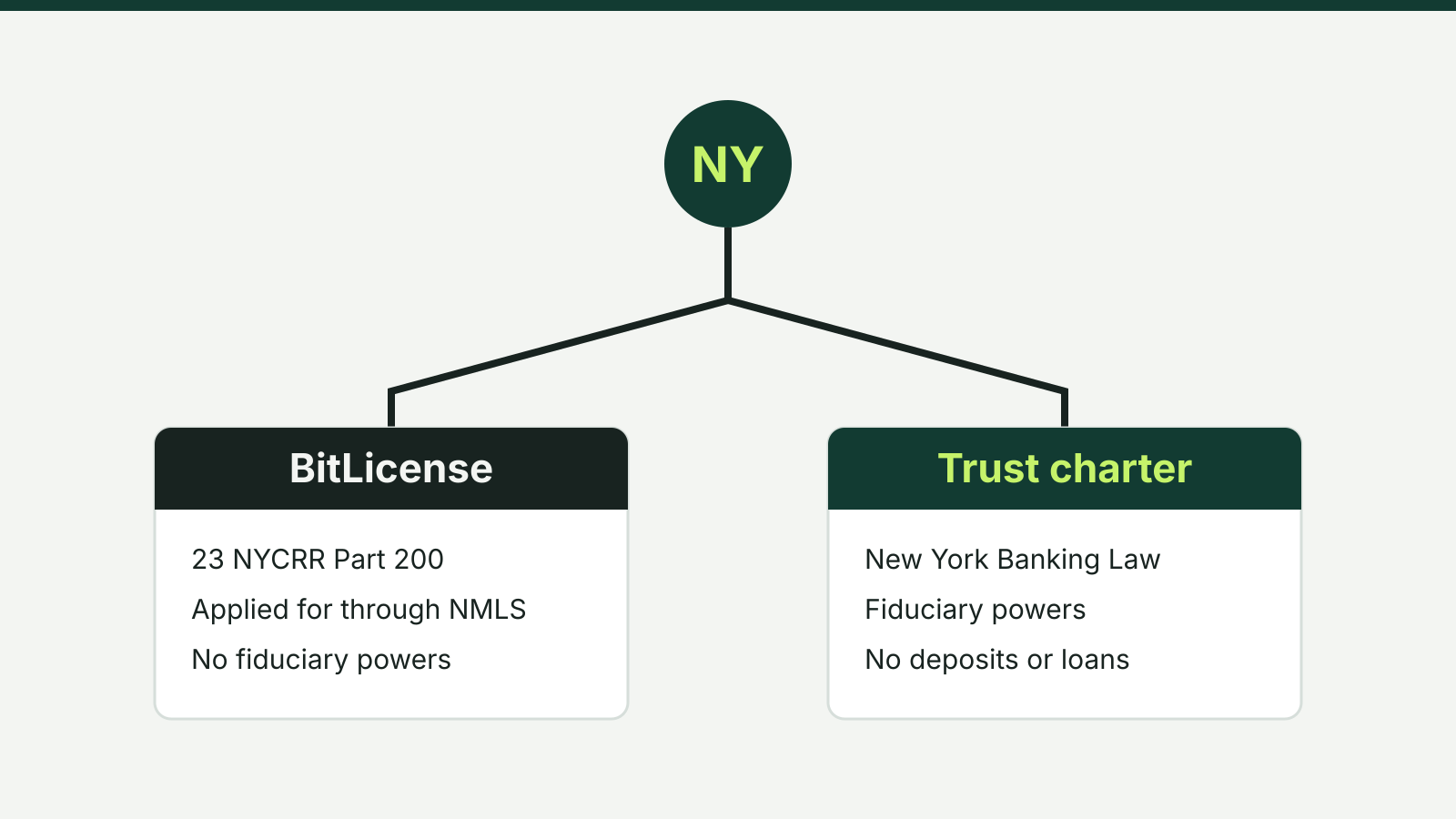
A crypto company that wants New York customers has two doors at the Department of Financial Services. One is the BitLicense, issued under the state’s virtual currency regulation. The other is a charter under the New York Banking Law, most often as a limited purpose trust company. The choice of BitLicense vs trust charter shapes what the firm may do, how it applies and which body of law it answers to.
DFS describes the two forms of authorization as similar in many respects. The differences sit in a few specific places, and those are the places a product team should read closely before it commits to a structure.
What needs authorization in the first place
New York’s rule, 23 NYCRR Part 200, took effect on June 24, 2015, according to the DFS licensing page. It defines “Virtual Currency Business Activity” as any of five activities involving New York or a New York resident:
- receiving virtual currency for transmission, or transmitting it, unless the transfer is for non-financial purposes and involves no more than a nominal amount;
- storing, holding or maintaining custody or control of virtual currency on behalf of others;
- buying and selling virtual currency as a customer business;
- performing exchange services as a customer business;
- controlling, administering or issuing a virtual currency.
The same section says that developing and disseminating software does not, on its own, count as virtual currency business activity. That line matters to developers: publishing a wallet library is different from holding customers’ keys.
Route one: the BitLicense
Section 200.3 makes a license from the superintendent the default requirement for anyone conducting those activities. The same section sets the BitLicense’s main limit: licensees “are not authorized to exercise fiduciary powers” as defined in Section 100 of the Banking Law.
Applications go through the Nationwide Multistate Licensing System. DFS points applicants to the NMLS application checklist and says that missing checklist items are the most common reason for delays. Section 200.5 sets a $5,000 initial application fee, which is not refunded if the application is denied or withdrawn.
Capital is not a fixed number. Under Section 200.8, the superintendent sets each licensee’s capital based on its specific risks, weighing factors such as the composition of its assets and liabilities, expected activity volume, leverage, liquidity and the products it offers. Required capital may be held in cash, virtual currency or high-quality, highly liquid, investment-grade assets.
Many BitLicense holders also hold a separate New York money transmitter license. The DFS register lists numerous companies with “Virtual Currency and Money Transmitter Licenses,” which reflects that a firm moving dollars as well as tokens may need both.
Route two: the limited purpose trust charter
The licensing exemption in Section 200.3 covers any entity chartered under the New York Banking Law that the superintendent has approved to engage in virtual currency business activity, so such an entity needs no BitLicense. The limited purpose trust company is the usual vehicle.
DFS’s chartering procedure defines a limited purpose trust company as an institution chartered under the bank and trust company provisions of the Banking Law but without the general power to take deposits or make loans. Its organization certificate typically states that the company “shall neither accept deposits nor make loans except for deposits and loans arising directly from the exercise of the fiduciary powers” in Section 100.
According to the DFS licensing page, the charter offers two benefits a BitLicense does not:
- the trust company can exercise fiduciary powers;
- it can engage in money transmission in New York without a separate money transmitter license.
The process is closer to opening a bank than to filing a license application. DFS asks for an outline of the business plan before a formal application, covering the rationale, target market, incorporators, the proposed chief executive and capitalization, according to its banks and trusts page. Statutory requirements sit in Article XV of the Banking Law. The applicant must show that “public convenience and advantage would be promoted,” submit a certificate of merit with personal data on incorporators, directors and owners of 10% or more, and apply for an exemption from deposit insurance, because a limited purpose trust company is ineligible for FDIC coverage.
DFS says the information and financial criteria are similar to those for a full-service bank or trust company, with two exceptions: the minimum capitalization and the FDIC insurance requirement. Once chartered, the company must agree not to materially change its products, services or activities without the superintendent’s prior approval.
Where the two routes converge
On customer assets, DFS treats both groups as virtual currency entities. Its September 30, 2025 custody guidance is addressed to BitLicensees and limited purpose trust companies that custody virtual currency. It covers segregation of customer assets, limits on the custodian’s use of them, sub-custody arrangements and disclosure, and it treats any new sub-custody arrangement as a material change that needs DFS approval in advance.
Chartered institutions that add crypto later also face a notice process. A December 2022 DFS industry letter asks New York banking organizations to seek prior approval before any new or significantly different virtual currency activity and to inform DFS at least 90 days before they intend to start.
Reading the register
Several corporate groups hold both forms through separate legal entities, which shows how the routes can be combined. Our NYDFS BitLicense list records each authorization with its legal entity and DFS source. Compare, for example, the Coinbase BitLicense with the Coinbase Custody trust charter, or PayPal’s BitLicense with the PayPal Digital trust charter.
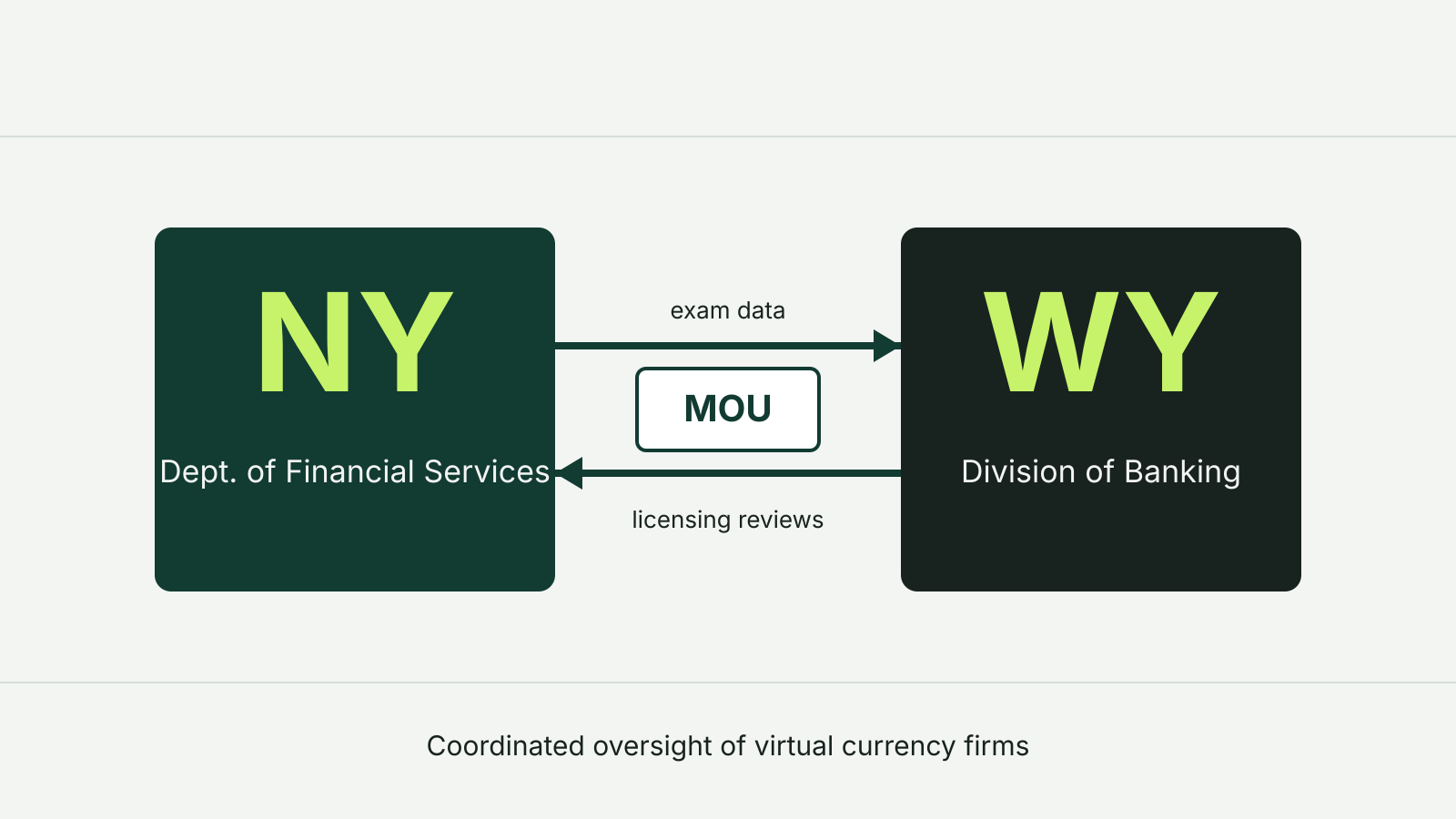
New York’s authorization also now connects to another state’s process. Under the October 1, 2026 memorandum with Wyoming’s Division of Banking, a firm supervised in one state for at least three years and not under an enforcement action can ask for an expedited review in the other. It still needs New York’s own license or charter.
Questions readers ask
Can a BitLicense holder act as a fiduciary?
No. Section 200.3(a) states that licensees are not authorized to exercise fiduciary powers under Section 100 of the Banking Law. That power comes with a Banking Law charter.
Does a trust company need a BitLicense as well?
Not if the superintendent has approved it to engage in virtual currency business activity. The licensing exemption in Section 200.3 covers such chartered entities.
Does a software developer need either one?
Publishing software is not virtual currency business activity on its own. Custody, transmission, exchange or issuance for customers in New York is.
Sources
- NYDFS: Virtual Currency Business Licensing.
- NYDFS: Procedure and Certificate of Merit for trust companies.
- NYDFS: Commercial Banks and Trusts.
- 23 NYCRR 200.2, definitions; 200.3, license; 200.5, application fees; 200.8, capital.
- NYDFS: Updated guidance on custodial structures, September 30, 2025.
- NYDFS: Industry letter on prior approval for virtual currency activity, December 15, 2022.
Sources reviewed October 2, 2026. This article describes the regulatory framework; it is not legal advice for a particular business.