A CFPB complaint is the federal government’s channel for a consumer who has a problem with a financial company and has not been able to fix it directly. The Consumer Financial Protection Bureau’s job in the process is to route it: it sends the complaint to the company, asks for a response and publishes basic data about it. That process gets companies to answer, and the published records show patterns regulators and researchers can study.
This guide covers how to file a CFPB complaint, what happens next, what becomes public and what the process cannot do. It is based on the CFPB’s own complaint pages, reviewed October 10, 2026.
What the CFPB takes complaints about
The bureau accepts complaints about consumer financial products and services, including:
- Checking and savings accounts, and credit cards
- Credit reports and other personal consumer reports
- Debt collection, and debt and credit management
- Money transfers, virtual currency and money services
- Mortgages, student loans and vehicle loans or leases
- Payday loans and personal loans such as installment, advance and title loans
- Prepaid cards
The complaint page also invites complaints about debanking, meaning an account or service denied or restricted because of political or religious beliefs, citing Executive Order 14331, “Guaranteeing Fair Banking for All Americans.” Complaints about issues outside its scope may be referred to another agency, and the bureau notes that it shares complaints with other federal and state regulators.
Before you file
Try the company first. The CFPB’s process starts from a dispute you have not been able to resolve, so it helps to have contacted the company and kept a record of what it said.
Credit report errors have a set order. For inaccurate or incomplete information on a credit report, the CFPB says you are required by law to dispute it directly with the consumer reporting agency first, then file if the dispute does not fix it.
Gather documents. Account numbers, dates, letters, statements and screenshots help the company find your account and help the bureau understand the issue. Don’t include more personal information than the complaint needs.
How to file a CFPB complaint
- Go to consumerfinance.gov/complaint, or call (855) 411-2372 (TTY/TDD (855) 729-2372) between 9 a.m. and 6 p.m. Eastern, Monday through Friday, except federal holidays. The bureau estimates 7 to 10 minutes online and 25 to 30 minutes by phone.
- Choose the product and the problem. The form asks you to pick the product, such as a credit card or mortgage, and the kind of problem.
- Describe what happened and what you want. Say what went wrong, what you have already done and what outcome would fix it, such as a refund, a correction or an explanation.
- Identify the company, give your contact details and attach documents. You need a name, email and phone number for the secure account, and an address so the company can respond.
- Decide whether to share your story publicly (see below), then submit. You can track the complaint and the company’s reply in your CFPB account.
If you think you have been the victim of a fraud or scam, the CFPB also points people to the Federal Trade Commission at ReportFraud.ftc.gov, and you may need to contact other local, state or federal agencies too. Someone can file for you only as your authorized representative.
What happens after you file
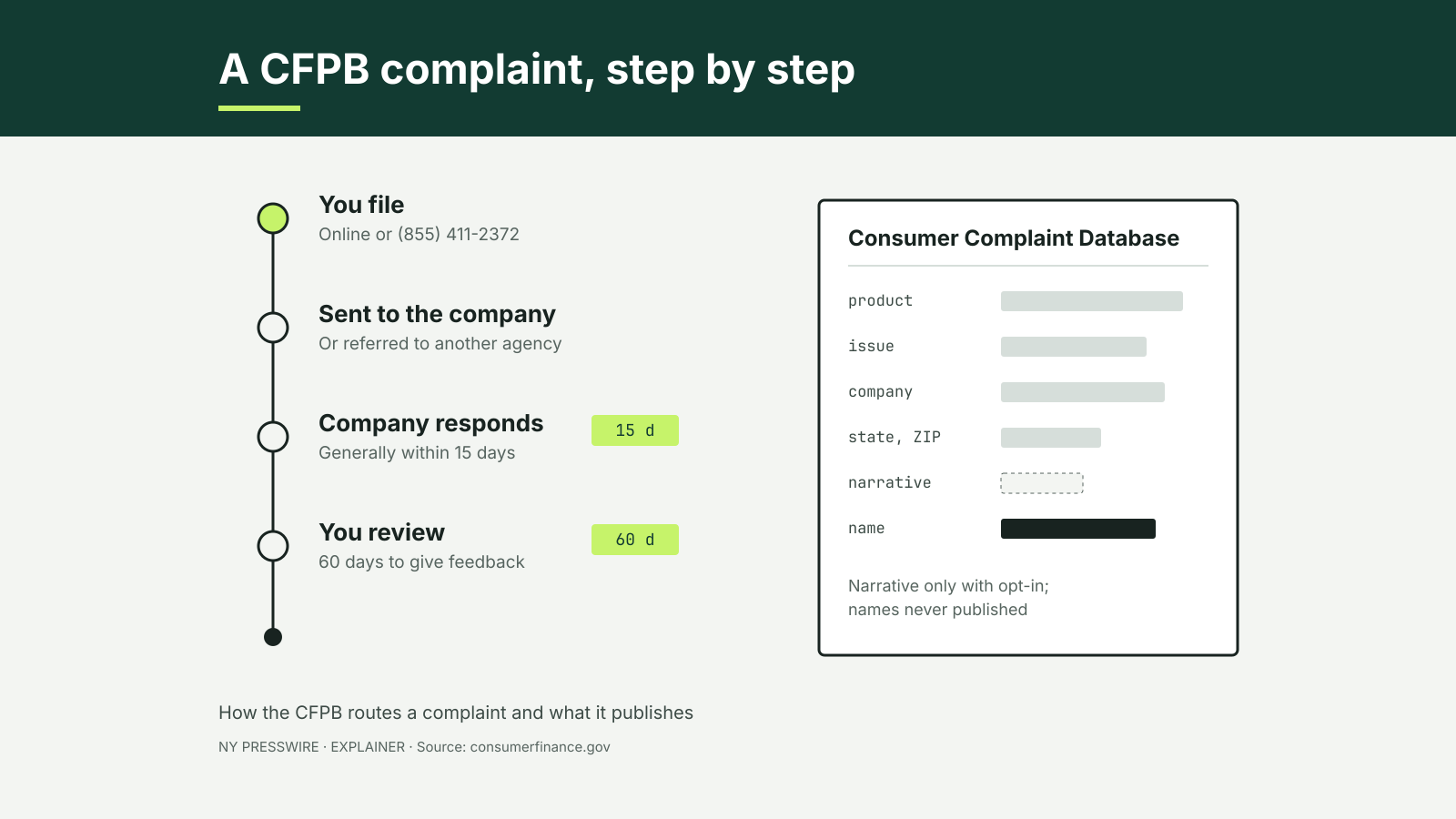
The CFPB forwards the complaint to the company, which reviews it, communicates with you if needed and responds. According to the bureau:
- Companies generally respond within 15 days. If a company can’t close the complaint in that time, it may say the work is in progress and give a final response within 60 days.
- You get 60 days to give feedback on the company’s response once it arrives.
- Some complaints go elsewhere. If another government agency handles the issue, the CFPB may send your complaint there and tell you. Complaints about depository institutions with less than $10 billion in assets, for example, are referred to other regulators.
The bureau says it sends more than 100,000 complaints a week to companies. It also uses complaints to inform its supervision and enforcement work and to share with other regulators.
Does filing a CFPB complaint work?
It usually gets a response: the CFPB’s database page says 98% of complaints sent to companies get timely responses. A response can unlock a refund, a correction or a clear answer that you could not get before. It does not guarantee the result you want, and the CFPB does not act as your lawyer. If the response is inadequate, use the feedback step to say so, and consider whether another route, such as a state regulator, an attorney or small claims court, fits the problem.
What becomes public
The CFPB publishes complaints in its Consumer Complaint Database, but not your name or contact details.
- Basic data such as the product, issue, company, state and ZIP code is published after the company responds or after 15 days, whichever comes first. The database is not a statistical sample, and complaints referred to other regulators are not published.
- Your written description is published only if you opt in, and only after the bureau removes personal information.
- The company’s response may be shown, if the company chooses a public response.
You can withdraw consent to publish your narrative by calling (855) 411-2372. The CFPB says it keeps personal information collected with complaints for 25 years under its records schedule and can’t delete it on request.
Refiling a complaint
The process page says that, in general, a complaint can’t be resubmitted about the same issue, including one that was already closed. If something new happens, file about the new problem and reference the earlier complaint. For questions about an existing complaint, use your account or call the bureau.
CFPB complaints and enforcement
Complaints and enforcement are different things. A complaint asks one company to answer one consumer. Enforcement actions are cases the bureau brings against companies for breaking federal consumer financial law; they are tracked on our enforcement actions page. The bureau’s supervision and enforcement teams use complaint data as one input among many.