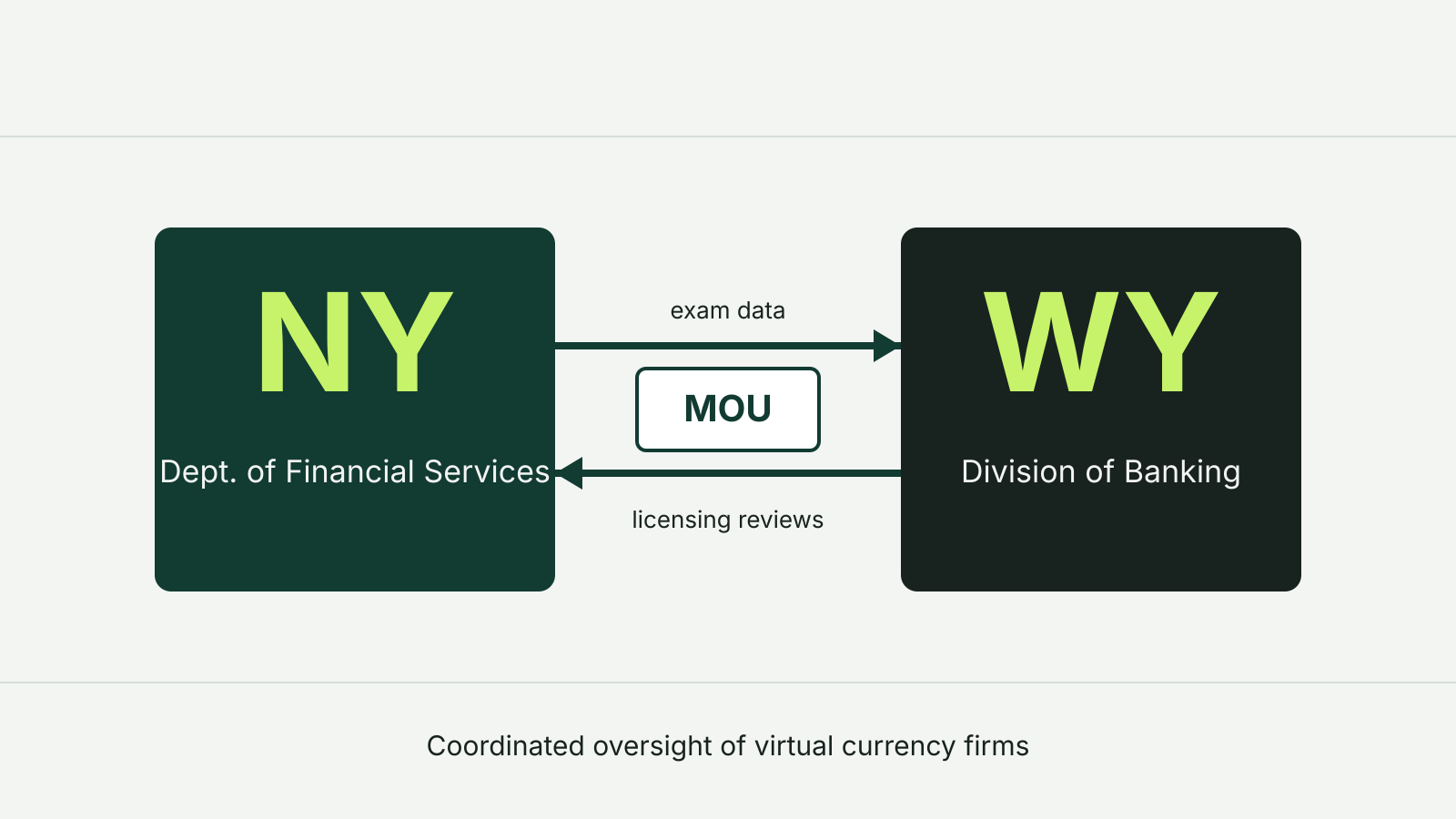
The New York-Wyoming crypto MOU, announced on October 1, 2026, commits New York’s Department of Financial Services and Wyoming’s Division of Banking to coordinate their oversight of companies that work with virtual currency and digital assets. It covers licensing, examinations and enforcement, and it sets out a faster review for some firms already supervised in one of the two states.
The DFS announcement names Acting Superintendent Kaitlin Asrow and Wyoming Banking Commissioner Jeremiah Bishop as the officials behind the agreement. The signed seven-page MOU carries signature dates of September 18 for New York and September 23 for Wyoming, after approval as to form by the Wyoming Attorney General’s office on September 11. It takes effect on the date of the last signature.
A shorter path for established firms
The licensing section is the part most applicants will read first. When a company licensed or chartered by one regulator applies to the other, the existing regulator will share information about it on request, and the two agencies will “confer to align their licensing decisions to the extent possible.”
An expedited review applies when three conditions are met: the firm holds a license or charter from one regulator, it has operated under that regulator’s oversight for at least three years, and it is not under an enforcement action. The regulators then meet to compare the business models proposed in each state. If they are sufficiently similar, the second regulator expedites its review and “shall endeavor” to reach a final decision within six months, counted from the application date or the date it receives the historical examination information, whichever is later.
For firms applying in both states at once, the regulators will share their analyses of the application and coordinate reviews.
Exams and enforcement
For companies licensed or chartered in both states, the agencies will try to coordinate examination schedules and, where practicable, run joint examinations, with either a joint report or separate coordinated reports. The MOU says neither side is expected to examine more often than its own law requires.
On enforcement, each regulator will try to notify the other when it reasonably believes a jointly supervised firm may face an action, share investigative information, and may act jointly, in coordination or separately.
What it does not change
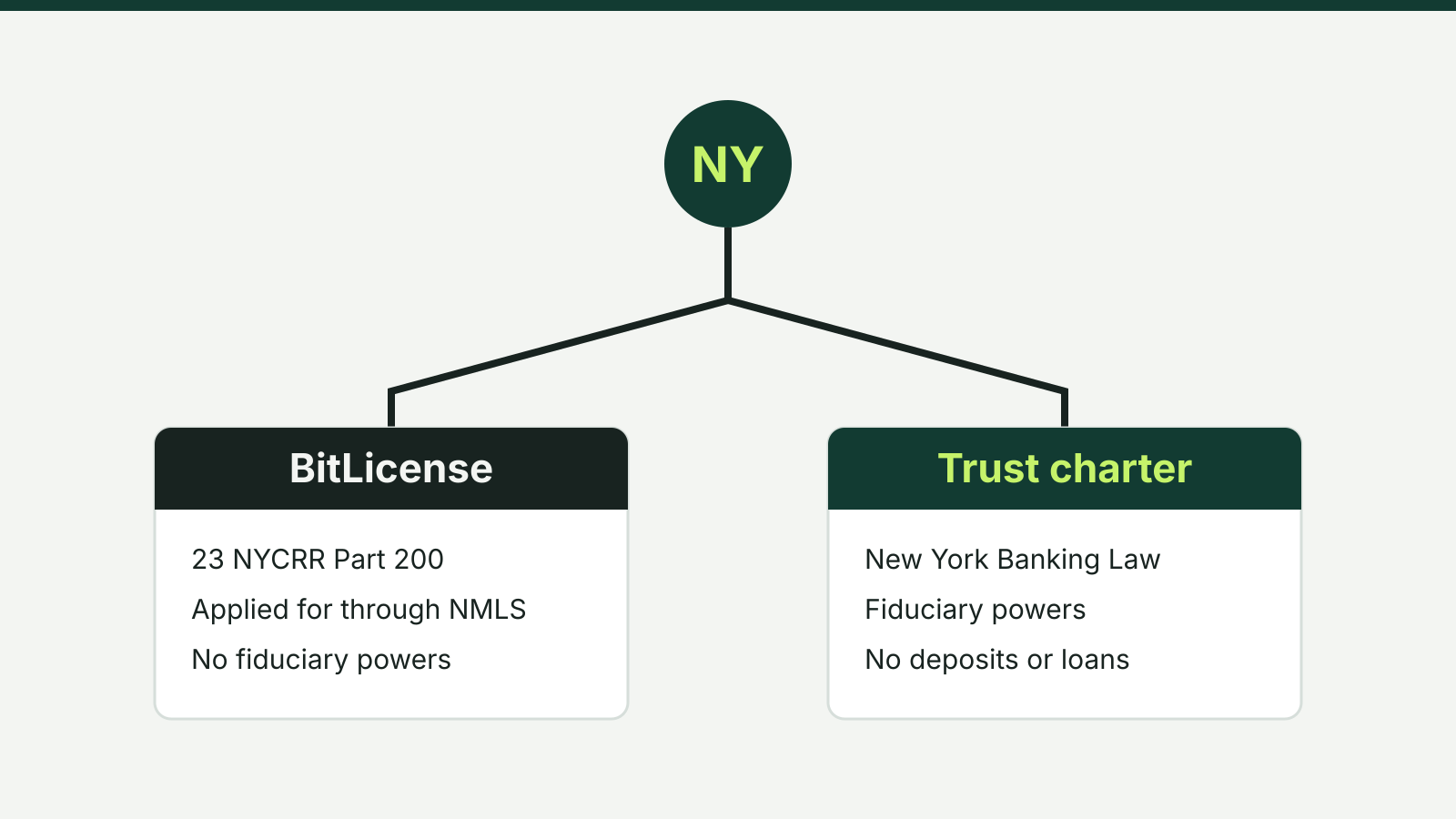
The MOU does not alter either agency’s legal authority, does not create enforceable rights for either party or for outside companies, and does not stop either regulator from acting on its own. Either side can end it with 30 days’ written notice. A firm still needs New York’s own authorization, a BitLicense under 23 NYCRR Part 200 or a Banking Law charter, to conduct virtual currency business in New York.
Companies already authorized by DFS appear in our NYDFS BitLicense list, and our explainer on BitLicense versus trust charter compares the two New York routes.
Questions readers ask
Does a Wyoming charter now count as a New York license?
No. The MOU gives no automatic recognition. A firm still applies to DFS, which may expedite the review if the conditions are met.
Who qualifies for the expedited review?
A firm licensed or chartered by one regulator for at least three years, not under an enforcement action, with a business model in the second state that the regulators judge sufficiently similar.
Can the agreement end?
Yes. Either regulator can terminate it with 30 calendar days’ written notice.
Sources
- NYDFS: press release on the MOU with the Wyoming Division of Banking, October 1, 2026.
- NYDFS: signed MOU between the Wyoming Department of Audit, Division of Banking and DFS.
Sources reviewed October 2, 2026.