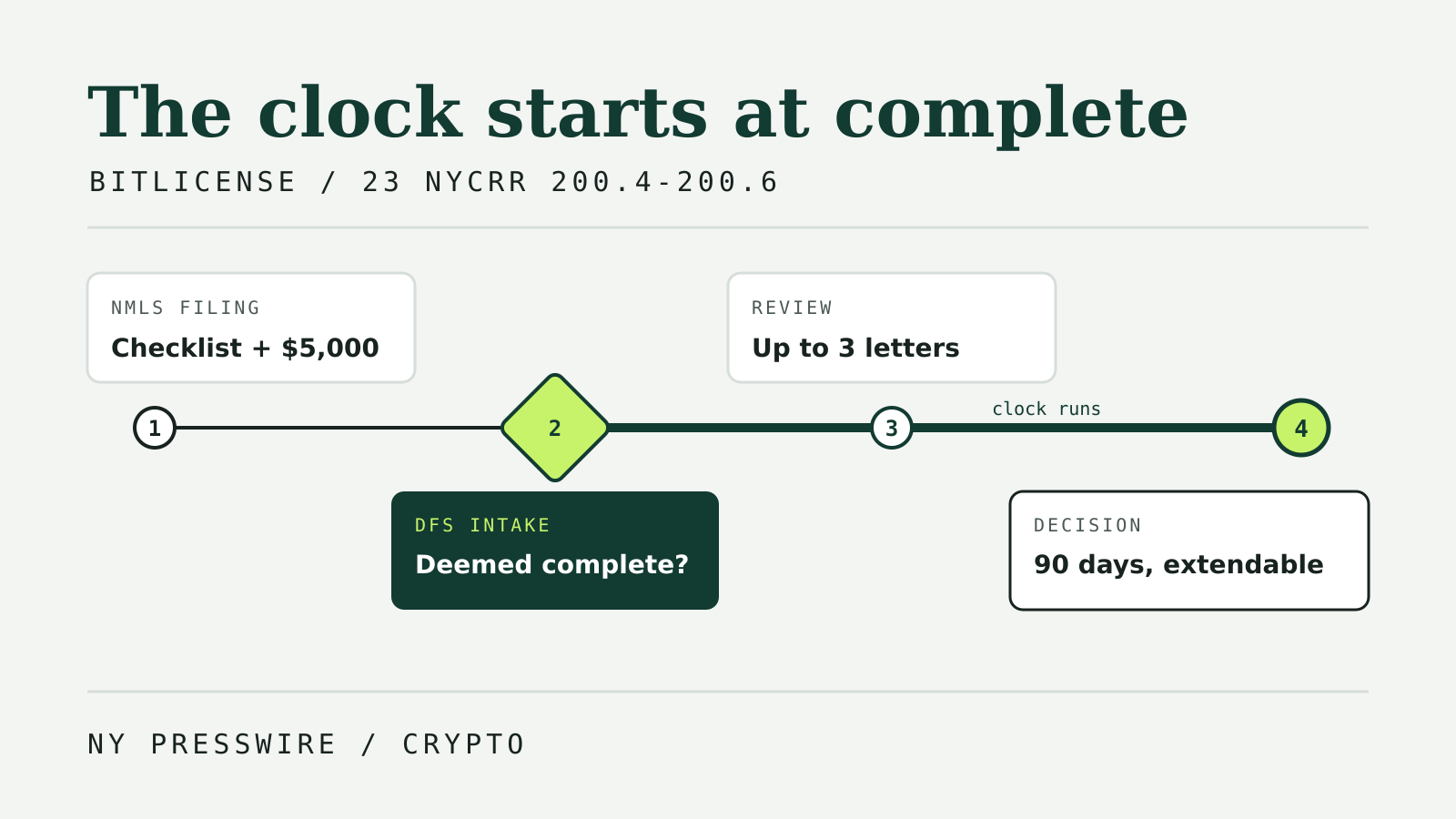
To get a BitLicense, a company files through the Nationwide Multistate Licensing System (NMLS), submits every item on New York’s BitLicense application checklist with a $5,000 nonrefundable fee, and then waits for the Department of Financial Services to decide the file is complete. That last step sets the timeline: the 90-day decision period in the regulation runs only from the day DFS deems the application complete, and DFS says missing checklist items are the most common cause of delay.
This guide follows the application from the first NMLS login to the decision, using 23 NYCRR Part 200 and DFS’s own pages, checked November 13, 2026.
Who has to apply
Section 200.2(q) requires a license for five activities involving New York or a New York resident: transmitting virtual currency, holding it for others, buying and selling it as a customer business, running exchange services, and controlling, administering or issuing a virtual currency. The DFS FAQ adds that out-of-state firms serving New Yorkers need one and that a FinCEN registration does not replace it.
A company chartered under the New York Banking Law, usually as a limited purpose trust company, can do the same business with DFS approval and no BitLicense. Our explainer on BitLicense vs trust charter compares the two routes.
Step by step
- Open an NMLS company account. File the Company Account Request Form and name a primary and a secondary administrator; DFS says login details arrive within three days. A firm that already filed Forms MU1 and MU2 for another state keeps its record but adds New York-specific information.
- Build the file from the checklist. DFS sends every applicant to the “NY Virtual Currency Business Activity License New Application Checklist” on NMLS. The NMLS identification number assigned to the application goes on every paper document sent to DFS.
- Pay the fee. Section 200.5 sets $5,000, kept by DFS if the application is denied or withdrawn.
- Pass intake. Under DFS’s June 24, 2020 notice on application procedures, a file is ready for substantive review only when every checklist document is in and each “appears to be adequate on its face.” A file can drop back out of review if an item turns out to be missing, or if a related company in the business model seems to need its own license and has not applied.
- Answer the deficiency letters. Each letter carries a return date. If the problems in one area, such as BSA/AML, cybersecurity or background checks, are still open after the third letter on it, DFS may deny the application without further notice.
- Get a decision. Section 200.6 has the superintendent investigate financial condition, business experience and “character and general fitness,” then approve or deny within 90 days of the application being deemed complete. The superintendent can extend that period.
A worked example: an application deemed complete on December 1, 2026 reaches the end of its 90 days on March 1, 2027, unless DFS extends it. Months spent at intake before that date do not count.
What the application must contain
Section 200.4(a) lists 15 items, filed in writing and under oath:
| Area | What the rule asks for | Paragraph |
|---|---|---|
| Company | Legal name, d/b/a, form, date and place of organization; affiliates with an organization chart | (1), (2) |
| People | Biographies and signed releases for directors, principal officers, stockholders and beneficiaries; independent background reports | (3), (4) |
| Fingerprints | For those people and every employee with access to customer funds, with two portrait-style photos each | (5) |
| Management | Chart of senior management and lines of authority | (6) |
| Finances | Current financial statements; projected balance sheet and income statement for the next year; banking arrangements | (7), (9) |
| Business plan | Products, websites, jurisdictions, target customers, any New York address | (8) |
| Compliance | Every written policy Part 200 requires | (10) |
| Legal and tax | Affidavit on pending or threatened actions; New York tax compliance; insurance, if any | (11) to (13) |
| Valuation | How virtual currency is valued in fiat | (14) |
Paragraph (15) lets the superintendent ask for more, and the applicant must show it will meet all of Part 200 on the day it is licensed.
What a license ties up
| Cost item | Amount or rule | Source |
|---|---|---|
| Application fee | $5,000, nonrefundable | 200.5 |
| Customer bond or trust account | Generally at least $500,000, per the DFS FAQ | 200.9 |
| Capital | Set firm by firm from assets, liabilities, volume, leverage, liquidity and products | 200.8 |
| Supervision | Four estimated quarterly bills and a year-end true-up, each due 30 days after billing | DFS assessments page |
The money transmitter question
A BitLicense covers virtual currency, not dollars. DFS’s FAQ says a firm that transmits fiat currency needs a money transmitter license under Article 13-B of the Banking Law, and its licensing page calls that a separate application. Our guide to the New York money transmitter license covers when a fintech needs one.
The DFS register shows how often the two go together. On November 13, 2026 it listed 26 BitLicense holders: 15 with a money transmitter license as well and 11 with the virtual currency license alone. All five holders listed with a 2025 or 2026 grant date hold both, from MoonPay USA (June 2025) to GalaxyOne Prime NY and Mastercard Transaction Services (May 2026). Our NYDFS BitLicense list keeps each authorization with its DFS source.
Conditional licenses
Section 200.4(c) lets DFS grant a conditional license to an applicant that does not yet meet every requirement. It can carry any reasonable conditions and heightened examination, and it expires two years after issue unless DFS renews it or lifts the conditional status. DFS may weigh, among other things, the firm’s risks, its FinCEN registration and licenses from other regulators. A June 2020 proposal to pair conditional licensees with an existing BitLicensee or trust company is still listed on DFS’s page as a request for comments.
After approval
Section 200.10 requires DFS’s prior written approval for a materially new product or a material change to an existing one. New coins follow the NYDFS coin listing policy, and cybersecurity follows Part 500.
DFS spelled out its marketing expectations on November 12, 2026, in its guidance on advertising and marketing. It expects board-approved policies reviewed every year, clear and conspicuous risk disclosures and ads that name the licensed entity. Its example of a misleading claim is “no-fee trading” that leaves out spreads or markups.