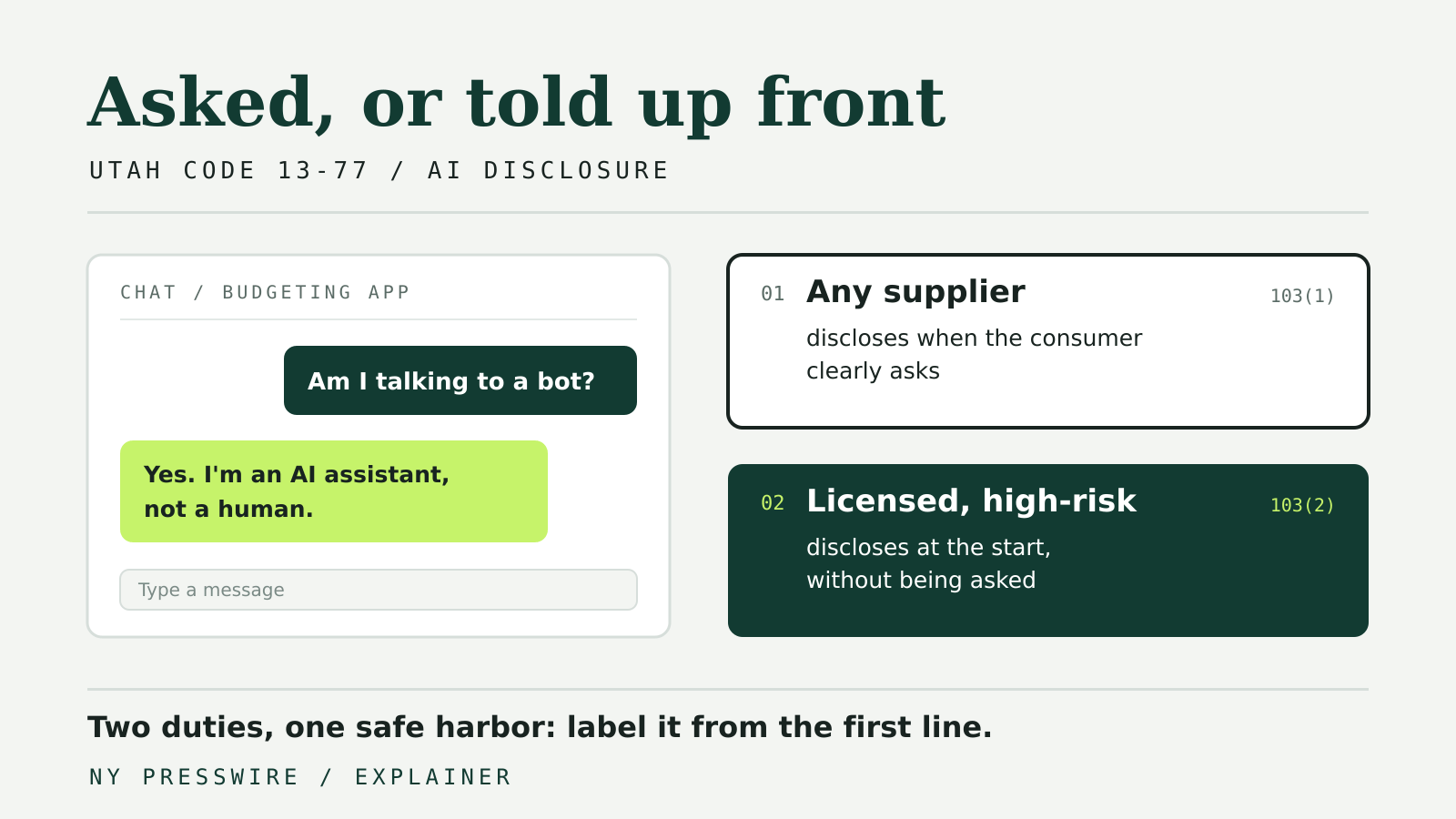
Utah’s AI disclosure law gives a business one of two jobs, depending on who is on the other side of the chat. A supplier whose generative AI talks with a consumer must admit it is AI when the person clearly asks. A licensed professional whose AI tool handles a high-risk conversation, such as collecting financial data, must say so at the start without being asked. Both rules sit in Chapter 77 of Title 13 of the Utah Code, in force since May 7, 2025.
For a fintech team, the hard part is working out which rule reaches its product, if either does. That turns on two borrowed definitions, “consumer transaction” and “regulated occupation,” and both leave out more of financial services than most summaries of the law mention.
The two duties in section 13-77-103
Section 13-77-103 sets them out:
- When asked. A supplier that uses generative AI to interact with an individual in connection with a consumer transaction must disclose that the person is dealing with generative AI and not a human, if the person asks or prompts. The question has to be “a clear and unambiguous request to determine whether the interaction is with a human or with artificial intelligence.”
- Up front, for licensed work. An individual providing services in a regulated occupation must prominently disclose generative AI use when it is a high-risk interaction: verbally at the start of a spoken exchange, in writing before a written one.
Section 13-77-101 defines a high-risk interaction as one that involves collecting sensitive personal information (health, financial or biometric data), or giving personalized recommendations, advice or information that someone could reasonably rely on for significant personal decisions, including financial advice or services, or another use the Division of Consumer Protection defines by rule. The items are joined by “or,” so collecting financial data is enough on its own.
The same section limits “generative artificial intelligence” to systems trained on data, designed to simulate human conversation, that produce non-scripted output with limited or no human oversight. A decision-tree bot that only serves prewritten answers falls outside it.
Two definitions that leave out much of finance
Chapter 77 takes “consumer transaction” from the Consumer Sales Practices Act. Section 13-11-3 covers sales and other transfers of goods, services or property for personal, family or household purposes, “except securities and insurance.” On the statute’s terms, the ask-and-answer duty does not reach a chatbot’s part in selling a security or an insurance policy. Payments, budgeting, deposits and lending are not on that excluded list.
A “regulated occupation” is one regulated by the Utah Department of Commerce that requires a license or state certification. Commerce houses the Division of Securities, which licenses investment adviser representatives and broker-dealer agents under section 61-1-3, and the Division of Real Estate, which administers the residential mortgage licensing chapter, along with the Division of Professional Licensing, according to the department’s own site. Banks, credit unions and other financial institutions answer to the separate Department of Financial Institutions, and the insurance code is run by the Insurance Department. The license also has to be held by an individual, so the up-front duty attaches to the licensed person, even when the firm built the tool.
Worked examples for fintech products
Our reading of the statute’s text, applied to common products:
| Product and conversation | Disclose when asked | Disclose up front | Why |
|---|---|---|---|
| Budgeting app chatbot answers a user’s spending questions | Yes | No | Personal-use service; no Commerce-licensed individual involved |
| Mortgage loan originator’s AI assistant collects a borrower’s income and assets | Yes | Yes | Originators are licensed through the Division of Real Estate; financial data makes it high-risk |
| Investment adviser representative’s AI tool gives a client a personalized allocation | Not for the securities sale | Yes | Licensed by the Division of Securities; personalized financial advice is high-risk |
| Bank or credit union chatbot handles a card dispute | Yes | No | Card and deposit services are not excluded; the bank’s regulator is not Commerce |
| Insurance agency chatbot quotes a renters policy | No | No | Insurance is excluded from “consumer transaction”; producers fall under the Insurance Department |
| FAQ bot with fixed, scripted answers | No | No | Not “generative” under section 13-77-101 |
Two caveats sit under the table. The Consumer Sales Practices Act carries its own exemptions in section 13-11-22, including credit terms and acts required or specifically permitted by state or federal law. Chapter 77 borrows that act’s definitions, and the text does not say whether those exemptions carry over. And “clear and unambiguous” will be tested by real chat logs. “Am I talking to a bot?” plainly qualifies. “Can I speak to someone?” asks for a transfer, and it is less obvious that it asks what the user is talking to.
The safe harbor
Section 13-77-104 protects a person from enforcement under section 13-77-103 if the generative AI clearly and conspicuously discloses, at the outset of the interaction and throughout it, that it is generative AI, is not human, or is an AI assistant. A persistent “AI assistant” label plus an opening line covers both duties and makes the wording of a user’s question irrelevant. The division may write rules on which forms of disclosure count; the division’s list of laws and rules shows no rule for Chapter 77 as of November 11, 2026.
Penalties
Under section 13-77-105, a violation counts as a deceptive act under section 13-11-4(1). The division director may impose an administrative fine of up to $2,500 per violation, and a court in a division case may order an injunction, disgorgement and repayment to injured consumers, and a fine of up to $2,500 per violation. Breaking an administrative or court order carries a civil penalty of up to $5,000 per violation. Section 13-77-102 adds that blaming the tool is no defense: a business cannot escape a consumer protection violation because its generative AI made the statement.
The 2027 date applies to a different chapter
Section 63I-2-213 repeals Chapter 72, the Artificial Intelligence Policy Act that runs the state’s AI office and learning laboratory, on July 1, 2027. It does not list Chapter 77, so the disclosure duties carry no repeal date of their own. Chapter 77 does depend on Chapter 72 in one place, though. It defines generative AI by pointing to the term “artificial intelligence technology” in section 13-72-101. If Chapter 72 lapses as scheduled, the definition Chapter 77 relies on goes with it unless the Legislature acts first.
The 2026 session touched Chapter 77 only lightly. Sections 13-77-101 and 13-77-102 were amended by Laws of Utah 2026, chapter 95, effective May 6, 2026, and a comparison of the two versions shows only updated cross-references to the division’s and the AI office’s code sections. Section 13-77-103, with the duties, still carries the text enacted by S.B. 226 in 2025, which also repealed the 2024 disclosure rule at former section 13-2-12.
Mental health chatbots have separate rules in Chapter 72a. Federal regulators look at chat tools from other angles, covered in our pieces on the CFPB’s chatbot report and FINRA’s generative AI guidance. This article explains the statute’s text and is not legal advice.