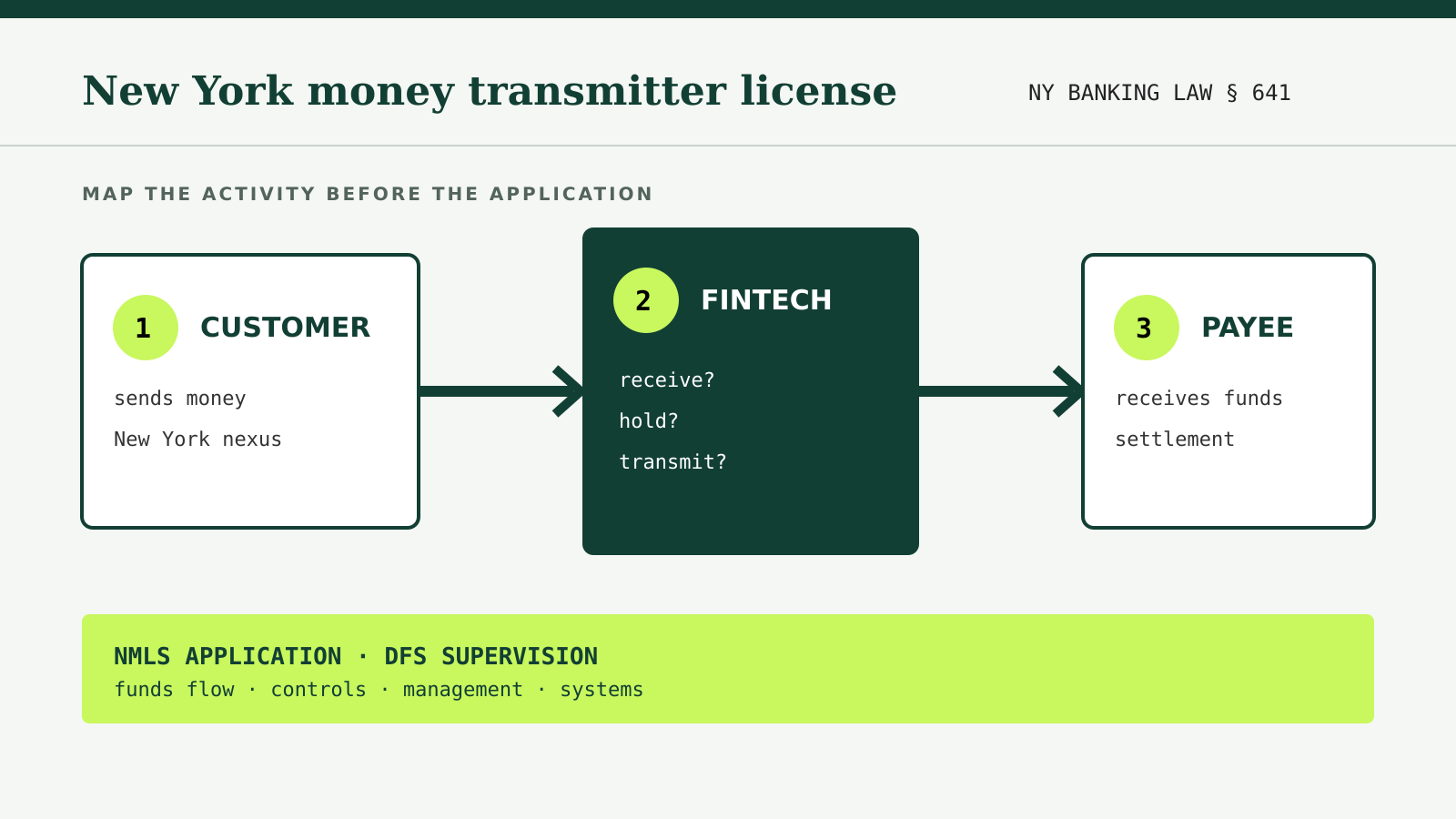
New York Banking Law generally requires a license before a business sells or issues checks, receives money for transmission, or transmits money. For a fintech product team, the difficult part is not finding that sentence. It is mapping the actual movement of customer funds, the parties involved, and the company’s role to the activities supervised by the New York State Department of Financial Services.
This guide is an operational starting point, not legal advice. A product label such as “wallet,” “marketplace,” “payments API,” or “stablecoin app” does not decide the licensing question. The flow of funds and the company’s obligations matter.
Start with the statutory trigger
DFS quotes Section 641(1) of the New York Banking Law on its licensing page: a person may not engage in the business of selling or issuing checks, receiving money for transmission, or transmitting money without a license from the superintendent, unless the person acts within an applicable authorized role.
That language should lead to a concrete product map. Document:
- who sends the money;
- who receives it;
- whether the company takes possession or control;
- which bank, processor, or licensed entity holds funds;
- when the customer’s obligation is considered paid;
- whether value can remain in an account or wallet;
- whether the company can redirect, delay, reverse, or release the funds;
- which entity contracts with the New York customer.
A diagram that skips settlement accounts, safeguarding arrangements, or agents will not answer the licensing question.
Product patterns that deserve review
Some designs are more likely to require a formal licensing analysis.
A stored-value or wallet product
If customers fund an account and later send value to another person or merchant, the company may be receiving money for transmission. The analysis should cover who legally holds the funds, whether the customer has a claim against the company, and how redemption works.
A marketplace that collects and pays sellers
Marketplaces sometimes assume they are only providing software. If the platform receives buyer funds and later pays sellers, its role in the flow needs review. Acting as an agent of a payee can be relevant, but the contract, disclosures, payment timing, and actual operation must support the claimed structure.
A payments API or orchestration layer
An API can be purely technical, or it can control payment instructions and funds. Product teams should separate messaging and routing from custody, settlement, and contractual responsibility. The name “orchestrator” does not create an exemption.
Cross-border remittances
Remittance products add federal requirements and other state regimes to the analysis. The New York question remains: does the business receive or transmit money for a New York customer or through a New York-regulated activity?
Virtual-currency services
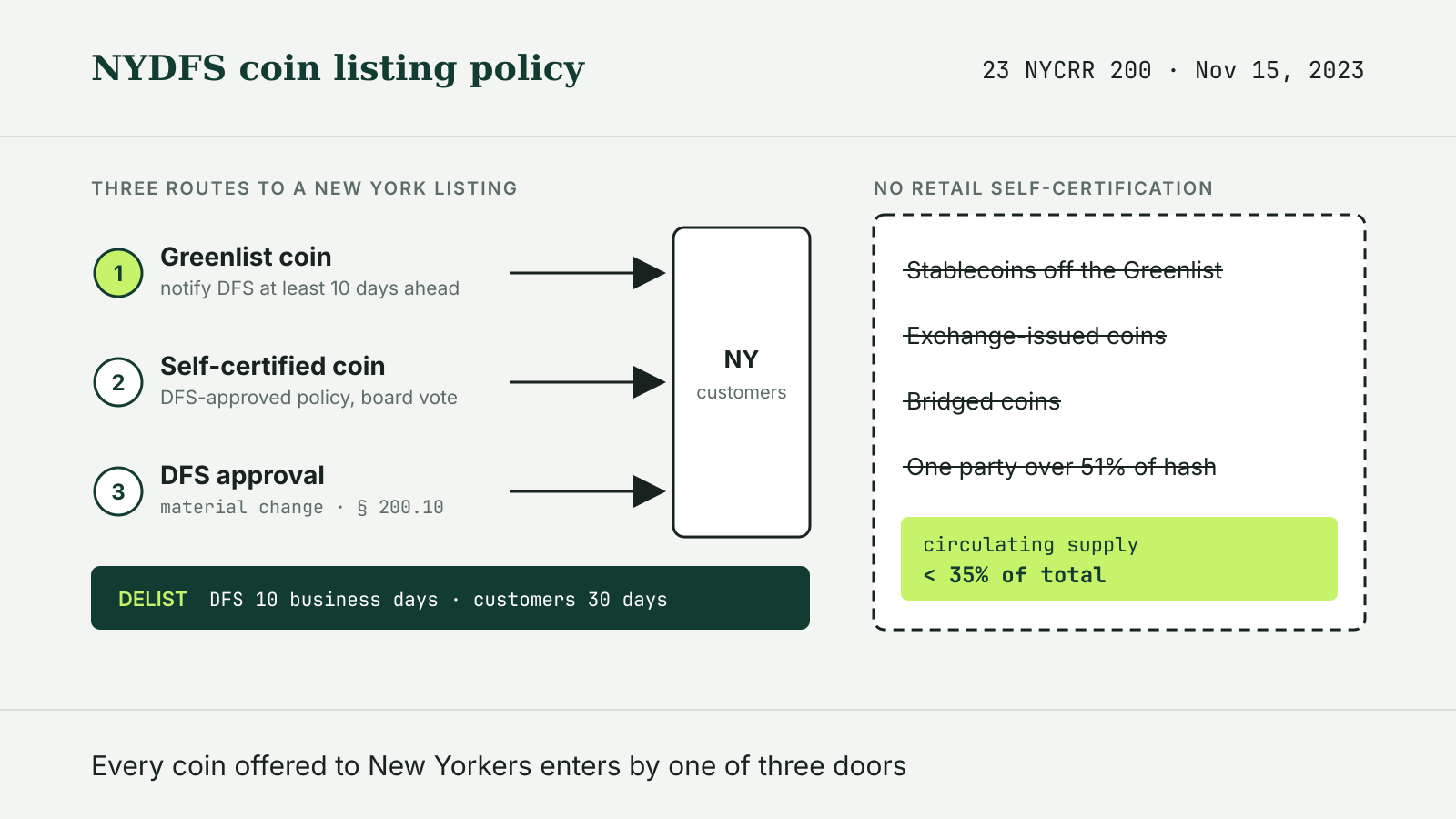
DFS maintains a separate virtual-currency licensing regime under 23 NYCRR Part 200. A company conducting virtual-currency business activity in New York may need a BitLicense or an approved New York banking charter. DFS explains that a limited-purpose trust company can engage in money transmission in New York without a separate money-transmitter license, while some listed firms hold both virtual-currency and money-transmitter licenses.
Do not assume that a BitLicense and a money-transmitter license are interchangeable. The required authorization depends on the activities and legal structure.
The application runs through NMLS
DFS uses the Nationwide Multistate Licensing System and Registry to manage money-transmitter applications and ongoing regulation. A company entering NMLS for the first time must request a company account and name primary and secondary account administrators.
DFS says a complete application must include all required information, documents, and fees. The department may request additional supporting material during review. NMLS assigns an identification number that becomes the application reference and must appear on hard-copy submissions to DFS.
An applicant that has already filed company and individual forms through NMLS for another state does not have to recreate the entire company record, but it still must provide New York-specific information.
This is why a “50-state filing” cannot be treated as one generic packet. Shared corporate data helps, but New York asks its own questions and applies its own law.
Build the evidence before filing
A product and compliance team should prepare a consistent set of records before the application reaches regulators:
- Funds-flow diagrams. Show every account, entity, processor, bank, agent, and settlement step.
- Product terms. Make the contractual role match what the system actually does.
- Policies and controls. Cover anti-money-laundering responsibilities, sanctions, transaction monitoring, complaints, fraud, information security, business continuity, and vendor oversight as applicable.
- Financial records. Identify capital, permissible investments, safeguarding, and how outstanding obligations are covered.
- Ownership and management. Keep organizational charts, control persons, biographies, background material, and governance approvals current.
- Technology documentation. Explain systems, access controls, data flows, monitoring, incident response, and change management.
Inconsistency is costly. If the architecture diagram says a partner bank holds funds but the customer terms say the fintech holds the balance, the application team must resolve the contradiction rather than explain it away.
Licensing is not the end of supervision
DFS examines licensed money transmitters for compliance with state and federal law and for safety-and-soundness concerns. The department assigns a FILMS rating covering financial condition, internal controls and auditing, legal and regulatory compliance, management, and systems and technology.
Ratings range from 1, described as strong, to 5, unsatisfactory. DFS says ratings of 4 or 5, or severe violations and deficiencies, can lead to actions including fines, suspension, and revocation.
Product changes therefore need a regulatory-change process after licensing. Adding a new funding method, asset, geography, agent network, settlement model, or customer type can change the risk and the accuracy of filed information.
Agents and third parties still need oversight
DFS uses NMLS’s Uniform Authorized Agent Reporting functionality for agent reporting. A licensed entity cannot treat agents and vendors as invisible infrastructure.
Maintain an inventory of authorized agents and material service providers, define which party performs each control, and verify that reporting matches production. Contractual allocation helps establish responsibility, but it does not replace monitoring.
The same principle applies to changes in directors, officers, owners, and control persons. DFS lists notification and documentary requirements for certain changes, with separate NMLS amendment procedures for licenses managed there.
A practical pre-launch checkpoint
Before opening a New York payment flow, ask:
- Have counsel and compliance reviewed the current, not planned, funds flow?
- Is the contracting entity the same entity shown in the application?
- Does any affiliate receive, hold, or transmit value?
- Are bank and processor agreements final enough to support the described model?
- Are customer terms, disclosures, and product screens consistent with the legal structure?
- Does the roadmap include activities that would require a different or additional authorization?
- Is there a plan for NMLS filings, agent reporting, examinations, and material changes?
If any answer is uncertain, pause the New York launch path until the structure is documented. A license analysis completed before the product architecture settles can become obsolete before release.
For adjacent New York digital-asset controls, see our explanation of the NYDFS coin-listing policy. Teams building automated decision systems should separately review model-risk management expectations.
Questions fintech teams ask
Does every payments software company need a New York license?
No. A purely technical provider may have a different role from a business that receives or controls funds. The actual funds flow, contracts, and customer relationship need review.
Is an NMLS filing the same as approval?
No. NMLS is the system DFS uses for applications and ongoing regulation. DFS determines whether an application is complete and whether to grant a license.
Does a BitLicense cover ordinary money transmission?
Not automatically. DFS distinguishes virtual-currency authorization from money-transmitter licensing. Certain chartered entities can have broader authority, while some firms hold both licenses.
What happens after the license is granted?
The licensee remains subject to reporting, examinations, change notifications, and supervision. DFS evaluates financial condition, controls, compliance, management, and technology.