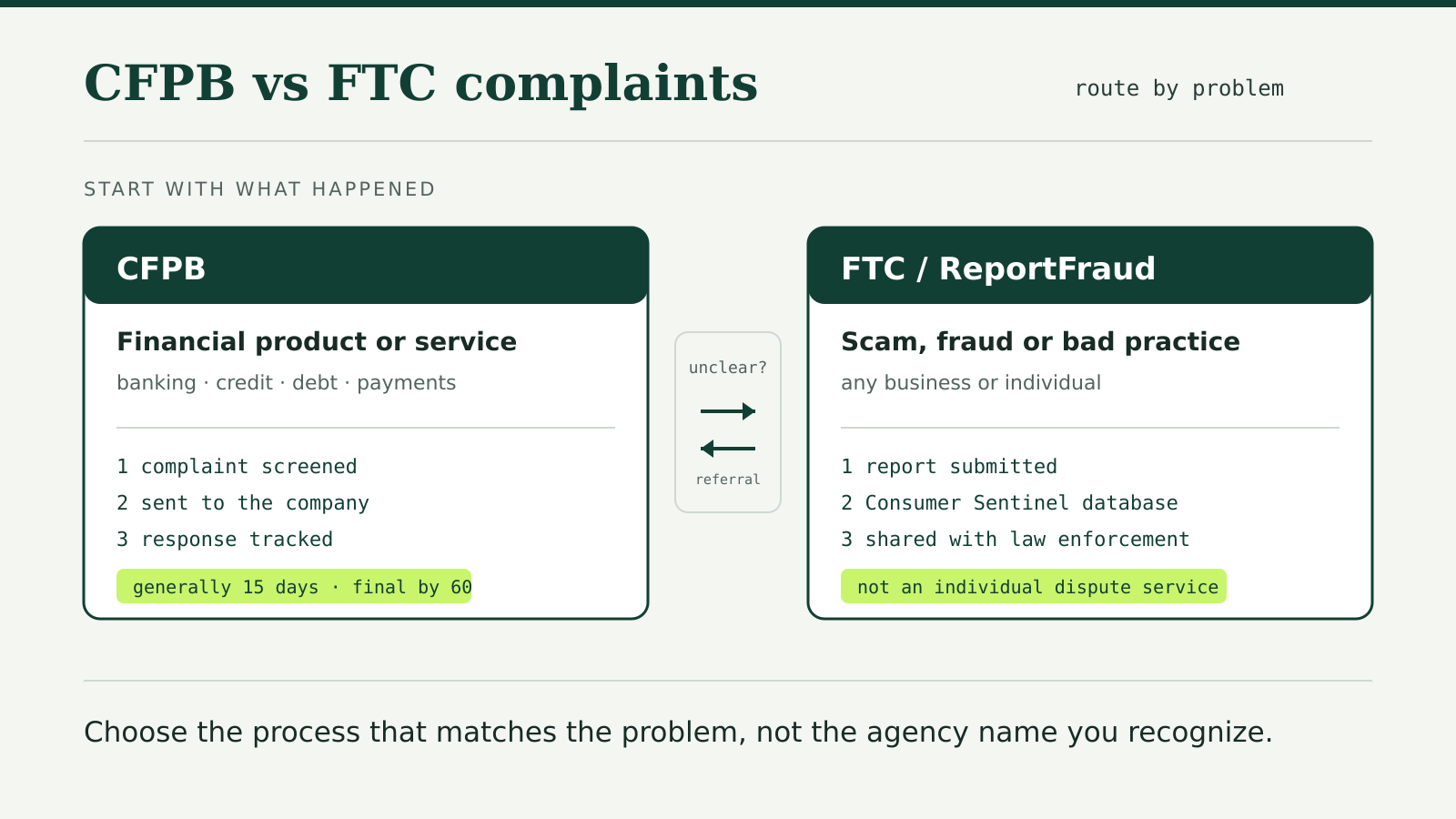
A CFPB complaint is the better route when the problem concerns a consumer financial product or service and you want the company to answer through a tracked process. An FTC report is the better route for a scam, fraud or bad business practice that investigators may use to identify patterns and bring cases. The two systems collect different information and promise different kinds of follow-up.
That distinction matters because filing with the wrong agency can add a handoff without changing the underlying problem. This guide compares CFPB vs FTC complaints, what each portal does after submission, and where the two routes overlap.
Use the CFPB for a financial product or service
The Consumer Financial Protection Bureau accepts complaints about consumer financial products and services. That includes problems involving bank accounts, credit cards, consumer loans, mortgages, debt collection, credit reporting, money transfers and other services within the bureau’s complaint categories.
The CFPB’s five-step complaint process is built around a company response:
- You submit the complaint and receive status updates.
- The bureau screens and routes it.
- The company reviews the complaint and responds.
- Eligible complaint information may be published without details that directly identify you.
- You can review the response and provide feedback.
The bureau says companies generally respond within 15 days. A company can mark its response as in progress and provide a final response within 60 days. That is a response timetable, not a guarantee that the company will give the remedy you asked for.
Our separate guide explains how to file a CFPB complaint, including what to gather before starting and what the public database can show.
Use ReportFraud for scams and bad business practices
The Federal Trade Commission’s ReportFraud portal takes reports about scams, fraud and bad business practices. Its questions help classify what happened, the business or person involved, the way you were contacted and any money lost.
The result is different from a CFPB complaint. The FTC says reports enter its Consumer Sentinel database, which is available to federal, state and local law-enforcement partners. Investigators use the reports to detect patterns and build cases. The agency is explicit that it cannot resolve an individual report for you.
That makes ReportFraud useful even when the money is unlikely to be recovered through the report itself. A cluster of similar reports can show how a scheme operates, which payment channels it uses and how widely it has spread.
Identity theft has a separate federal route. The FTC directs identity-theft victims to IdentityTheft.gov, which creates a recovery plan in addition to taking the report.
The practical difference
| Question | CFPB complaint | FTC ReportFraud |
|---|---|---|
| Main subject | Consumer financial product or service | Scam, fraud or bad business practice |
| What happens next | Complaint is routed to the company for a response | Report enters a law-enforcement database |
| Individual status tracking | Yes | The portal records the report, but the FTC does not resolve it individually |
| Published data | Eligible complaint information may appear in the CFPB database | Reports support investigations and aggregate fraud data |
| Typical objective | Get a documented company response | Alert investigators and contribute evidence about a pattern |
The agencies can refer matters. The CFPB says it will send a complaint to another government agency when that agency is better able to assist. Filing with one agency therefore does not necessarily trap a report in the wrong system, but choosing the closer fit avoids an extra step.
When the same incident fits both
A single incident can have two parts. Suppose a scammer persuades someone to send money, and the person’s bank then mishandles the dispute. The scam itself fits ReportFraud. The bank’s handling of the financial product may fit a CFPB complaint.
Treat those as separate factual records. In the FTC report, describe the scammer, contact method, payment request and loss. In the CFPB complaint, describe the financial company, the account or transaction, the dispute already made and the response received. Do not make one narrative carry claims that belong to the other process.
Other reports may also be appropriate. Local police, a state attorney general, a bank’s fraud team or a sector regulator may have a role. Neither the CFPB nor the FTC portal replaces an emergency call, a time-sensitive attempt to stop a transfer, or legal advice.
What to prepare before submitting
For either route, make a short chronology before opening the form:
- names of the company, person or account involved;
- dates, amounts and transaction identifiers;
- copies of messages, statements, receipts or dispute letters;
- the outcome you requested and any response already received;
- how and when you discovered the problem.
Avoid sending passwords, authentication codes or unrelated sensitive records. Use the portal’s requested fields and upload only evidence that supports the report.