The U.S. Treasury’s quarterly refunding is not a single auction and it is not a forecast of interest rates. It is a recurring decision process that turns the government’s financing needs into a concrete mix of bills, notes, bonds and buybacks.
For anyone following public finance, the useful part is knowing which document answers which question — and when it appears.
Document check: This guide reflects Treasury documents available on August 5, 2026. Treasury’s current calendar lists the next borrowing estimates for November 2 and the next quarterly refunding announcement for November 4, 2026.
What “quarterly refunding” means
Treasury says major debt-management decisions are generally informed by, and communicated through, the quarterly refunding process near the middle of each calendar quarter. The process covers much more than replacing securities that are about to mature. It also explains how Treasury expects to raise new cash, how it plans to distribute issuance across maturities, and how buybacks fit into its operating plans.
That distinction matters. “Refunding” is the name of the process, but the resulting package can both refinance maturing debt and raise additional cash.
The sequence of documents
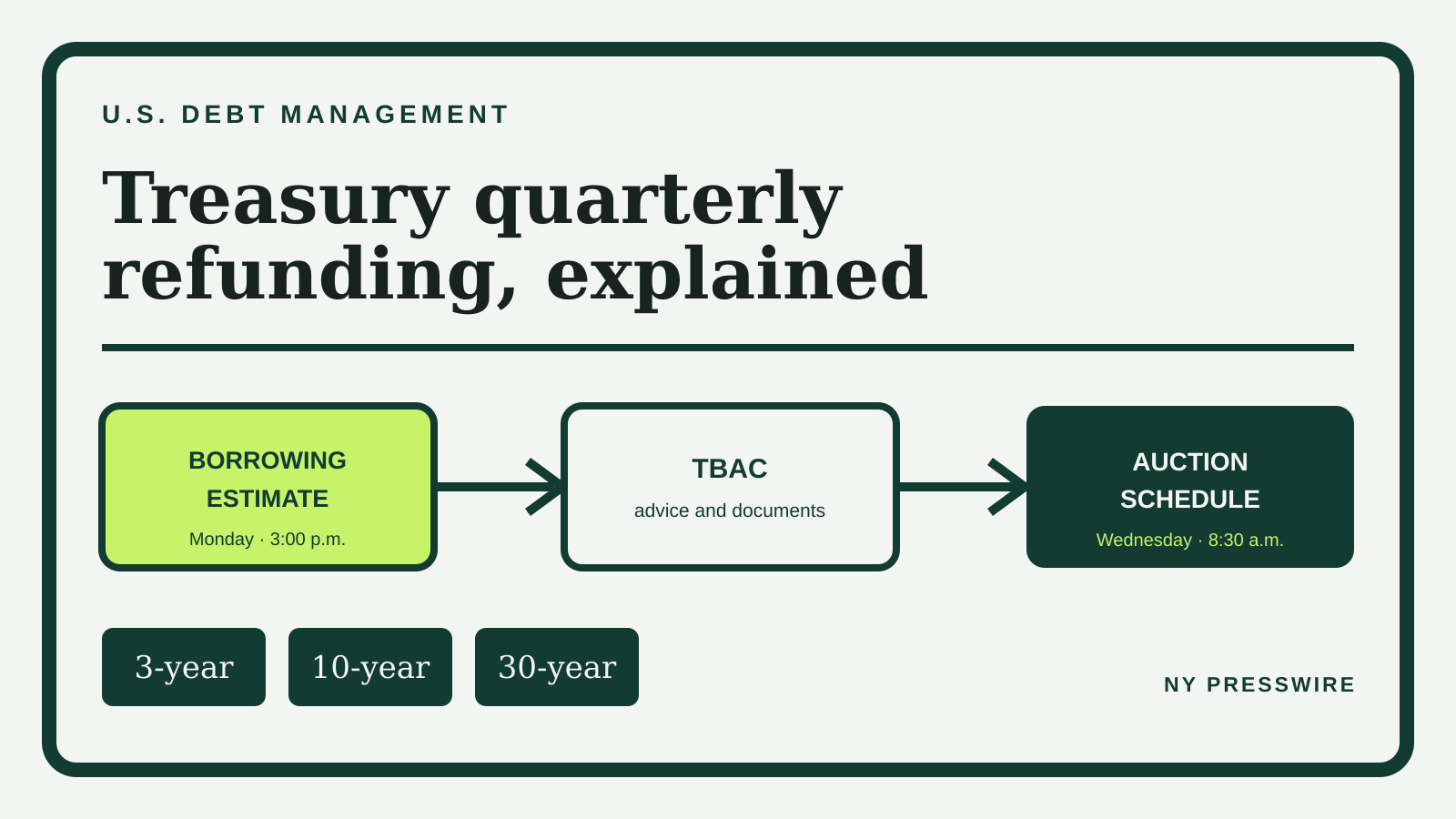
A normal refunding week has two main public milestones.
1. Borrowing estimates
Treasury first publishes its estimate of privately held net marketable borrowing for the current and following quarters. The release also states an assumed end-of-quarter cash balance.
The August 3, 2026 release, for example, estimated $739 billion of borrowing for July–September and $628 billion for October–December, based on stated Treasury General Account assumptions. Those figures were estimates for those specific quarters, not a permanent run rate.
Read the assumptions alongside the headline number. A change in projected borrowing can come from fiscal flows, cash-balance assumptions, or both.
2. The refunding statement and auction schedules
Two days later, Treasury publishes the policy statement, auction sizes and associated schedules. The accompanying materials can include Treasury Borrowing Advisory Committee documents, economic presentations, dealer meeting minutes and buyback schedules.
In the August 5, 2026 statement, Treasury announced a $125 billion refunding package: a $58 billion three-year note, a $42 billion ten-year note and a $25 billion thirty-year bond. Treasury said the package would refund about $96.3 billion of privately held securities and raise about $28.7 billion in new cash.
The official quarterly refunding page is the best starting point. Treasury also maintains a most recent documents page that groups the materials for the current cycle.
What TBAC does — and does not do
The Treasury Borrowing Advisory Committee gives Treasury market-informed recommendations on debt-management questions. Its meeting materials can be useful for understanding the trade-offs being discussed: demand across maturities, issuance regularity, buybacks and market functioning.
But TBAC does not set the final auction sizes. Its recommendations are advisory. Treasury makes and publishes the financing decisions.
That is why a committee presentation and the Treasury statement should not be treated as interchangeable sources. When they differ, the Treasury announcement is the operative document.
How the auction package fits the rest of financing
The three-, ten- and thirty-year auctions are the most visible part of a refunding package, but they are not the whole financing program.
Treasury’s August statement said it expected to meet remaining financing needs through regular weekly bill auctions, cash management bills and monthly issuance of other nominal coupon securities, Treasury Inflation-Protected Securities and floating-rate notes.
The schedule therefore answers two separate questions:
- Which benchmark securities are being auctioned as part of the refunding?
- What other instruments will Treasury continue using to manage its cash needs?
For a practical introduction to the mechanics behind those sales, see our guide to how Treasury bill auctions work. If you are comparing short-term yields, the T-bill calculator can help translate a quoted discount rate into a more usable return measure.
What readers should check first
A quick reading order makes the release easier to use:
- Borrowing estimate: current-quarter and next-quarter needs, plus cash-balance assumptions.
- Refunding statement: final auction sizes, timing and policy language.
- Auction and buyback schedules: operational dates and maturity buckets.
- TBAC materials: the analysis behind recommendations, clearly separated from Treasury’s decisions.
- Changes from the prior quarter: shifts in sizes, cadence or instrument mix.
Do not infer a policy signal from one number in isolation. Auction sizes, cash balances and bill supply interact, and Treasury frequently emphasizes regular and predictable issuance.
Where to find the official record
Treasury’s August 3 borrowing-estimates release provides the financing estimates and assumptions for the two quarters then in view. The August 5 refunding statement contains the final package, auction details and broader issuance guidance.
Treasury’s document index should remain the source of record for later revisions or the next cycle. This explainer describes how to read the process; it is not investment advice and does not predict rates, prices or future issuance decisions.