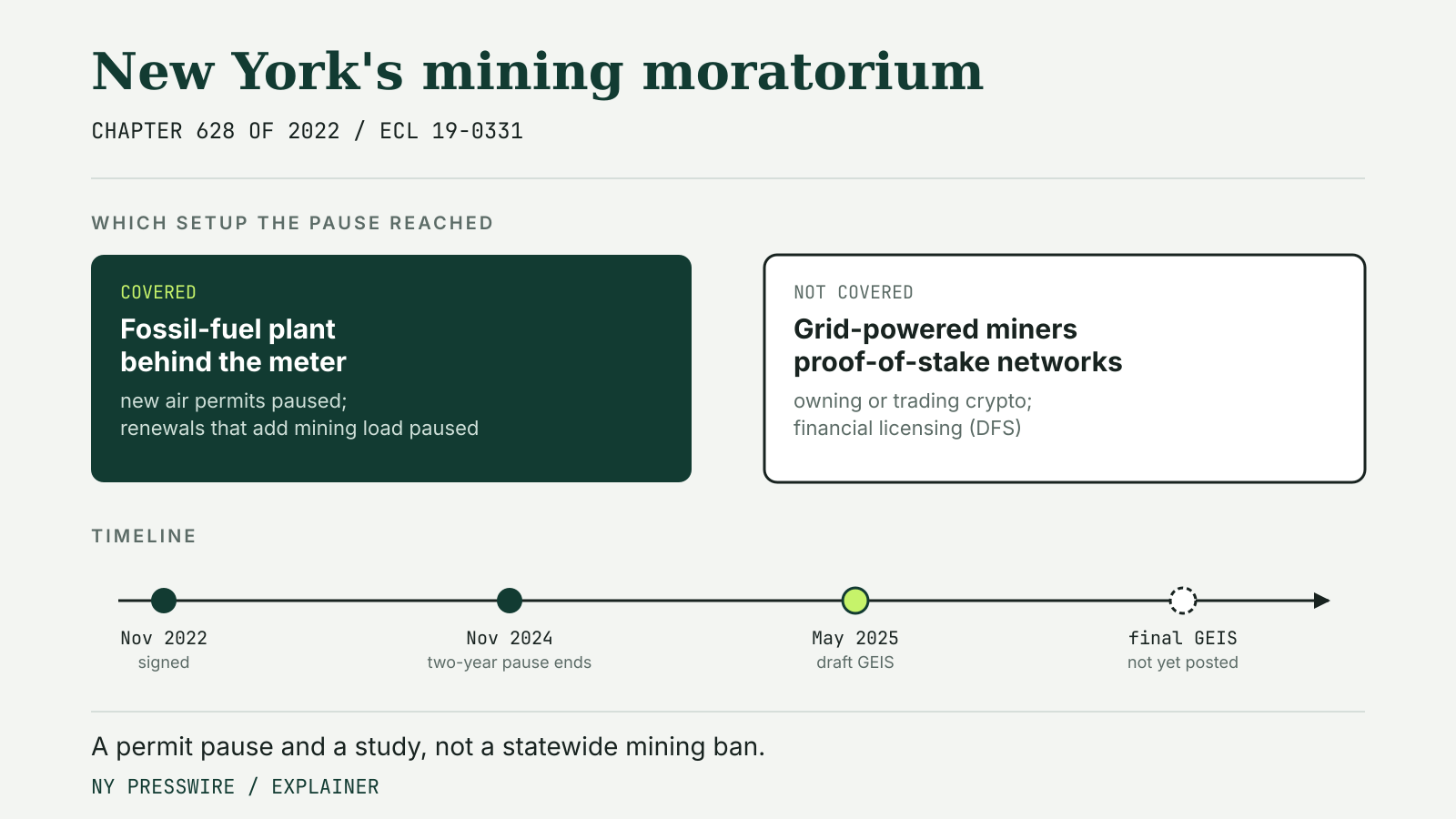
New York’s crypto mining moratorium is narrower than its nickname. The 2022 law did not ban bitcoin mining in the state. It paused one kind of air permit, for fossil-fuel power plants that feed proof-of-work miners directly, for two years, and it ordered the state’s environmental agency to study the whole industry. The pause has run its course. The study has been published only in draft.
What the law says
The measure began as Assembly bill A7389C, sponsored by Assemblymember Anna Kelles. The Assembly passed it on April 26, 2022, the Senate passed it on June 2, 2022, and the governor signed it on November 22, 2022 as Chapter 628 of the Laws of 2022. The bill took effect immediately and applies to permits and renewal applications filed after that date.
It added section 19-0331 to the Environmental Conservation Law, titled “Moratorium on air permit issuance and renewal.” The section has two parts:
- For two years, the Department of Environmental Conservation (DEC), after consulting the Department of Public Service, could not approve a new application or issue a new air permit for an electric generating facility that uses a carbon-based fuel and supplies behind-the-meter electricity, in whole or in part, to proof-of-work mining.
- For the same two years, DEC could not renew an existing permit for such a facility if the renewal would increase the electricity used by the mining operation.
The law defines proof-of-work as a consensus algorithm in which competitors complete new blocks and the difficulty rises in a way designed to, or that results in, more energy use for each competitor. Its legislative findings tie the measure to the state’s Climate Leadership and Community Protection Act, which requires an 85% cut in statewide greenhouse gas emissions by 2050.
What the moratorium did not cover
The text targets a specific setup: a fossil-fuel plant with miners on the same side of the meter. It says nothing about miners that buy power from the grid, miners running on hydropower or other non-carbon generation, or proof-of-stake networks. It does not prohibit owning, trading or mining crypto.
It also has nothing to do with financial licensing. A mining company’s power plant needs environmental permits from DEC. A company that holds or exchanges customers’ crypto needs authorization from the Department of Financial Services, which our guide to BitLicense and trust charters covers. The two regimes answer different questions.
The two-year clock
DEC’s draft generic environmental impact statement states the moratorium period as November 22, 2022 to November 22, 2024. That window has closed.
The end of the pause does not settle how an individual plant is reviewed. DEC’s draft study says it is meant to inform site-specific reviews and does not replace reviews of individual facilities under the State Environmental Quality Review Act or the Climate Act.
The environmental study
Section 3 of the law told DEC to prepare a generic environmental impact statement (GEIS) on proof-of-work mining. It listed ten topics, including the number and location of existing operations, how much electricity each uses and where that power comes from, emissions, water use, public health effects, and social and economic costs and benefits. A draft had to get 120 days of public comment and at least one hearing in each of eight named regions. The final statement was due no later than one year after the law took effect.
The work ran well past that deadline. According to DEC’s notices:
| Step | Date | Source |
|---|---|---|
| Final scope published | April 10, 2024 | DEC Environmental Notice Bulletin |
| Draft GEIS released | May 28, 2025 | DEC Environmental Notice Bulletin |
| Regional virtual hearings | July 2025, eight regions | DEC hearing notice |
| Written comments closed | September 25, 2025 | DEC notices |
When we checked DEC’s climate statutes page on October 23, 2026, it listed the final scope, the draft GEIS and the eight hearings, but no final GEIS.
What the draft found
The draft identified 11 known mining operations in New York with relevant public information. DEC said the public data do not show the validation method, so it assumed all known large operations use proof-of-work and run at full capacity. On that basis it estimated total demand of about 7.7 TWh a year, of which 6.1 TWh came from the grid and 1.6 TWh from on-site generation, and emissions of about 3 million metric tons of CO2e a year.
Eight of the 11 facilities sit in communities the state classifies as disadvantaged. One of them, Greenidge Generation, produces its own electricity by burning natural gas, according to the draft.
DEC was open about the limits. Miners are not required to report their electricity use, the only forward-looking data come from grid interconnection requests for loads above 10 MW, and growth projections are, in the draft’s words, highly uncertain. Those caveats apply to every figure above.
The draft’s alternatives section ranges from taking no new action to requiring a move to renewable or zero-emission power, including a possible license specific to proof-of-work miners with decarbonization conditions. Those are options for policymakers to weigh, not rules in force.
What to watch
Three documents will settle where New York lands: the final GEIS, any bill that turns one of the draft’s alternatives into law, and DEC’s permit decisions for individual plants. Each is public, and each matters more than headlines that describe the 2022 law as a ban.
For how New York applies its older securities statute to crypto firms, see our explainer on the Martin Act.