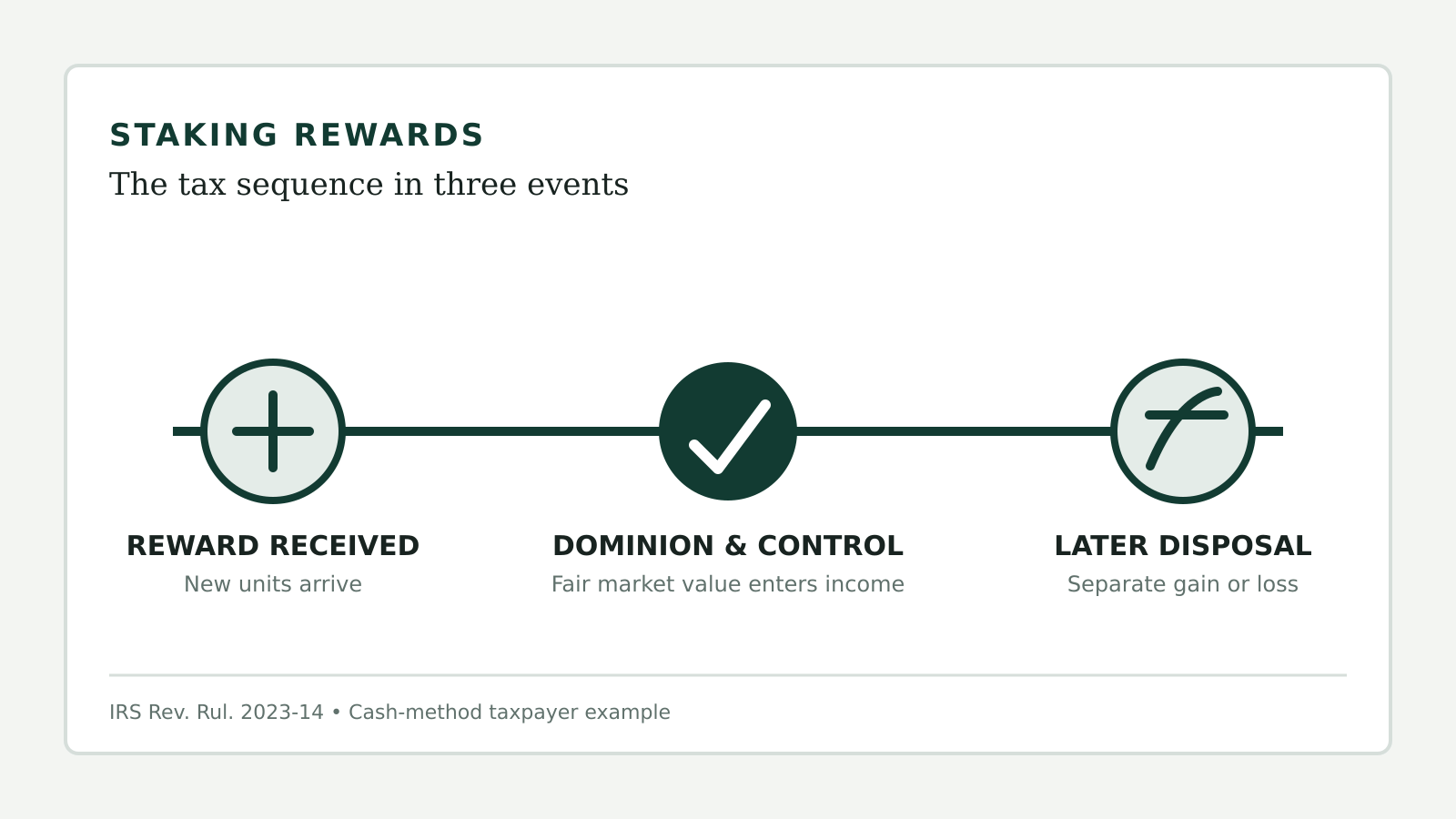
Crypto staking rewards taxes involve two separate events under current IRS guidance. A cash-method taxpayer includes the fair market value of validation rewards in gross income when the taxpayer gains dominion and control over the units. A later sale, exchange or other disposal is a separate property transaction that can create a gain or loss.
The core rule comes from Revenue Ruling 2023-14. It applies to rewards from staking cryptocurrency native to a proof-of-stake blockchain, including rewards received through a cryptocurrency exchange. It does not turn every staking arrangement into the same tax fact pattern, and it does not answer every issue that can arise under other parts of the tax code.
The income event is control, not merely validation
The ruling follows a cash-method taxpayer who stakes units of a hypothetical cryptocurrency, receives two additional units as validation rewards and later gains the ability to sell, exchange or otherwise dispose of them.
The IRS treats that last point as the income event. The taxpayer has dominion and control when the units are available for the taxpayer to use. Their fair market value at that date and time is included in gross income for the tax year that contains that event.
That distinction matters when a protocol records a reward before it is transferable, or when a platform imposes a waiting period. Revenue Ruling 2023-14 uses the ability to dispose of the units as the relevant fact. It does not supply a universal rule for every lockup, custody agreement or platform restriction. Taxpayers need records showing when control actually became available under their arrangement.
The rule also covers rewards through an exchange
Direct validation is not the only fact pattern in the ruling. The holding says the same income rule applies when a taxpayer stakes native cryptocurrency through an exchange and receives additional units as a result of validation.
The exchange statement is useful evidence, but the tax rule does not depend on a platform’s marketing label. A product called “earn,” “rewards” or “staking” may have different legal and technical terms. The ruling addresses validation rewards from proof-of-stake activity. It expressly leaves other questions outside its scope, including issues that may arise under rules it does not cite.
Fair market value sets the income amount
The income amount is the fair market value of the reward units at the date and time dominion and control begins. That makes the timestamp and valuation source part of the supporting record.
A practical record should identify:
- the asset and number of reward units;
- the wallet, validator or platform account;
- the date and time the units became transferable or otherwise disposable;
- the U.S. dollar fair market value at that moment;
- the price source and any conversion used; and
- platform statements or blockchain records that support the event.
The IRS digital assets page tells taxpayers to keep the asset type, acquisition date and time, number of units and U.S. dollar value needed to determine basis. A consistent method and contemporaneous records are more useful than reconstructing a year’s rewards from a final account balance.
A later sale is a second calculation
The income inclusion does not finish the tax life of the reward units. Digital assets are treated as property for federal income tax purposes. When the taxpayer later sells, exchanges or otherwise disposes of the units, the transaction can produce a gain or loss.
The value already included in income generally becomes part of the basis used for that later calculation. The holding period and the character of the result depend on the facts and the applicable property rules. The IRS’s digital asset transaction FAQs explain the general sale and reporting framework, while the forms and instructions control the actual filing.
Keeping the receipt event and the disposal event in one lot record prevents a common accounting error: counting the reward as income and then treating the entire later sale proceeds as gain. Our guide to crypto cost basis wallet by wallet explains the separate-account lot rules that apply after acquisition.
The tax-return question is broader than sales
The digital asset question on federal returns is not limited to disposing of cryptocurrency. The IRS says a taxpayer who receives digital assets from mining, staking or similar activities generally answers “Yes” to the question. The IRS digital assets guidance also says ordinary income from staking is reported on the applicable income form, while later capital transactions use the forms for sales and dispositions.
Form instructions change, and the correct line can depend on whether the activity is personal, business or connected to another arrangement. Check the instructions for the tax year being filed rather than copying a prior year’s line number.
What Revenue Ruling 2023-14 does not decide
The ruling is deliberately narrow. Its facts concern a cash-method taxpayer and validation rewards from a proof-of-stake blockchain. A footnote says the ruling does not address gas or transaction fees other than the validation rewards in the example. Another says it does not address issues under uncited rules, including section 83.
It also does not set a single valuation exchange, prescribe a bookkeeping app or decide how every liquid-staking token, delegated arrangement, pooled product, slashing event or frozen platform balance should be treated. Those differences can change when control exists and what property the taxpayer received.
The useful takeaway is a sequence, not a shortcut: identify the reward, document when the taxpayer can control it, value it at that moment, then track the same units through any later disposal.