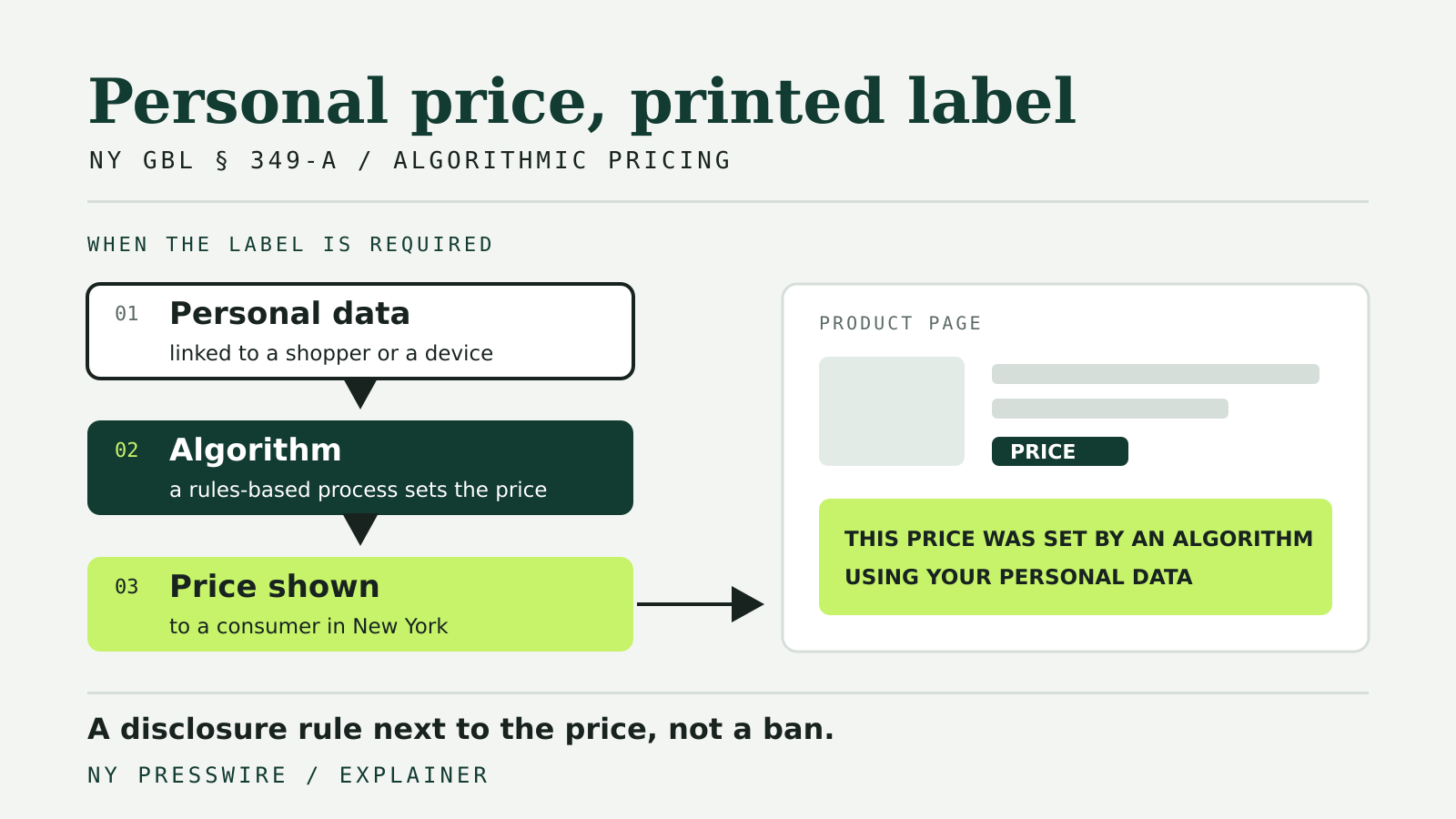
New York’s algorithmic pricing disclosure law requires a business that sets a consumer’s price with an algorithm fed by that consumer’s personal data to say so next to the price. The required words are fixed by statute: “THIS PRICE WAS SET BY AN ALGORITHM USING YOUR PERSONAL DATA.” The rule sits in section 349-a of the General Business Law, and the New York Attorney General enforces it.
The law does not ban personalized pricing. It is a disclosure rule, and its reach depends on a handful of defined terms. For product teams that run pricing engines, loyalty discounts or in-app offers, those definitions decide whether a label is needed at all.
When the law took effect
Governor Kathy Hochul announced on November 24, 2025 that the law, championed in the state’s FY26 enacted budget, was in effect. The Attorney General’s office had said in a November 5, 2025 consumer alert that the Algorithmic Pricing Disclosure Act would take effect on November 10, 2025, and later releases repeat that date.
The definitions that set the scope
The statute builds its main obligation from several defined terms:
- Algorithm: a computational automated process that uses a set of rules to define a sequence of operations.
- Dynamic pricing: pricing that fluctuates dependent on conditions.
- Personal data: any data that identifies, or could reasonably be linked directly or indirectly with, a specific consumer or device.
- Personalized algorithmic pricing: dynamic pricing set by an algorithm that uses personal data.
- Consumer: a natural person seeking or solicited to buy, lease or receive a good or service for personal, family or household use.
- Entity: any person or organization domiciled or doing business in New York State.
The definition of an algorithm is broad. It is not limited to machine learning; a rules-based pricing script can fit it. The narrowing work is done by the personal-data element. A price that moves with inventory or time of day, without using data linked to the shopper or the device, is dynamic pricing but not personalized algorithmic pricing under these definitions.
What the disclosure must look like
When an entity sets the price of a specific good or service using personalized algorithmic pricing and publishes that price to a consumer in New York, using personal data specific to that consumer, it must include the statutory sentence with the price.
The law defines a “clear and conspicuous disclosure” as one in the same medium as the price, provided on, at or near and at the same time as every advertisement, display, image, offer or announcement of the price, in lettering and wording that the average consumer can easily see and understand.
That definition rules out a few common designs. A sentence in terms of service, a privacy policy or a help page reached by a separate click is not on or near the price. In a January 8, 2026 letter to Instacart, the Attorney General warned that disclosures “buried on a page only accessible by clicking on fine print text” and not shown near product prices may not comply. The office also asked the company for details about its price experiments and its compliance efforts. That letter is a demand for information, not a finding of a violation.
Exceptions
Section 349-a lists four exceptions:
- persons and businesses, and their agents or employees, subject to the New York insurance law or its regulations;
- financial institutions and their affiliates, as defined in 15 U.S.C. 6809, to the extent they are subject to Title V of the Gramm-Leach-Bliley Act and its rules;
- financial institutions as defined in section 801(f) of the New York Financial Services Law;
- a price offered to a consumer with an existing subscription contract when that price is lower than the price for the same good or service set out in the subscription agreement.
The definition of personal data also carves out location data used by New York City for-hire vehicles or transportation network company vehicles solely to calculate a fare from mileage and trip duration between pickup and drop-off.
For fintech companies, the financial-institution exceptions are written with conditions. The Gramm-Leach-Bliley exception applies “to the extent” the institution is subject to Title V of that act. Whether a particular app or affiliate fits is a legal question about its own regulatory status, not something the product category settles.
How enforcement works
The statute gives the Attorney General a set sequence. When the office has reason to believe there is a violation, including from a consumer report, it first sends a cease and desist letter that names the alleged violation and sets a timeline to cure it. If the entity keeps violating the law after that deadline, the Attorney General can bring a special proceeding in court for an injunction, without having to prove that anyone was injured or damaged.
If the court finds a violation, it may impose a civil penalty of up to $1,000 for each violation. The Attorney General’s appeal brief describes the law as enforceable only by her office, with no private right of action. The Attorney General’s consumer alert asked New Yorkers to file complaints when they see algorithmic pricing without the disclosure, and the office repeated that guidance in its release on the top consumer complaints of 2025.
The court challenge
The National Retail Federation sued the Attorney General in the Southern District of New York in July 2025, arguing that the required statement is compelled speech that violates the First Amendment. In October 2025, Judge Jed S. Rakoff granted the Attorney General’s motion to dismiss the complaint with prejudice and denied the federation’s request for a preliminary injunction as moot, according to the Attorney General’s February 10, 2026 appeal brief. The brief says the court treated the required sentence as factual and uncontroversial and reviewed it under the Zauderer standard for commercial disclosures.
The federation appealed to the Second Circuit, case number 25-2818. The appeal docket shows the opening brief, the Attorney General’s brief, amicus briefs on both sides and the federation’s reply filed by February 2026. The district court ruling stands unless the appeals court changes it, so teams should check the docket for later developments.
A checklist for product teams
- Map the inputs. List every signal a pricing or discount system uses and mark which ones identify or can be linked to a shopper or device.
- Separate the price types. Distinguish list prices, conditions-based dynamic prices and prices or discounts that change with personal data.
- Place the label where the price appears. Each surface that shows a personalized price, including apps, emails and push offers, needs the statutory sentence in the same medium and near the price.
- Check exception status in writing. Insurance and financial-institution exceptions depend on legal status, not product labels.
- Keep records. Version histories of pricing logic and disclosure placement help answer a cease and desist letter within its cure period.
New York has other AI rules with different targets. NYC Local Law 144 covers automated hiring tools, and the state’s RAISE Act addresses frontier model developers. This article explains the published statute and official statements and is not legal advice.