ISO 20022 messages explained for developers start with the job each message performs. A payment instruction, an interbank transfer, a status report and an account statement can concern the same payment while carrying different evidence. Reading the family before mapping fields helps prevent a payment application from treating an instruction or acknowledgment as the final account result.
Start with the business message
ISO 20022 defines financial messages, not one universal payment endpoint. The ISO message catalogue separates business areas and identifies individual definitions and versions. A rail or banking channel then selects the definitions and usage rules it supports.
For an application team, “supports ISO 20022” is therefore an incomplete integration requirement. Ask which business process, message identifier, version and market practice the counterparty means. The answer determines the schema and the operational meaning of the response. Our payment API versioning guide covers the related problem of keeping an integration aligned with its provider.
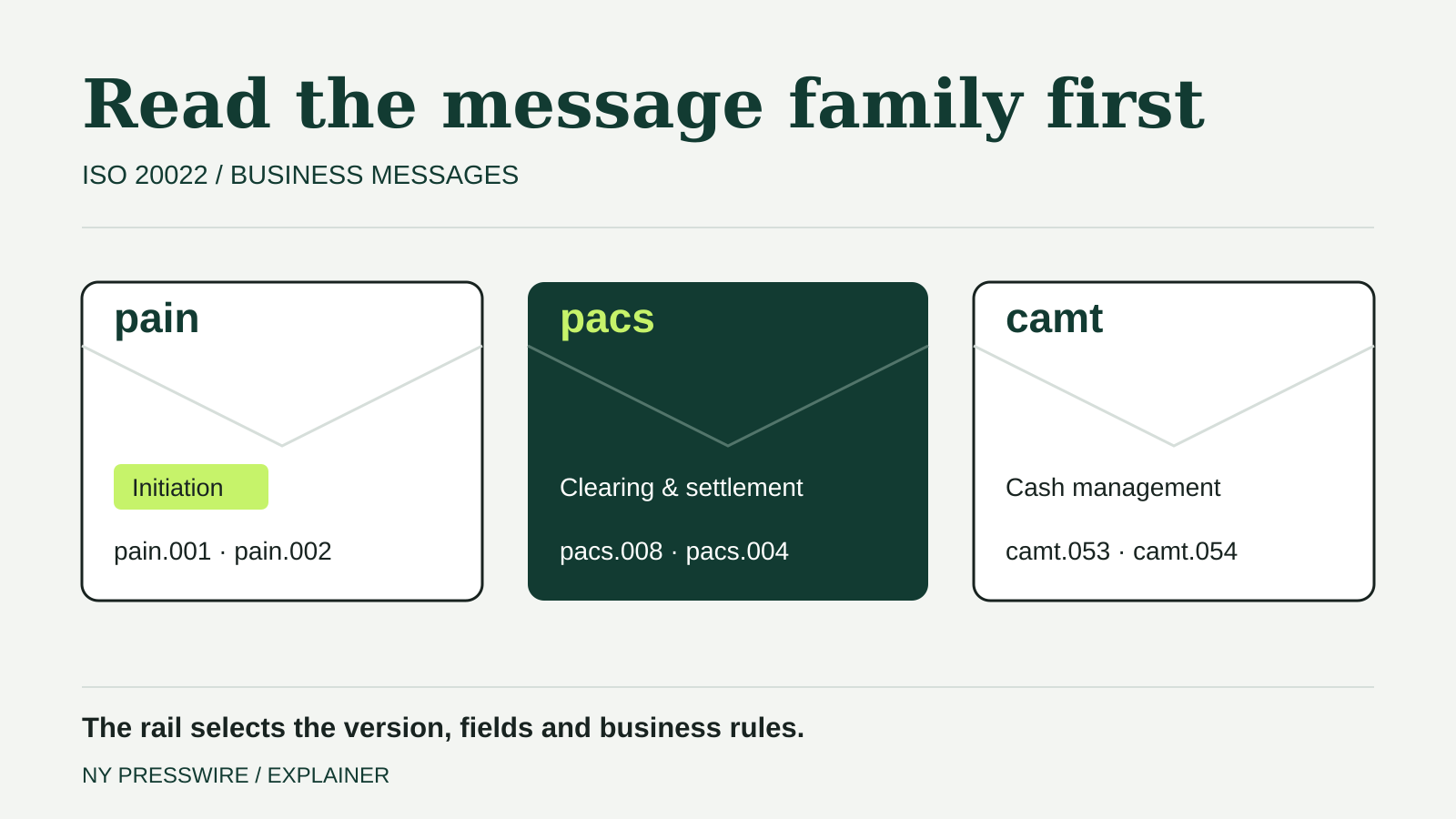
The three families do different work
The prefixes are useful navigation aids. They do not, on their own, establish whether money moved.
| Family | Business area | Examples and their jobs |
|---|---|---|
| pain | Payments Initiation | pain.001 initiates a customer credit transfer; pain.002 reports customer payment status |
| pacs | Payments Clearing and Settlement | pacs.008 is an FI-to-FI customer credit transfer; pacs.004 is a payment return |
| camt | Cash Management | camt.053 is a bank-to-customer statement; camt.054 is a debit/credit notification |
The ISO catalogue supplies the message names. SIX’s Swiss Payment Standards page describes the customer-bank uses of pain.001, pain.002 and the camt reporting messages. Those Swiss implementation guidelines are a concrete market practice, not a promise that every bank or rail accepts the same payload.
The camt family extends beyond the reporting examples in the table. Fedwire, for instance, also uses camt.110 and camt.111 for investigation requests and responses. A family name helps you find the right documentation; the individual definition tells you the actual job.
Follow one payment without inventing a universal flow
Consider a hypothetical treasury application preparing a supplier payment. It needs to distinguish the instruction it sends, the bank’s response and the account information it later receives. A pain.001 instruction and a pain.002 status report are different artifacts. A camt statement or notification serves a reporting purpose.
Inside the banking chain, a pacs message may concern the interbank movement. That does not mean the customer’s application sends every message shown in an industry diagram. The bank’s interface and the rail determine which messages the application exchanges and which remain inside the banking infrastructure.
Keep the customer’s order identifier, the bank’s references and the incoming message type together in your records. Then define which documented event changes the order’s state. For a comparison of the rails themselves, read FedNow versus RTP for developers. Message vocabulary and rail operating rules answer different questions.
A newer catalogue version is not automatically your version
The Federal Reserve’s Fedwire technical FAQ illustrates the distinction. It lists Fedwire’s selected versions and explains why its business application header and payment-return version differ from CBPR+.
Downloading the newest global schema is not a substitute for obtaining the counterparty’s implementation guide. Fedwire also specifies an envelope, business application header and business message. Its FAQ distinguishes technical errors from business errors and identifies different response messages.
A useful acceptance test records both layers: did the message satisfy the required structure, and what did the service say about the business request? Keep the raw response and its documented interpretation. A local “XML valid” result cannot answer every service-level question.
Structured fields still need usable source data
Format migration also reaches the application that collects beneficiary information. In its November 2026 preparation guidance, Swift says fully unstructured postal addresses will be removed after November 14, 2026, with hybrid or structured addresses accepted for the cross-border transition.
Swift asks corporates to source creditor address information, store it in their ERP or treasury application and provide it at initiation, including town and country at minimum. The message serializer cannot recover accurate information that the product never collected. Treat this as a data-capture and counterparty-testing task as well as a mapping change.