Generic listing standards for spot crypto ETFs changed who does the gatekeeping. Until September 2025, an exchange that wanted to list a trust holding bitcoin or another commodity filed a proposed rule change for that one product and waited for the Securities and Exchange Commission to act. Since the SEC approved generic standards for Commodity-Based Trust Shares on September 17, 2025, an exchange can list a trust that meets a published checklist without a rule filing for each product.
What the SEC approved
The SEC order, Release No. 34-103995, granted accelerated approval to three exchange proposals at once: Nasdaq (file SR-NASDAQ-2025-056, amending Rule 5711(d)), Cboe BZX (SR-CboeBZX-2025-104, amending Rule 14.11(e)(4)) and NYSE Arca (SR-NYSEARCA-2025-54, adding a new Rule 8.201-E (Generic)). The order describes the three sets of standards as substantially identical, and the SEC’s release page lists all three exchanges.
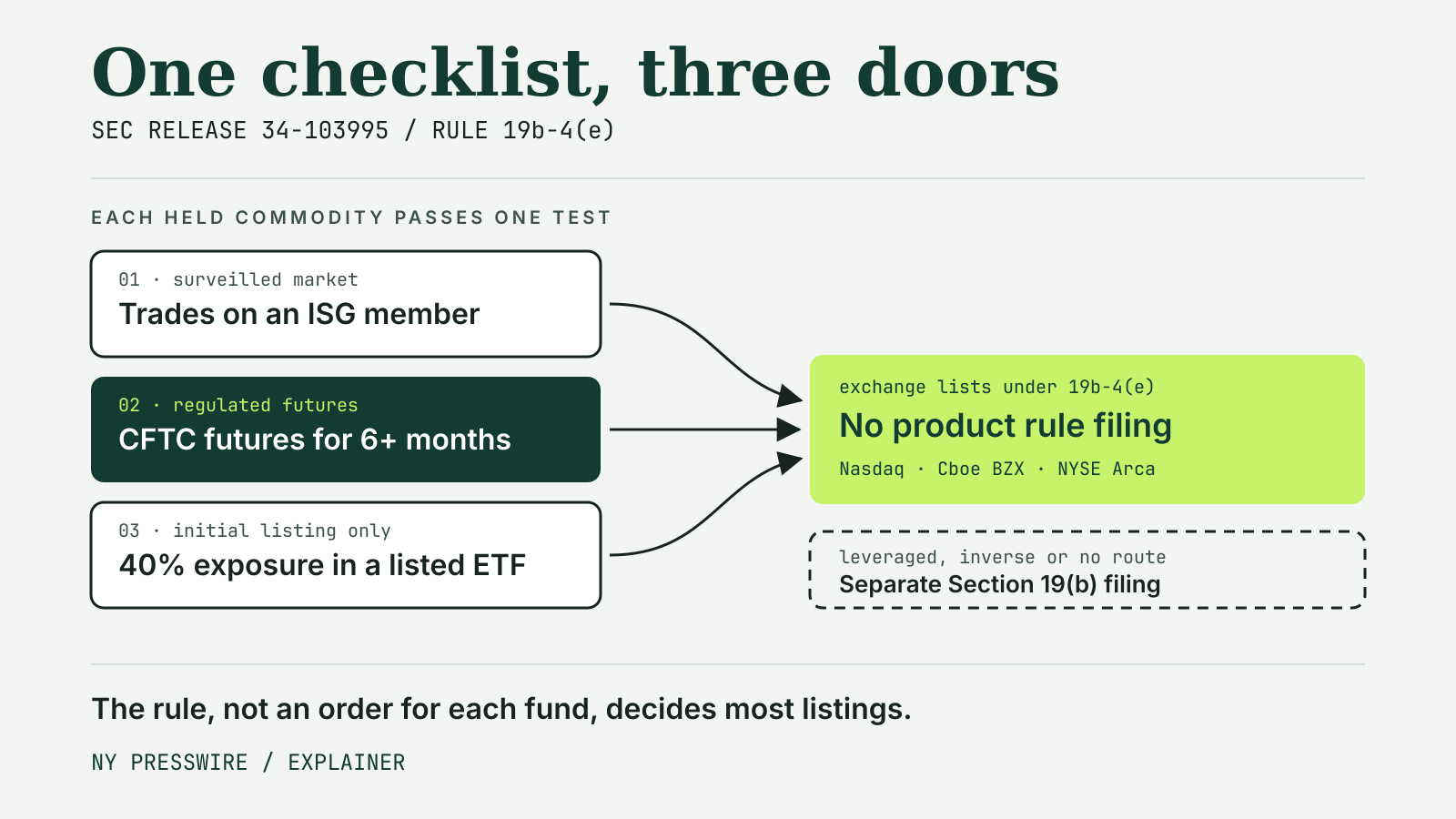
The legal mechanism is older than crypto ETFs. Exchange Act Rule 19b-4(e) lets an exchange list a “new derivative securities product” without filing a proposed rule change when the SEC has already approved the exchange’s trading rules and listing standards for that product class and the exchange has a surveillance program for it. The exchange must then post basic facts about the product on its website within five business days after trading begins. The order traces the rule to a 1998 SEC release on new derivative securities products. What changed in 2025 is that commodity trusts got a generic standard of their own.
Which trusts are covered
The standards apply to a Commodity-Based Trust Share: a security issued by a trust, limited liability company or similar entity that is not registered as an investment company under the Investment Company Act of 1940. The trust is designed to track one or more reference assets, holds commodities or commodity-based assets (futures, options or swaps on a commodity), and may also hold securities, cash and cash equivalents. Shares are created and redeemed in large blocks, either in kind or for cash based on the next net asset value.
“Commodity” uses the Commodity Exchange Act definition, excluding the financial “excluded commodities.” The order does not list eligible tokens by name. It does, however, address trusts that hold digital assets and stake them, which shows the drafters expected crypto trusts to use these rules.
The three eligibility routes
Each commodity a trust holds, or that underlies a derivative it holds, must pass at least one test:
| Route | Test | Timing |
|---|---|---|
| Surveilled market | The commodity trades on a market that is a member of the Intermarket Surveillance Group (ISG), and the exchange can get trading information from that member | Initial and continuing |
| Regulated futures | The commodity underlies a futures contract that has been available to trade on a CFTC-designated contract market for at least six months, and the exchange has a comprehensive surveillance sharing agreement with that market, directly or through ISG | Initial and continuing |
| Existing ETF exposure | An ETF listed on a national securities exchange gives at least 40% of its net asset value in exposure to the commodity | Initial listing only |
The SEC’s reasoning rests on surveillance. In the order, the Commission says the ISG and futures routes help ensure the exchange can obtain the information needed to detect and deter fraud and manipulation in the underlying asset. That is the same concern that drove years of one-by-one reviews; the difference is that it is now written into a rule an exchange can check itself.
What a generically listed trust must publish
To use the generic route, a trust must post on a free public website, among other items:
- its holdings before the market opens each day, with identifiers, quantities and percentage weights;
- the prior day’s net asset value per share, market price and premium or discount;
- a table and line graph of days traded at a premium or discount over the last calendar year and the quarters since;
- the median bid-ask spread over the last 30 calendar days, measured at 10-second intervals;
- its liquidity risk policies, its NAV methodology, the previous day’s trading volume and a downloadable prospectus.
Liquidity, staking and continued listing
If less than 85% of a trust’s assets are readily available to meet redemptions on a given day, it must have written liquidity risk policies, reviewed at least annually. An asset counts as not readily available if it is pledged, encumbered or otherwise cannot be sold or transferred within one business day. The order gives the example of a trust that holds digital assets and engages in protocol staking, so a staking trust that locks up more than 15% of its assets falls under this requirement.
Listing is not permanent. After the first 12 months of trading, the exchange will consider suspension and start delisting if, among other triggers, the trust has fewer than 50 holders while more than 60 days remain until termination, fewer than 50,000 shares outstanding, or a market value below $1,000,000. Failures to publish NAV, holdings or the indicative value also count. Trusts must keep firewalls around index providers and any affiliate that can influence the price or supply of a held commodity.
What still needs an SEC filing
The generic route has hard edges. A trust that seeks a multiple of an index’s return, or an inverse return, over a set period cannot use it. Neither can a product whose holdings fail all three eligibility tests. In those cases the exchange can still file a proposed rule change under Section 19(b), and the order says the generic rules do not prevent that.
That is why leveraged products kept their own track. Our report on the SEC clearing Cboe to list six 3x bitcoin ETFs covers one of those separate approvals. The generic standards also say nothing about whether a token is a security; for the SEC’s separate view on that question, see our explainer on the 2026 crypto asset interpretation.
What changed for issuers and readers
For issuers, the order shifts work from regulatory timing to product design: pick assets that meet a route, build the daily disclosures and liquidity policies, and the listing exchange can act under Rule 19b-4(e). For readers, a listing under the generic standards is a statement about market structure and surveillance. It is not an SEC judgment on an asset’s merits, and nothing here is a recommendation to buy any fund.